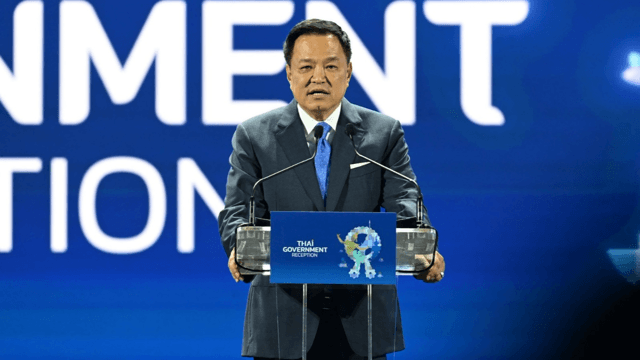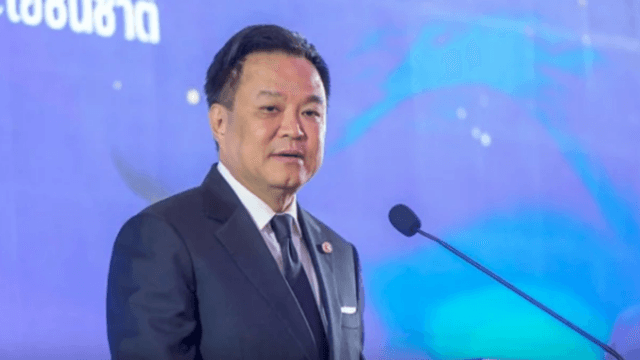



Thailand and Cambodia have agreed to withdraw heavy weaponry from the border to their original locations, Thai acting Defence Minister Gen Nattaphon Nakpanich said today.
An Interim Observer Team (IOT), comprising ASEAN defence attachés, will be invited to assess the withdrawal once it is completed, Nattaphon said. He was speaking after co-chairing the special session of the General Border Committee (GBC), with his Cambodian counterpart Gen Tea Seiha, in Koh Kong, Cambodia, today.
The GBC and Regional Border Committee (RBC) secretariats will meet within three weeks to map out the timeframe and operational details.
On mine clearance, Nattaphon revealed that a joint coordination committee, comprised of the GBC secretariat and Cambodia’s Mine Action Authority, will be set up within a week to draft clearance and pilot project plans along the Thai-Cambodian border. Operations are expected to begin within a month.
Interior ministries and national police forces from both sides will also form a joint task force within a week, to combat cross-border scam centres.
Thailand has already provided Cambodia with the coordinates of more than 60 such centres as targets for specific suppression. Both countries will hold follow-up talks on September 16, to establish a coordination centre in Sa Kaeo province.
The two sides also discussed the Nong Chan area in Sa Kaeo, which has been at the centre of recent unrest. Nattaphon said that the RBC will draft management measures, with the governors of Sa Kaeo and Banteay Meanchey acting as coordinators.
If successful, this model will be applied to other disputed areas, he said.
To ease economic disruption caused by border tensions, the RBC has also been tasked with exploring the possibility of allowing trans-border goods transport that pose no security concerns. Pilot operations may begin at permanent checkpoints in Chanthaburi and Trat.
Gen Nattaphon hailed the progress as significant, noting that Cambodia has, for the first time, agreed to cooperate on two issues long prioritised by Thailand, namely mine clearance and the suppression of scam networks.
Thai agencies will follow up closely, to ensure implementation. The next GBC meeting will be held within 30 days, hosted by Thailand.
Nattaphon stressed that Thailand and Cambodia “cannot move away from each other,” making it essential to resolve disputes peacefully, so that border residents can return to normal life. He also cited Prime Minister Anutin Charnvirakul’s call to prioritise sovereignty and national defence, while safeguarding people’s livelihoods.
The general, who is tipped to become defence minister in Thailand’s new government, also outlined a zoning approach to manage tensions:
· Zone 1 (high tension): Ubon Ratchathani, Si Sa Ket, Surin, Buri Ram (Second Army Region)
· Zone 2 (medium tension): Sa Kaeo (First Army Region)
· Zone 3 (lower tension): Chanthaburi and Trat
Easing measures will begin in Zone 3, with Chanthaburi-Trat forces coordinating with the Customs, Commerce and Industry ministries to support security-based negotiations.
Before the GBC meeting, Gen Nattaphon held one-to-one talks with Cambodian Defence Minister Gen Tea Seiha. Discussions included a congratulatory message from PM Hun Manet to Thai PM Anutin, expressing goodwill and an intent to ease tensions.
“I told Gen Tea Seiha that the painful issues we must resolve today are mine clearance and Nong Chan village. I asked for Cambodia’s cooperation, which they accepted. We must, however, watch closely whether Cambodia will follow through on today’s commitments with sincerity,” Nattaphon said.