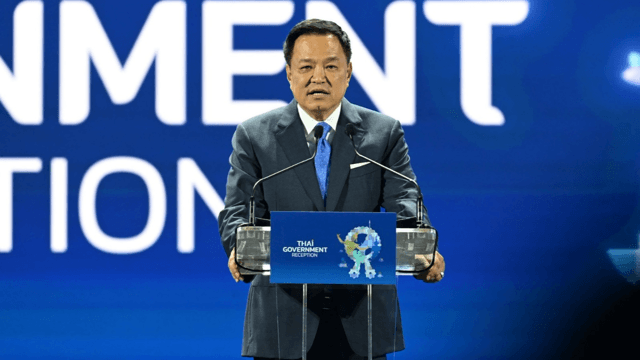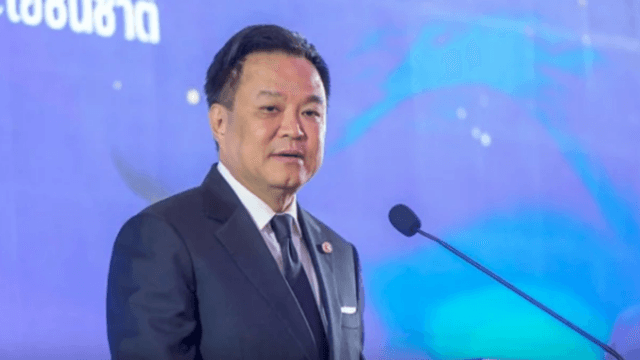


Despite facing arguably the toughest test of his political career, Anutin Charnvirakul becomes Thailand’s new prime minister today – a prize that has eluded him for over two decades.
The Bhumjaithai leader, once branded a perpetual runner-up, now won the premiership thanks to support from the opposition People’s Party.
Anutin’s path to power was cleared when the ruling Pheu Thai Party failed to woo the largest voting bloc in the House – the 143 People’s Party MPs – and saw its request for Parliament’s dissolution rejected by the Privy Council.
Anutin – who leads an alliance of 146 MPs, including government defectors – managed to secure an agreement with People’s Party leader Natthaphong Ruengpanyawut, who announced on Wednesday (September 3) that his party would back Anutin during the House vote today.
The Bhumjaithai leader, with 289 votes in hand, is on track to secure a majority in the 500-seat House and claim the PM’s seat.
Today, he secured 311 votes from the 490 MPs present at the session, while Chaikasem received 152, with 27 abstentions.
From crisis to opportunity
His path to the top job opened when the Constitutional Court removed Pheu Thai leader Paetongtarn Shinawatra as premier on August 29, ruling she had breached ethical standards in a leaked phone call with Cambodian strongman Hun Sen.
The verdict left the ruling party in caretaker mode, triggering a frantic scramble to form a replacement government.
Pheu Thai made various offers to entice members of the People’s Party, including a promise to dissolve the House in exchange for supporting its last remaining prime ministerial candidate, Chaikasem Nitisiri.
However, the opposition party declined and instead backed Anutin – a decision analysts say is payback for Pheu Thai’s past betrayal of the party.
Pheu Thai finished second to the People’s Party predecessor, Move Forward, in the 2023 general election, but withdrew from their alliance and instead formed a coalition government with Bhumjaithai and other conservative parties.
Move Forward was dissolved by court order last year after being ruled guilty of attempting to overthrow the constitutional monarchy in its campaign to amend the lese majeste law.
Kingmaker’s bargain
With 143 seats in the House, the People’s Party is the undisputed “kingmaker” in this crisis. On Wednesday, Natthaphong announced that his party was prepared to back Anutin on five conditions, the most important being a promise to dissolve the House within four months of taking office, paving the way for new elections, and establishing an elected assembly to draft a new constitution.
Anutin swiftly agreed and signed a written agreement before a throng of reporters and photographers at a press conference that same day.
A career of near misses
For Anutin, who turns 59 on September 13, this moment marks the end of years spent in political limbo. Time and again he was tipped for the top job, only to be leapfrogged by rivals.
His latest near miss came in 2023, when he was considered a viable successor after Srettha Thavisin was ousted as prime minister by the charter court. Instead, Paetongtarn took over.
His political fortunes dipped further in mid-June, when the collapse of the Pheu Thai-Bhumjaithai alliance prompted him to quit his posts as interior minister and deputy PM.
The falling-out occurred as both parties fought for control of the Interior Ministry and Senate, aiming to boost their chances of winning the next election.
Victory would help Pheu Thai fend off allegations related to the Alpine temple-land scandal, and benefit Bhumjaithai by shielding it from claims of vote-rigging in last year’s senatorial election and the Khao Kradong land dispute in Buri Ram linked to certain party figures.
Tycoon turned politician
Born in Bangkok in 1966, Anutin is heir to the Sino-Thai Engineering and Construction (STECON) conglomerate built by his father, Chavarat Charnvirakul, a veteran politician who co-founded Bhumjaithai in 2008 alongside powerbroker Newin Chidchob.
After earning an industrial engineering degree from Hofstra University in New York, he returned to Thailand to lead the family-owned business, serving as company president from 1995 to 2004.
Despite his privileged background, Anutin has managed to craft an image as a man of the people. His nickname, “Noo” (Mouse), has inspired comparisons with the fable of the mouse that helps the lion, reflecting his role in coming to the aid of political giants at critical moments.
He promotes his “common man” image with frequent posts about his favourite streetside eateries and selfies in T-shirts and shorts.
He also plays the saxophone and piano, often performing in charity events held in honour of the King.
Flying for a cause
Anutin made his political debut in 2000 with the Thai Rak Thai Party led by former PM Thaksin Shinawatra, Paetongtarn’s father. In 2006, he was banned from politics for five years after the party was dissolved by court order.
During his break from politics, Anutin learned to fly and began collecting aircraft, starting with a four-seater. What began as a hobby soon became a public relations tool when he began transporting patients and donated organs across the country.
In 2014, after learning that his surgeon friend had spent years relying on commercial flights to pick up donor organs, Anutin personally flew him to Udon Thani to collect a donated heart.
Last year, Anutin was awarded the Thai Sky Doctor pin by the National Institute for Emergency Medicine for his role in transporting at least 44 life-saving organs.
Political legacy and cannabis
When his political ban ended in 2012, Anutin joined Bhumjaithai, then led by his father, and later that year assumed the party leadership at age 46 with the backing of Chavarat and Newin.
Anutin has held multiple ministerial portfolios over the past two decades: deputy commerce minister in 2004, deputy public health minister in 2005, public health minister from 2019 to 2023, and interior minister from 2023 to mid-June this year. He has also served as deputy to Thailand's three most recent prime ministers.
As public health minister in General Prayut Chan-o-cha’s government, Anutin won both praise and criticism for his handling of the COVID-19 crisis and vaccination programme.
He and his party later oversaw the legalisation of medicinal cannabis in 2022 – a policy that cemented his party’s reputation as a force to be reckoned with in Thai politics.
The politician has two grown-up children from his first marriage, which lasted over two decades. He married his second wife in 2013 but divorced again in 2019. His third marriage, to businesswoman Thananon Niramit, came three years ago.
Anutin is one of Thailand’s wealthiest politicians, with declared assets of more than 4.4 billion baht, including bank deposits, investments, concessional rights, and vehicles ranging from private aircraft and a yacht to luxury cars.