


Local elections were held this weekend in four provinces – Surin on Saturday (November 23), followed by Udon Thani, Phetchaburi, and Nakhon Si Thammarat on Sunday (November 24).
All eyes were on Udon Thani, once known as “the red-shirt capital” for its strong support of Thaksin Shinawatra during his tenure as prime minister and his fight to reclaim power following the 2006 military coup.
The Northeast province has become the latest battleground in Thailand’s new political war – between the ruling Pheu Thai Party and the opposition-leading People’s Party (PP). On Sunday, their candidates faced off for the seat of Udon Thani Provincial Administrative Organisation (PAO) chief executive.
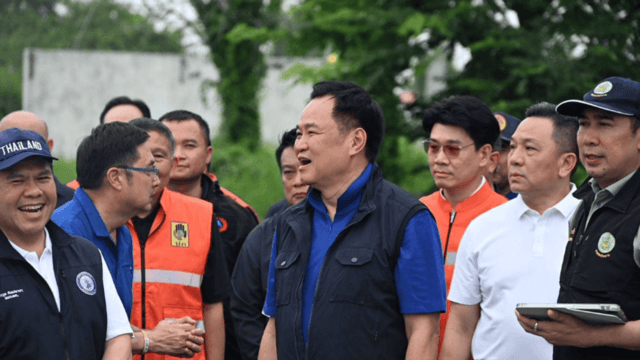
Thaksin, widely viewed as Pheu Thai’s de facto leader, visited Udon Thani last week to deliver his first campaign speech in 18 years since his ousting by the military. He wooed voters with the government’s pledge to “make people happier” while launching a thinly veiled attack on the PP.
The People’s Party, meanwhile, wheeled out its heavy guns for the final few days of campaigning under its orange banner. Key party figures and former leaders of PP’s predecessors – Thanathorn Juangroongruangkit, Pita Limjaroenrat, and Chaithawat Tulathon – all joined a campaign caravan going door-to-door in Udon Thani.
Fierce fight for PAO top seats
Olarn Thinbangtieo, a political science lecturer at Burapha University, said that although local election wins don’t guarantee success in general elections, parties have strong incentives to fight fiercely for PAO posts.
“Control of PAOs gives them power over local budgets, enabling them to expand their political network. Even if they lose a national election, having PAO chiefs gives them peace of mind,” Olarn said.
He added that the power of a PAO chief is almost comparable to that of a government minister, with an annual budget of up to 5 billion baht to spend.
“Many national politicians have switched their focus to securing a PAO chief’s seat for the power and budget. Switching makes it easier for them to deal with [administrative] problems since the PAO chief and his or her executive members are all from the same team. Also, PAO chiefs face less media scrutiny than Cabinet members.”
Olarn noted that PAOs are the top tier of local government and thus allocated higher budgets than municipalities and tambon administrative organisations (TAOs). He said powerful provincial dynasties often target PAO chief’s seats to boost their local influence in the hope of winning MP seats in their province.
This year saw numerous PAO chiefs resign before their term expired on December 19, hoping to benefit from subsequent snap elections.
Olarn said this tactic may have been designed to combat the growing popularity of the People’s Party. The early resignations left the opposition leader unprepared, meaning it failed to find suitable candidates in many provinces, he added.
The analyst believes that entrenched local political dynasties still have an advantage over newcomer PP in provincial elections. “In the provinces, the patronage system and familial relationships remain pivotal in winning voters’ hearts. The People’s Party may only be able to secure significant support in cities,” he said.
Bitter past defeats
PP’s original incarnation, Future Forward, was disbanded ahead of the last PAO chief elections in December 2020 but reformed to contest the vote in 42 provinces under the banner of the Progressive Movement. However, it failed to win a single seat.
The party’s next iteration, Move Forward, also suffered bitter defeats in PAO chief elections earlier this year – even in provinces where it secured MP seats with big majorities at last year’s general election, where it won the popular vote.
Despite the defeats, Olarn pointed to a major benefit of PP continuing to contest local elections: it forces local political dynasties to attract voters via genuine policy platforms rather than relying on patronage or vote-buying, as in the past. He pointed to the PAO chief election in Khon Kaen on November 3, where underdog candidate Watthana Changlao, who was linked to Move Forward, managed to defeat six-term incumbent Phongsak Tangwanichkaphong by deploying a platform of “good-move policies” that focused on local development and quality of life.
Olarn noted that changes in voter demographics may also be influencing local elections.
“Don’t forget that many provinces have seen a rise in middle class and younger voters relocating there. Politicians need to sell their policies, which in turn makes the competition more vibrant.”
Turning to the poor performance of the Progressive Movement and Move Forward in past elections for PAO top seats, Olarn attributed it to a failure to comprehend the local political context.
“Unlike in national politics, local elections cannot be fought with a uniform plan devised by the party executive board. Decisions on candidates cannot be made by central leadership without a thorough knowledge of the local political scene. They seem to assume that villagers think like Bangkokians,” he said.
These are the main reasons why the Progressive Movement and Move Forward have failed to resonate with provincial voters, he added. “Building a relationship based on personal trust and care is the key in local politics, but Move Forward seemed to focus on building popularity alone,” the analyst said.
PAOs are local governments
PAOs sit at the tip of Thailand’s local government pyramid. Each of the country’s 76 provinces – excluding the capital, Bangkok – has its own Provincial Administrative Organisation. Its key mission is to provide public services, in support of the government’s work, to residents in areas not covered by municipalities or TAOs.
Each PAO has one chief executive, who is elected. A PAO, however, has between 24 and 48 elected councillors, depending on the population size of the province it serves.
Chief executives of PAOs lead the provinces’ local executive branch, while councillors form the legislative branch. The former formulate local development plans, draw up budget plans, and compile performance and spending reports while the latter passes legislation that covers provinces and keeps local executives in check.
Elected PAO chief executives and councillors serve a four-year term, with their tenure limited to two consecutive terms. PAO chiefs are paid 75,530 baht per month, while councillors receive a salary of 19,400 baht.
By Thai PBS World’s Political Desk