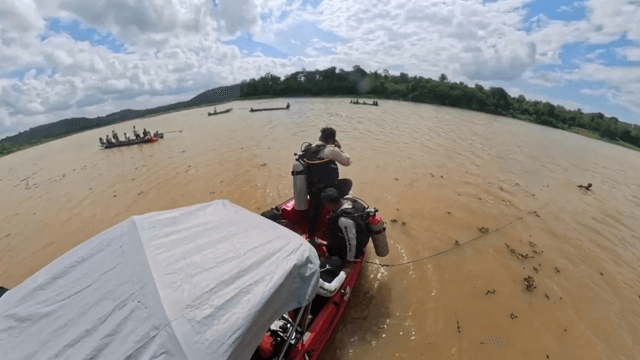



Flooding that engulfed the southern city of Hat Yai last month, killing over 100 people, also exposed deadly gaps in Thailand’s disaster-management system, experts say.
They warn that unless lessons are learned from the massive floods, the ongoing cycle of preventable tragedies will continue.
“If governance doesn’t improve and people are not alerted, disasters like this will keep recurring,” said Assoc Prof Seree Supratid, director of Rangsit University’s Centre for Climate Change and Disasters.
The Public Health Ministry puts the death toll in Hat Yai at 145 as of December 3, but that figure is expected to rise when the waters recede and reveal the disaster’s true scale.
Kasikorn Research Centre estimates the flood damage at 25 billion baht if recovery efforts succeed in restoring normalcy within 30 days. A longer recovery will bring far higher economic costs, it said.

Worst flood in centuries
On November 21, Songkhla’s Hat Yai district – Thailand’s southern economic hub – was hit by a monsoon cyclone that dumped over 1,000 millimetres of rain in five days.
By November 25, satellite images showed 84,000 rai (13,440 hectares) were submerged under floodwaters that reached 5 metres deep in some places.
Among horrifying stories emerging from the disaster, one family described clinging to furniture for 48 hours on the second floor of their house as the water surged through their home.
Mixed messages from authorities reportedly added to confusion over whether residents should evacuate or stay in their homes as floodwaters rose. Many chose to stay, reassured by Hat Yai Mayor Narongporn Na Phatthalung’s claims on November 19 and again on November 23 that the situation was under control.
“I admit I was mistaken and apologise to all Hat Yai residents,” Narongporn said later.
He explained that his water-management team based its estimates for Hat Yai on water volumes in neighbouring Sadao district, adding that he had not expected the deluge to be so intense. The storm resulted in the worst flooding the city has seen in 300 years.

A preventable tragedy
Seree said losses could have been avoided if authorities had issued an evacuation order on November 20, rather than waiting until four days later, by which time it was too late.
“Water levels were already neck-high by November 24,” he said. “People couldn’t evacuate even if they wanted to.”
He added that authorities had also failed to give people the means to evacuate. “Boats, equipment and personnel should have been provided to help,” he said.
The Hat Yai Municipality Facebook page eventually advised residents to contact local military units for evacuation assistance at 10.41am on November 24. The Facebook page then went silent for several days.
Seree said that officials in charge failed to act despite knowing on November 24 that water levels would keep rising. “If they felt the situation was getting out of hand, they should have called the prime minister or the Disaster Prevention and Mitigation Department immediately.”
Calling for improved coordination in the line of command, he said all sides must learn urgent lessons from the disaster.
Asst Prof Sitang Pilailar, a water resouces engineering lecturer at Kasetsart University, said rain was not the main factor behind the devastation.
“The real reasons were unnecessary delays, confusion and gaps in water management from policy to operational levels,” she said.
She observed that the Thai Meteorological Department had misforecast rainfall on several previous occasions this year, for example, underestimating Tropical Storm Wipha’s volume by 100mm.
The storm hit Nan, Phayao and other northern provinces in July, affecting tens of thousands of people. Forecasts for Typhoon Kalmaegi were also inaccurate, leading water authorities to focus on the wrong locations.
Sitang also criticised the Office of National Water Resources (ONWR), saying its water-management policy for the South had failed to account for the high flood risk during La Niña.
“I think recent official reshuffles have affected operations,” she commented.
The retirement date for Thai civil servants is September 30, meaning widespread staff rotations occurred just weeks before Hat Yai was hit by the deluge.
The ONWR, however, argues that local authorities had received timely alerts about the rising floodwater, with the Disaster Prevention and Mitigation Department issuing a warning on November 22.
‘Too many chiefs’
Sitang said that despite imposing an Emergency Decree to handle the flood crisis, the government failed to establish a central command to coordinate resources and set a clear direction.
“That’s why confusion prevailed,” she said.
On November 24, Prime Minister Anutin Charnvirakul put Deputy PM and Agriculture Minister Thamanat Prompow in charge of the situation.
The following day, the Cabinet placed Chief of Defence Forces Ukris Boontanondha in charge of the rescue and relief operations.
Soon after, Prime Minister’s Office Minister Paradorn Prissananantakul was named director of the flood response centre.
“Who was actually in charge here? Who was at the top?” Sitang asked.

Recommendations
Seree said disasters like the Hat Yai flood could be prevented with an efficient warning system, local officials who are capable of accurately interpreting data, and a detailed evacuation plan.
“Prepare clear guidelines and a budget to ensure proper preparations,” he urged.
Sonthi Kotchawat, an environment and health expert, said Hat Yai’s drainage capacity had reduced as fields were replaced by roads and other urban infrastructure.
“When it rains, water that would normally soak into the soil is now directed to canals or pipes that have limited capacity.”
He added that Songkhla requires more water-retention areas in upstream and midstream zones, as well as around Songkhla Lake, to prevent severe flooding.
“Some urban neighbourhoods will need to be repurposed as water retention zones during floods,” he said.
He also urged authorities to expand the flood-drainage capacity of Hat Yai’s main canals – Khlong U-Tapao and Khlong Phuminat Damri.