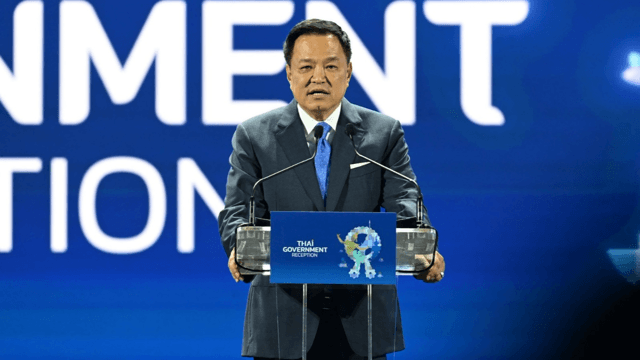
This time last year, Prime Minister Paetongtarn Shinawatra was promoting soft power and, ironically, the proposed Entertainment Complex. She and her family were enjoying regained political power and had no idea what was about to come at the Cambodian border.
Then 2025 began, with what seemed like a manageable political rumbling against so-called “daddy-daughter” running of Thailand. Protests were sporadic and small, but they featured something that shall never go unnoticed. A conservative heavyweight, Warong Dechakitvikrom, allied himself with a former red-shirted leader Jatuporn Prompan at an anti-government demonstration.
When February came, things still looked relatively calm for the Pheu Thai Party. The Constitutional Court demanded a public referendum before a proposed charter rewrite, meaning the conservatives and the People’s Party (formerly Move Forward) would have to keep pushing through the bumpy road while Pheu Thai could just sit on the fence and wait to see which way the
wind blew.
However, a small crack appeared in the fragile Pheu Thai-conservative alliance. All of a sudden, the former wanted the Interior Ministry, which was under the Bhumjaithai Party’s control.
Yet the tussle looked at the time like a husband-and-wife quarrel that would go away in no time, thanks largely to the “Till death do us part” contract.
Pheu Thai’s real anxiety must have come in March. A lot of conservatives were seen at an anti-Entertainment Complex demonstration, and then the People’s Party made it clear that the Entertainment Complex could be a main censure
subject.
In other words, the controversial project was doing what nothing else had been unable to. It brought the conservatives and the People’s Party together, at least temporarily.
But the People’s Party learned a hard lesson as well. There was no way to bring down Paetongtarn except through the measures it always decried _ “weaponizing” justice through judicial bodies appointed with little involvement of Parliament. As long as Pheu Thai outvoted it in Parliament, there was nothing the People’s Party could do.
But in April, the conservatives, already a weak force in the House of Representatives, went separate ways. The thinking that it was a good idea to ally themselves with Pheu Thai in order to isolate the People’s Party was no longer unanimous.
The telltale evidence was seen in the attitudes towards the Entertainment Complex. The extremists threatened to take to the streets. The moderate ones yielded to Pheu Thai. Those in the middle could not care less.
If Thailand’s Romance of the Three Kingdoms Part I ended with the formation of the Srettha government in 2023, bringing together former enemies, Part II was about how to maintain the shaky alliance and how the Pheu Thai Party can pull off a big balancing act of making the People’s Party remain scary but not so threatening.
Successful isolation could give Pheu Thai the parliamentary strength it wanted.
Then, from a Pheu Thai perspective, a perfect storm happened in the middle of the year. The Medical Council decided to penalise three doctors involved in Thaksin Shinawatra’s “treatment” at the Police Hospital; Yingluck Shinawatra was ordered by the court to pay heavy fines concerning the rice pledging scandal; the Thai-Cambodian border erupted; and, last but not least, the Hun Sen-Paetongtarn private phone conversation was leaked.
The Medical Council’s move paved the legal way for his “real” imprisonment while the leaked phone clip would ultimately remove Paetongtarn Shinawatra as prime minister. All three leading Shinawatras were dealt big political blows in a matter of weeks.
In September, another unthinkable yet happened. Anutin Charnvirakul became prime minister thanks to Paetongtarn’s downfall and the People’s Party’s ironic support that many saw as a payback for the Pheu Thai-conservative partnership after the 2023 election.
Twists and turns kept coming, and local politics was influenced by outside factors apart from Cambodian as well. The pro-West stance of key political camps were rocked by the BBC controversy, which portrayed Thailand as a dangerous and dishonest place, resulting in a major international backlash against the famous news network, and the Trump tariffs.
Anutin’s Bhumjaithai Party, ideologically conservative, benefited more than the others, in addition to the local support stemming from the border dispute. What was going to be his short reign turned out to be a blessing in disguise, as he didn’t have to worry about political factions when forming his Cabinet, hence being able to bring “quality” from the outside into his government.
In October, the Democrats threw a Hail Mary, bringing back Abhisit Vejjajiva as their new leader. His return is both good news and bad news for Thailand’s oldest political party. Good because he was at the helm during their best days, but bad because he was the leader during their “bad” days as well.
He was making a return at a time when the Thai political environment was just like him, ideologically hard to explain.
But just when things seemed to be going Anutin’s way, big floods hit southern Thailand just weeks into his prime ministerial tenure, and his government was vastly criticised for allegedly slow, disorganized and insufficient responses. He was reeling, but another thing happened.
Out of the blue, the Thai-Cambodian border boiled over again. The peace declaration he and Cambodian leader Hun Manet signed in Kuala Lumpur with Malaysian Prime Minister Anwar Ibrahim and US President Donald Trump beaming witnesses all but collapsed. It distracted attention from badly-damaged South and Anutin went back to business.
Pheu Thai’s downward spiral showed no signs of stopping, though. In November, Thaksin was asked to pay an enormous amount of tax for Shin Corporation share transfers to his children some two decades ago, and the prosecutors announced they would not let go of his 112 case.
Many saw these developments as the final nail on the Shinawatras’ coffins, although Paetongtarn would try to carry on, not officially at Pheu Thai’s helm, however. One of the first things new Pheu Thai leader Julapan Amornvivat did in early November was giving conservative big gun Sondhi Limthongkul a birthday visit.
But a “charter reform” down the road could also restore the Pheu Thai-People’s Party bonds. Whether its decline would nudge Pheu Thai back towards the People’s Party remains to be seen. Both parties have more similar stances on proposed charter amendments than either has with the conservatives.
All that has been mentioned so far will greatly affect the general election, which Anutin promises will take place early next year as part of a gentleman agreement with the People’s Party. From opinion polls, his popularity was rising fast until the southern floods, and the number of undecided voters as of now is significantly big.
But to him, sooner is better than later when a snap election is concerned, even in terms of weeks or just a couple of months. He just announced a House dissolution on hours ago.
That means different things to different people. What is certain is that the great irony of Thai politics, its unpredictability, the future of proposed charter amendment, the pre-election alliances, the post-election alliances, will continue to shock, surprise and probably sadden everyone.