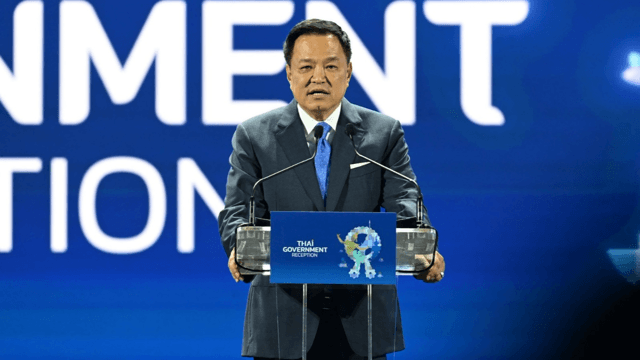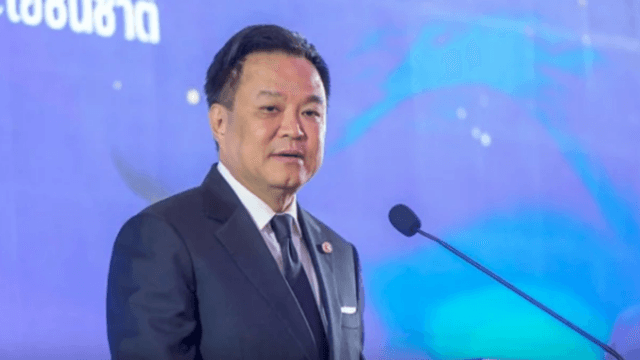



Thailand’s economy is still growing too slowly, with sluggish new investment, despite a large amount of idle capital—“like a rich man who has no future because he does not know the economic direction and chooses to rely on his accumulated wealth, which will one day run out,” said Finance Minister Pichai Chunhavajira.
In a keynote speech, on “Navigating Economic Challenges: The Future of Fiscal Policy”, the minister said that new investment this year has dropped to only 20% of GDP, compared to about 40% in previous years.
Meanwhile, while annual growth over the past decade averaged 1.9%, though this year it is forecast to be about 2.7%, which is still low.
Inflation is low, about 0.7 -0.8%, partly due to a lack of new investment, which impacts employment and household debt, currently estimated at around 90% of GDP, mostly in the form of mortgages and car loans, said the finance minister, adding that most SMEs have accumulated high levels of debt and are finding it difficult to access funding.
Public debt, at about 12 trillion baht, is approaching 66% of GDP, with the ceiling set at 70%. The finance minister pointed out that the government can only borrow a further three trillion baht, or about 3% of GDP, for investment in the next four years. That’s only about 750 billion baht per year and is conditional upon growth not falling below 3.5%.
He said that fiscal discipline must be strictly maintained in the allocation of budget, because public sector borrowing cannot exceed 70% of GDP (~ 15 trillion baht).
The finance minister said that, with close cooperation between government and the private sector, growth could rise to 3-3.2%.
Although the exports remain a key driver of economic growth, Pichai said that the sector will face more challenges in the future if it is not modernised, by attracting new investment and adopting new technology.
He also emphasised the importance of skills development for Thai workers, to meet the needs of new investors in hi-tech development, as well as the development of green energy, ease of investment and the promotion of savings among Thai people.