


The leaders of the Asia-Pacific Economic Cooperation (APEC) forum pledged to bolster regional cooperation amid growing global economic uncertainty, transformative technological change, and demographic shifts.
At the conclusion of their annual summit, the 21 member leaders adopted the 2025 APEC Leaders’ Gyeongju Declaration in Gyeongju, South Korea.
The summit, held under the theme “Building a Sustainable Tomorrow: Connect, Innovate, Prosper,” reaffirmed APEC’s mission to create an open, dynamic, resilient, and peaceful Asia-Pacific community by 2040.
The declaration acknowledges that the global trading system is under pressure, while rapid advances in AI and demographic shifts are reshaping labor markets and growth prospects, according to the joint leaders’ statement.
Among the flagship commitments was a reaffirmation that robust trade and investment remain vital to growth in the region, with greater emphasis on trade facilitation, connectivity, supply-chain resilience, and digitally enabled services.
The APEC leaders also endorsed the APEC AI Initiative to build AI capacities across the region and to promote an investment ecosystem for resilient AI infrastructure. Furthermore, they adopted the APEC Collaborative Framework for Demographic Changes to respond collectively to the region’s aging populations and declining birth rates.
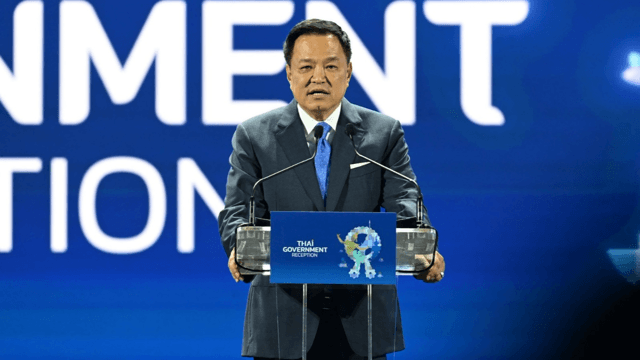
Prime Minister Anutin Charnvirakul’s APEC speech added a distinct Thai-led emphasis. He set out Thailand’s vision to become a “bridge” between South Asia, East Asia, and the Pacific, underlining a landmark “land bridge” project linking the Indian and Pacific oceans.
He also declared Thailand’s intention to join the Organization for Economic Co-operation and Development (OECD) by 2030, as part of efforts to raise governance standards and enhance investment attractiveness.
His vision rests on four strategic pillars: food security, logistics, the digital economy, and the green economy — each aligning closely with APEC’s theme of connectivity, innovation, and sustainability.
The meeting in Gyeongju comes at a moment of increased strategic and economic turbulence in the Asia-Pacific. Member economies are navigating trade tensions, disruptions in global supply chains, the rapid rise of AI, and demographic headwinds.
The joint declaration reflects an attempt to recalibrate regional cooperation in light of these pressures. The emphasis on “benefits for all” in trade and investment is no longer as strong as before, while the commitment to openness remains.
The APEC leaders appear cautious about restoring the previous “rules-based” free trade order without addressing its shortcomings.
For Thailand, Anutin’s speech demonstrates a more outward-looking economic diplomacy. He aims to position Thailand as a logistical and digital hub in the region. This approach complements APEC’s connectivity and innovation agenda and aligns with ASEAN’s economic priorities.
The land bridge project also fits into broader regional supply-chain strategies and could boost Thailand’s role as a strategic connector within mainland Southeast Asia.