


The National Economic and Social Development Council (NESDC) raised its full-year economic growth forecast for 2026 today to 2.5%, up from a previous projection of 2.2%, following a stronger-than-expected third-quarter expansion driven by exports, investment and private consumption.
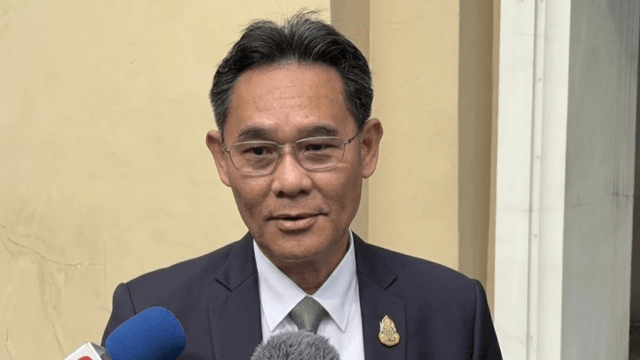
NESDC secretary-general Danucha Pichayanan said Thailand's gross domestic product (GDP) grew 2.9% year-on-year in the third quarter, bringing overall growth for the first nine months of 2026 to 2.8%.
The nine-month performance was bolstered by sustained merchandise export growth, steady investment, resilient private consumption and a methodology revision for the Manufacturing Production Index (MPI).
On the economic stability front, the unemployment rate inched up to 1.02% in Q3, compared with 0.95% in the second quarter and 0.77% in the same period last year.
Headline inflation averaged 2.4%, while core inflation stood at 1.4%. The current account returned to a surplus of US$1.4 billion, or about 47 billion baht.
At the end of September, international reserves stood at US$276.1 billion, while public debt totalled 13.4 trillion baht, equivalent to 68.6% of GDP.
For the full year of 2026, the state planning agency’s upgraded 2.5% growth forecast surpasses the 2.4% expansion recorded in 2025. Headline inflation is projected to average 2.0%, with the current account expected to post a surplus of 0.6% of GDP.
Looking ahead to 2027, the NESDC forecasts GDP growth in the range of 2.0% to 3.0%, with a midpoint of 2.5%. Key growth drivers include accelerated public investment, continued private consumption and investment, a tourism recovery and positive balance of trade.
Next year, private consumption is projected to expand by 2.0%, private investment by 7.9% and export value in US dollar terms by 8.6%. Headline inflation is forecast at 0.8% to 1.8%, alongside a current account surplus of 1.4% of GDP.
To sustain economic momentum and cushion against external risks, particularly heightened uncertainty from conflicts in the Middle East, the NESDC recommended several policy priorities for the remainder of 2026 and into 2027.
First, regarding Middle East contingency planning, the agency advises close monitoring of geopolitical impacts on trade and energy costs to prepare timely relief measures.
Second, for agriculture support, authorities should accelerate water resource management plans, prepare fiscal and financial aid and boost farm productivity and value-added output to stabilise farmers' incomes.
Third, to drive a tourism revival, the focus must be on restoring foreign tourist confidence, advancing the Tourism Authority of Thailand’s 2027 “The Year of Transformation” campaign, and promoting domestic travel.
Fourth, for export diversification, policymakers need to mitigate the impact of US trade protectionism by expanding economic partnerships, tapping new markets to reduce reliance on traditional buyers and assisting exporters with partner trade regulations.
Fifth, to spur private and public investment, investment promotion criteria should be revised so foreign direct investment (FDI) creates stronger supply-chain linkages and benefits local businesses, while fiscal 2027 budget disbursements, public-private partnership (PPP) projects and Thailand Future Fund mobilisation are accelerated.
Finally, regarding fiscal discipline, the government must maintain sufficient fiscal space, alongside prudent budget and public debt management, to safeguard long-term economic stability against external shocks.