


At the end of the harvest season in the 4th lunar month, it’s time for Boon Pha Wet, one of the biggest merit-making traditions of people in the Northeast of Thailand.
Boon Pha Wet has different names according to the region. In the central region, it is known as “Thet Maha Chat” and is usually held in the 12th lunar month or after Kathin season.
In the North, it is called “Tang Tham Luang” and is held anytime from November to March, also after the harvest season. People in the South have a similar tradition and they call it “Tham Maha Chat”.
But whatever it is called, this tradition is regarded as the biggest merit for people who join. They believe that listening to the story of Phra Wetsandorn or Prince Vessantara, which has 13 parts, is a great merit and will lead them to enlightenment someday.
In the small town of Chumphae, Khon Kaen province, Boon Pha Wet remains a strong tradition although the world moves fast and new technology and the modern lifestyle are replacing the old way of life.
Each year, a group of committee members, selected by the locals to represent several villages in and around Chumphae, meet and plan for this big event.
“I’m glad to see lots of young people joining the committee nowadays,” said Ajarn Apirak Prabpairee, a retired lecturer at the Chaiyaphum Rajabhat University who has been the head of the committee for several years.

Ajarn Apirak Prabpairee //Photo by Veena Thoopkrajae
“Young people bring in new ideas. At the same time, they respect the old tradition, the wisdom of the older generations,” he said.
In the past, fresh flowers and a lavish procession were among the priorities. Today, as the need for sustainability and “less is more” prevail, people have been looking at alternatives.
Instead of fresh flowers, they use stems of local plants to make flowers. The stems are dried, broken, curved into flower shapes, and dyed in natural pigment from plants.
These dried “flowers” are used to decorate the venue and the flower procession, and, of course, kept for the following year or reused in other events. There is no waste.
On the eve of Boon Pha Wet, residents of Chumphae hold a big procession around the city to raise awareness and to allow everyone to join this merit-making event. The procession heads to one of the big ponds in the city and the first activity of Boon Pha Wet begins.
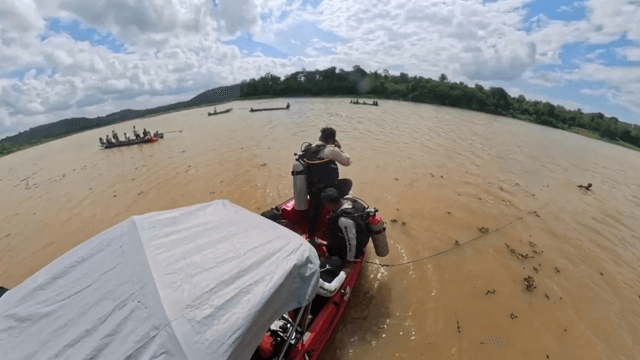
A group of young men dive into the pond to search for Phra Uppakut, a sacred Buddha image that the committee hides in the water the night before. Once the Buddha image is found, it will be moved to the temple where the big ceremony will take place the next day.
On Boon Pha Wet Day, locals will gather at the temple waiting to listen to the story of Phra Wetsandorn or Phra Wet as he is known locally.

Illustration of Phra Wetsandorn (Phra Wet) //Photo by Veena Thoopkrajae

Illustration of Phra Wetsandorn (Phra Wet) //Photo by Veena Thoopkrajae
The entire temple is decorated with colorful fabric flags, spider flags, the dry flowers, and empty bamboo baskets.

Bamboo baskets filled with sticky rice - one of key elements of Boon Phawet //Photo by Veena Thoopkrajae
The procession starts early in the morning. Many villagers join the procession and dance as a blessing. When arriving at the temple, the villagers help each other fill the empty bamboo baskets with a thousand small sticky rice balls they bring from home.
Each sticky rice ball represents one Pali verse they will hear on the day.
A group of monks, with special skills in narrating the story of Phra Wetsandorn, will then take turns chanting. The chanting starts with Phra Malai, which tells the story of a monk called Phra Malai who met with Phra Sri Ariya Mettrai, the future Buddha. Phra Sri Ariya Mettrai told him that people who listen to the entire story of Phra Wetsandorn, or joined Boon Pha Wet or Thet Maha Chat, will be reborn in the era of the future Buddha.

Decoration at the temple during the Boon Phavet tradition //Photo by Kanokchan Patanapichai
Then it is time for the story of Phra Wetsandorn to begin. The monks narrate how Phra Wetsandorn stayed in a magnificent palace and how he performed the biggest merit of giving.
He gave away everything people asked of him – his treasure, his palace, even his wife and children. At the end, after he completed his giving mission, with a little help from Indra he returned to his city and palace and reigned his country peacefully until he died.

Of all the 13 parts, the most colorful and enjoyable chapters are those about Chuchok, a Brahmin, who came to ask for his children, the episode when his children Kanha and Chali cleverly hide in the lotus pond but are found and have to leave with Chuchok, the part about Chuchok dying from eating too much, and the final part when the entire family reunites again and returns to the city.
During these parts, the monks use all their skills to make people cry, laugh, or even curse Chuchok. The more impressed the people are, the more money they will donate.
The sound of coins clinking against the metal alms bowls becomes more frequent and worshippers continue to drop banknotes in the alms receptacles with interruption.

Decorative details for the Boon Phavet tradition //Photo by Kanokchan Patanapichai
At the end of the day, people leave the temple feeling satisfied at making so much merit, impressed with the story they heard, knowing that donating is a great merit, and having fun seeing the beautiful procession and meeting other people.
Another benefit, which they might not realize, is that have achieved a bigger mission – that of maintaining the beautiful tradition of the locals.