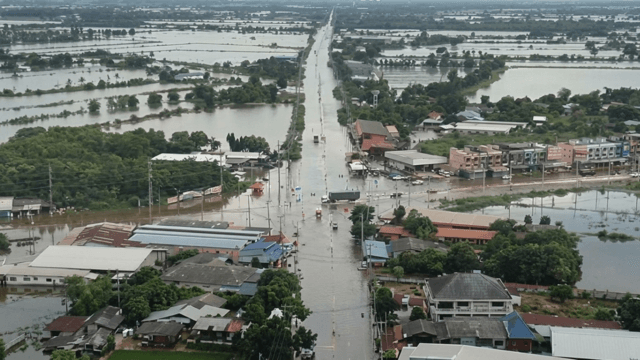
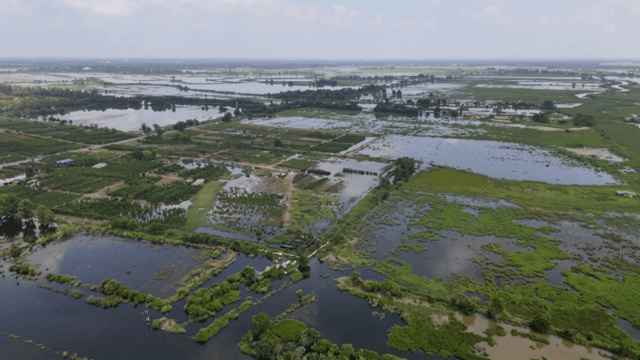
All 50 districts were declared disaster zones late last month, as the worst floods in living memory exposed the capital’s vulnerability to seasonal weather patterns. Experts say that without major upgrades to flood defences, the city will fall deeper into an annual pattern of chaos and paralysis as climate change takes hold.
Despite proposals ranging from wider drainage tunnels to AI weather forecasting and more efficient water management, Bangkok still lacks a long-term defence plan to protect its 10 million residents.
Drainage bottlenecks
Bangkok Governor Chadchart Sittipunt blamed the historic flooding on bottlenecks in the city’s drainage network, which was overwhelmed by more than 300 millimetres of rainfall over three days (from 4pm on September 24 to 6.30am on September 26).
“These chokepoints are also present in the city’s canal network, meaning we urgently need more large-scale drainage solutions,” the governor said.
To address these constrictions, the Bangkok Metropolitan Administration (BMA) has approved plans for a massive tunnel to funnel water from the Prawet Burirom Canal into the Nong Bon reservoir.
The project will direct runoff into a vast water-retention basin on the city’s eastern outskirts, before it drains into the Chao Phraya River and empties into the Gulf of Thailand.
Over the past week, around 700,000 Bangkokians found their homes submerged by water up to several metres deep, many cut off as emergency transport services were paralysed.
In response, the governor also vowed to use lessons from the deluge to upgrade forecasting and water-management models.
“Weather forecasting is a complex task involving many variables, ranging from localised rainfall and water-flow patterns to zone-specific topography,” Chadchart said.
Anger over delayed warning
The lack of timely information about the flooding sparked widespread anger, with experts accusing city hall of failing to issue timely public alerts.
“The BMA should have realised by the morning of September 25 that it could not cope with such huge volumes of rain,” said Dr Sitang Pilailar, a professor of water-resource engineering at Kasetsart University.
“City officials should have shifted immediately from monitoring the situation to issuing alerts when the risk level turned severe.”
She stated that BMA monitoring stations in Nong Chok and Nong Khaem can accurately predict rainfall three to five hours in advance, leaving plenty of time to forecast flood levels in each zone of the capital.
“I am not saying that the BMA should be capable of predicting every minor detail, but it should be able to inform residents of the possible impacts so they can make timely decisions.”
Sitang was among several prominent experts who urged residents to head home early last Friday, rather than wait out the rain at work or school. Bangkok is notorious for traffic jams when it rains, and locals generally prefer to wait till rainfall stops before heading home.
Days of continuous rain in the last week of September triggered flooding that paralysed the city’s road system and forced schools and offices to shift into a work-from-home mode.
Bhichit Rattakul, a former Bangkok governor who currently advises the Asian Disaster Preparedness Centre, said the capital already had sufficient tools to produce accurate forecasts.
“With its AI applications, city hall has the capability to alert officials of the need to prepare for imminent flooding and issue early public warnings,” he said.
He added that warning households even three to five hours ahead of a disaster gives residents enough time to move vulnerable family members, vehicles and valuables to safer ground.
“Early warnings serve to minimise damage,” Bhichit noted. He gave the current administration a failing grade for its handling of disaster communications.
“The BMA knows full well which parts of Bangkok are low-lying, so it should have the capacity to identify communities vulnerable to floods,” he said.
Where were the phone alerts?
Deputy Interior Minister Jeseth Thaiseth also questioned why the BMA failed to utilise the existing emergency cell broadcast system during the peak of the crisis.
“In fact, a relevant authority contacted the BMA on September 26 to ask if it wanted to issue a warning,” he said.
However, residents only began receiving emergency cell broadcasts late on Saturday – well after heavy flooding was already underway.
Jeseth noted that Bangkok’s governor is not required to attend national-disaster preparedness drills along with other provincial governors, since the BMA falls under a special administrative category.
Responding to the criticism, Deputy Bangkok Governor Tavida Kamolvej acknowledged the gaps in communication and promised improvements. “Next time, we will broadcast early-warning messages and coordinate directly with the Disaster Prevention and Mitigation Department on further action,” she said.
Health and environment expert Sonthi Kotchawat demanded that the BMA establish a war room in cases of imminent disaster in order to coordinate responses with all relevant authorities.
“A centralised crisis command would ensure efficient disaster management,” he said.
Unimplemented plans
After the southern city of Hat Yai was submerged by 600mm of rainfall over three days last year, the BMA said it would learn lessons from the disaster to draw up a blueprint for Bangkok’s flood management.
Deputy Governor Tavida was tasked with the job of overseeing the comprehensive response plan featuring mapping of high-risk areas, water removal capacity, evacuation routes and an early-warning system.
The plan also included stockpiling of emergency supplies, preparing staff for relief and rescue operations and reviewing Bangkok’s long-term flood prevention measures.
“If these plans had already been prepared, why weren’t they implemented?” asked Sitang.
Bhichit stated that no significant flood solutions have been created for Bangkok since systems were established under the initiative of HM the late King Rama IX.
“The Bangkok flood embankment and Phra Khanong pumping station were both built under the late king,” Bhichit said. “Decades later, we urgently need an upgrade for the capital’s water drainage system.”
By Thai PBS World’s General Desk