


Ban Nong Chan, a quiet Thai village neighboring Cambodia, once again finds itself pitchforked into a historic border disagreement, as citizens on both sides, divided by a disputed barbed-wire fence, ramp up the conflict.
Troops, police and security volunteers were deployed in the disputed areas adjacent to Ban Nong Chan in Thailand’s Sa Kaeo province and Chok Chea in Cambodia’s Banteay Meanchey province, after Thai right-wing groups gathered to express their patriotic sentiment, confronting the Cambodians living there.
The area has been swept up in tensions since the July border flare-up, when Thailand accused Cambodia of using civilians to invade and occupy Thai territory for over four decades since the end of the civil war in Cambodia.
The Thai Foreign Ministry has confirmed a claim made by the Thai military that “this is an area in Thai territory which originally served as a temporary shelter for Cambodians fleeing combat in the past but has expanded over the years thereafter despite continuous protests by Thailand over encroachment on Thai territory, in violation of the Memorandum of Understanding signed in 2000”.
Refugee camp and stronghold
Nong Chan’s troubled history dates back to the middle of the 20th century, when a Khmer Serei (Free Khmer) camp was set up by a group of anti-King Sihanouk fighters.
The area was populated by bandits and smugglers until the 1970s, when refugees from the notorious Khmer Rouge regime formed a resistance force.
The Nong Chan refugee camp became one of the most crowded camps along the Thai-Cambodian border after the fall of the Khmer Rouge regime in early 1979. The population of Nong Chan camp has fluctuated between 10,000 and 48,000 since its inception in 1979.
Nong Chan was not only established as a refugee shelter for humanitarian purposes, but it also served as a stronghold of the Khmer People's National Liberation Front (KPNLF), an anti-Vietnamese organization set up by former prime minister Son Sann.
A UN report said that the camp's administration was very closely aligned with the KPNLF leader.
Refugees under attack
The camp's 13 sections are administered by leaders appointed by the central administration. That is the reason why the camp was attacked by Vietnamese forces in 1980, 1983 and 1984, resulting in the relocation of refugees to various sites such as Ang Sila camp, Site 3 and 6, and Chanmeh camp.
Nong Chan camp was finally incorporated into Site 2 in 1986.
However, Thais were not reportedly so kind to the refugees in Nong Chan. At least two ugly incidents took place in 1979 amid the chaotic situation after the invasion of Cambodia by Vietnam.
International media, such as the Washington Post and the New York Times, reported in June 1979 that the Thai military had forcibly transported several thousand Cambodian refugees from Nong Chan Refugee Camp to the border near Preah Vihear temple.
They were pushed into a hazardous zone littered with landmines on the Cambodian side—a move widely considered forced repatriation into dangerous territory.
The Washington Post reported in November 1979 that the Thai military shelled the Nong Chan refugee camp, killing approximately 100 Cambodians in retaliation for the death of a Thai soldier who was accused of raping a Cambodian woman.
Incomplete repatriation
When the civil war in Cambodia ended after the 1991 Paris Peace Agreement, the United Nations High Commissioner for Refugees shut down the Site 2 refugee camp and began the repatriation program in 1993.
However, many people chose to stay in nearby areas due to fears for their safety, uncertainty and instability at their places of origin.
They were worried about landmines and their properties being occupied by strangers.
Many refugees believe that the original barbed-wire fence, erected to mark the boundaries of the refugee shelter, was located inside Cambodian territory.
As a result, they refused to leave and instead built houses and expanded their farmland right up to and against the barbed wire, according to Thai officials. This led to disputes, as Thai nationals lost access to their agricultural land, they said.
Cambodia subsequently organized the community into Chok Chea village in the jurisdiction of Banteay Meanchey province, which has since grown into a settlement of more than 200 households today.
Peace amid discord
Resolutions by the Thai cabinet in 1999 and by the National Security Council in 2005 granted a relaxation, allowing them to maintain the status quo until the completion of boundary demarcation.
Thailand and Cambodia signed a memorandum of understanding in 2000 to jointly survey the land boundary. A survey conducted between 2006 and 2007 identified boundary pillars No. 46 and No. 47 near Ban Nong Chan, but both sides still disagreed over whether they were located at their original sites.
In December 2010, Thai nationalist Veera Somkwamkid was arrested by the Cambodian authorities when he and six other Thai activists entered the disputed area to prove Thai ownership.
The arrest occurred amid escalating tensions and armed conflicts between Thailand and Cambodia over the border area, particularly around the Preah Vihear and Ta Moan Thom Hindu temples.
He was found guilty and got a prison sentence, but received a royal pardon in July 2014 after serving three and a half years.
As fresh border skirmishes broke out on July 24 this year, the Burapha Task Force of the First Army Region carried out operations to reclaim Thai territory encroached upon by Cambodia.
The operation involved both military pressure and negotiations, resulting in six Cambodian civilian and military families being pushed out from a 10-rai (3.95 acres) plot at Ban Nong Chan on July 26.
However, that was not the end but the beginning of the new round of conflict at Ban Nong Chan. Cambodian people from the Chok Chea community came out to protest, demanding that the Thai authorities remove the barbed wire fence.
Meanwhile Thai nationals, mostly non-Nong Chan residents, confronted the Cambodians demanding that Thai citizens who have land titles be allowed to exercise their right to enter the territory.
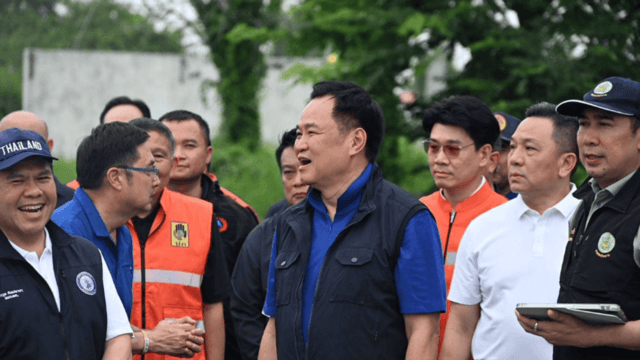
Such provocative actions risk violating the ASEAN-brokered ceasefire agreement, according to Deputy Defense Minister Natthaphon Narkphanit, who ordered the First Army Region Commander to coordinate the withdrawal of Thai protesters from the border area.
If clashes were to break out between civilians on both sides, the situation would be difficult to control, he said.