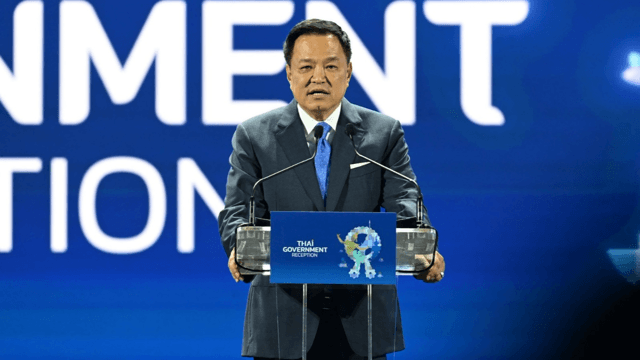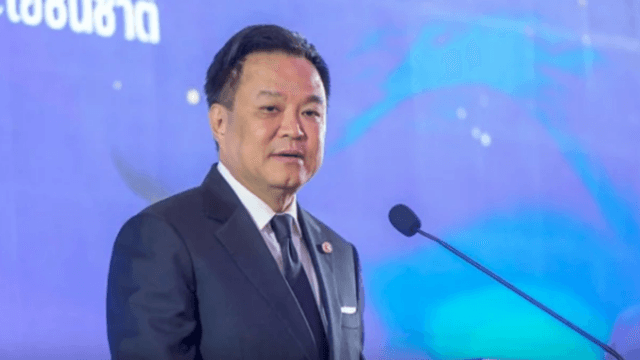



File photo: Phumtham Wechayachai
Newly appointed Defense Minister Phumtham Wechayachai could find himself on inhospitable terrain after a staunch ultra-rightist retired general flagged his past ties to a communist insurgency to cast doubt on his loyalty and undermine his authority with the military.
The rancour, unless nipped in the bud, could create a deep schism between the civilian government and the armed forces.
A day before the royal endorsement of Phumtham as the defense minister, General Somjate Boonthamnom, a former senator who was involved in the coup to topple the elected civilian government of Thaksin Shinawatra in 2006, went public to oppose Phumtham.
"The fact that Khun Phumtham has a past that opposes the core ideology of the military and is now leading the armed forces is a blow to the spirit and an affront to the hearts of the soldiers who have been through wars. Appointing Khun Phumtham as the defense minister is like trampling on the hearts of these brave soldiers,” Somjate said in an interview with local media.
Phumtham, aka Comrade Yai, decided to join the insurgency warfare launched by the Communist Party of Thailand (CPT) a week after the student massacre in Thammasat University on October 6, 1976. His operational area was mostly in the lower Northeastern region, and he was sometimes reportedly active in the Northern region.
Contrary to the portrait painted by the hawkish military of Comrade Yai being the great strategist of the CPT, his insurgent activities are not well documented. His own accounts to local media have mostly dwelt on the hardships he faced in the jungle.
He gave up the Revolutionary War in 1979 shortly before the military-dominated government of General Prem Tinsulanonda officially announced a relaxation policy in 1980 to pave the way for the return home of communist insurgents.
“The old images of the events from October 1976, back when I entered the forest [to join the CPT], it’s been 50 years now, and I can hardly remember anything," said Phumtham in response to Somjate’s statement. “Today, we should start from the truth, look towards the future, and focus on working for the country."
Creating mistrust
Somjate made clear that he tied Phumtham with the past insurgency to warn the young generation in the armed forces, who have never had such an experience fighting the communists, not to trust the new minister.
Phumtham has served Thaksin loyally since the 1990s when they formed the now-disbanded Thai Rak Thai Party and Thaksin is still the number one enemy of the Thai armed forces, he said.
"Thaksin has been undermining the military since his time in power from 2001 to 2006, which eventually led to the military coup against him. How can we be sure that Phumtham won't follow Thaksin's approach to weaken the military?" Somjate said.
Thaksin was accused of politicizing the military during his time by implementing several measures aimed at centralizing power, reducing military autonomy, and ensuring loyalty within the armed forces.
According to Somjate, some of Thaksin's moves, such as reshuffling the military leadership and placing allies in key positions, were attempts to weaken the military's independence and make it more politically aligned with his government.
However, Phumtham has emphasized he would be focusing on cooperation and maintaining good relations with the military. He has publicly stated that there is no need to revisit past conflicts and has said he looked forward to future collaboration for the country’s benefit.
The minister also noted the importance of working within the legal framework for matters such as military promotions and transfers, which could indicate a more measured approach compared to the more controversial maneuvers associated with Thaksin’s tenure.
Hands are tied
Unlike during Thaksin’s time, Phumtham has no liberty to order a reshuffle of senior officers with the rank of general, as the 2008 Defense Ministry Law issued after Thaksin was toppled in a coup authorizes only the so-called super board to appoint or promote generals to positions.
While the minister and deputy minister are members of the board, the majority of the panel are commanders of all branches including the chief of army, navy, air force, and the supreme commander as well as the permanent secretary of the Defense Ministry and the head of the Military Service Commission Division.
The law also authorized the Defense Council — the majority of 28 members are military officers — to oversee and approve security policies, the defense budget, personnel recruitment, and many other matters concerning military affairs. Even if the law needs to be amended to empower the civilian government or ministers, it will require permission from the council.
Phumtham could feel lonely at the ministry, as his deputy — General Nattapon Nakpanitch, a former secretary-general of the National Security Council, and former deputy army chief — is a confidant of former prime minister Prayut Chan-o-cha, who masterminded the 2014 coup.
Nattapon was chosen to be a member of the cabinet under the quota of Prayut’s associate, Ruam Thai Sang Chart Party. He was appointed as a secretary to Sutin Klungsang, the defense minister in Srettha Thavisin’s administration.
Perhaps Phumtham will have less power than Sutin, as he is being discredited and misportrayed, leading to a trust deficit because of his insurgency background, according to military sources.
Thaksin and Pheu Thai Party’s connections within the armed forces were retired and Prayut purged everyone who he believed was associated with or had empathy for the party after the 2014 coup, leaving no Thaksin loyalists in the military.
Unaccomplished mission
Prime Minister Paetongtarn Shinawatra has yet to announce her policy to parliament but she has said that most of the policies, including the ones on security and military affairs, would not be dramatically different from those pursued by the Srettha Thavisin administration.
The ruling Pheu Thai Party had vowed to push for reforms in the military to make the armed forces more professional, smaller, and transparent. It also wanted to end conscription as well as stop military intervention in politics.
While the law and regulations on military drafting have not been amended, the recruitment method has remained the same. In April, the military recruited 85,000 young men for defense service this year. Some 70,000 of them were drafted by the drawing of lots, and only 15,000 joined the armed forces voluntarily.
Former defense minister Sutin had earlier said that he agreed with a draft to amend the 2008 Defense Ministry Law, which would have reduced the number of officers in the Defense Council and authorized the minister to suspend an officer who was suspected of staging a coup against the government.
A draft of the amendment as seen by Thai PBS World prohibited commanders from mobilizing or moving troops to seize political power. It was not finalized and needed to be heavily scrutinized by parliament.
The draft was the counter to a draft proposed by the opposition to drastically reduce the power of the Defense Council and empower the civilian government, according to an MP of the opposition People’s Party.
If the government and new Defense Minister Phumtham want to bring about reforms in the military, they do not need to do anything but support all draft bills previously proposed to reform the military, he said.
Minister Phumtham also has to deal with many unfinished tasks of the previous administration and minister, including the controversial submarine project with China that has been stuck for years.