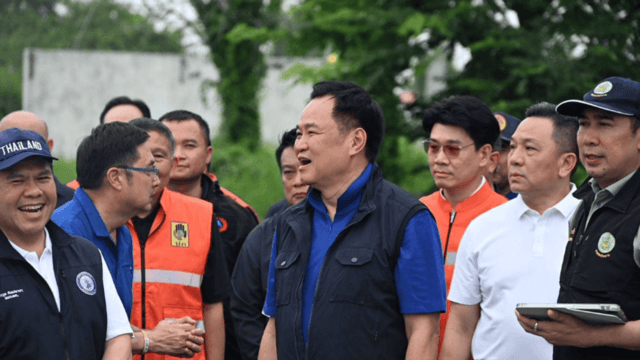



Bowing to political sensitivities, Prime Minister Paetongtarn Shinawatra swept under the carpet all controversial issues with Cambodia, notably pesky maritime disputes and joint exploration of hydrocarbon resources in the Gulf of Thailand, during her official visit to the neighbouring country on April 23-24.
The two-day visit, mainly to celebrate the 75th anniversary of diplomatic relations, highlighted cooperation in areas of mutual interest for economic development, such as trade, connectivity and labor.
Prior to her first trip as Thailand's prime minister to Phnom Penh, a Thai right-wing nationalist group led by the Student and People's Network for Thailand Reform had expressed doubts on whether there would be discussions on the overlapping claims areas (OCA).
Local media in Thailand and Cambodia expected Paetongtarn to discuss with her counterpart, Hun Manet, resumption of negotiations on maritime boundary delimitation and sharing benefits from joint petroleum resource development.
The two countries had signed a Memorandum of Understanding (MOU) in 2001 regarding the areas of their maritime claims to the continental shelf when Paetongtarn’s father, Thaksin Shinawatra, was the prime minister.
The OCA, a 26,000-square-kilometer area believed to contain significant oil and gas reserves, has been a bone of contention between Thailand and Cambodia for decades.
Assertive nationalists on both sides
While the 2001 MOU provides a framework for joint development and boundary negotiations, its implementation has been stalled due to political sensitivities and opposition by nationalists in both countries.
Nationalists on both sides have accused their respective governments of utilizing their deep family connections to benefit themselves and their cronies in the energy sector, while possibly compromising on national territorial integrity, particularly the area near Koh Kut.
Thai nationalist groups threatened to call a street protest to bring down the government like they did successfully in the case of the Preah Vihear temple over a decade ago, if Paetongtarn’s administration resumed talks with Cambodia and compromised on territory and national resources in the Gulf.
The Cambodian opposition was similarly vocal, demanding that the Hun Manet government officially file a claim for sovereignty over Koh Kut with the International Court of Justice, which had ruled in favor of Phnom Penh in the Preah Vihear case in 2013.
Given these complexities, the absence of public discussions on the OCA during the recent visit suggests that both governments are cautious in their approach, balancing domestic political considerations with the potential benefits of cooperation, according to a senior Thai official who is close to the matter.
Paetongtarn was tight-lipped when asked if the OCA issue was discussed during her visit to Cambodia. She suggested that reporters see the outcome of the meeting reported by the TV Pool.
Boosting bilateral trade
At the joint press conference with Hun Manet, Paetongtarn said the discussions were cordial and constructive, and both parties were committed to strengthening cooperation based on trust, mutual respect and shared benefits.
Both sides mapped out several areas of cooperation, including economic, security, border area development, tourism promotion and labor cooperation, according to Thai government spokesman Jirayu Huangsap.
On economic cooperation in particular, the two countries committed to increasing bilateral trade from US$10 billion to $15 billion by 2027. Both sides agreed to coordinate more closely within ASEAN to deepen regional economic integration and promote stronger economic linkages within the Mekong subregion, he said.
Thailand was ready to host a joint cabinet retreat meeting at the border in conjunction with the official opening of the Thailand-Cambodia Friendship Bridge at Ban Nong Ian – Stung Bot.
Both countries agreed to accelerate demining efforts along the border, promote cooperation between special economic zones and expedite negotiations on a bilateral road transport agreement that would allow private vehicles to cross the border.They plan to develop cross-border rail freight services to reduce logistics costs and improve efficiency, said Jirayu.
Both sides also discussed ways to promote cross-border tourism, including advancing the "Six Countries, One Destination" initiative for tourism in the Mekong basin covering Southern China, Myanmar, Laos, Thailand, Cambodia, and Vietnam.
They agreed to update the Border Crossing Agreement to better facilitate border crossings for tourism purposes, he said.
During the visit, Paetongtarn witnessed the signing of seven MOUs on bilateral cooperation.
They included ones on the management of the friendship bridge, the establishment of a Thai-Cambodian skills development center, employment of workers, labour cooperation, technical assistance on the detailed design for improvement of national Road No. 57 on the Battambang-Prom section of the International Border Checkpoint project, and the construction of a new border bridge at the Ban Pak Kard checkpoint in Pong Nam Ron district of Chanthaburi province.
Concern over dissidents
Cambodian PM Hun Manet reportedly assured his Thai counterpart that his country would not allow any one to use its territory to target the Thai government and urged Thailand to reciprocate.
“I appreciate Thailand’s foreign policy of not allowing anyone to use Thai territory to interfere in the internal affairs and carry out activities that harm Cambodia. The Cambodian government will implement this principle as well,” Hun Manet told the press conference.
The Cambodian PM had also harped on this point during his first official visit to Thailand on February 7 last year when he met with then Thai PM Srettha Thavisin.
Last November, Cambodian authorities detained six political activists after they were deported by Thai immigration authorities for illegal entry.
Hun Manet's administration has faced pressure from nationalist groups, especially concerning territorial disputes like the one over Koh Kut island. Opposition groups abroad have been vocal on such issues, potentially destabilizing domestic politics.
The recent incident took place on January 7 when Lim Kimya, a former Cambodia opposition MP, was shot dead in Bangkok's Bang Lamphu area. The investigation is unlikely to unveil any deeper plot as the arrested suspect, Ekkalak Pheanoi, a Thai ex-marine, told police he was hired to take the life of the Cambodian politician over a personal conflict.
The Bangkok Criminal Court has issued arrest warrants for two Cambodian nationals, Ly Ratanakraksmey and Pich Kimsrin, who are both connected to high-ranking Cambodian government officials and remain at large.
Human Rights Watch has accused the two governments of engaging in transnational repression to silence dissidents by
committing human rights abuses against their own citizens outside their respective territory.
The 2020 abduction of 37-year-old Thai pro-democracy activist Wanchalearm Satsaksit in Phnom Penh highlighted the risks associated with cross-border political activities. Even as Wanchalearm's whereabouts remain unknown after four years, Cambodian police have closed their investigation into the case.