Thailand has been inundated by cross-border smog for decades, but the government’s response has remained lukewarm.
In the North of Thailand, however, locals are now grappling with a far more serious threat than foul air. Recent tests showing arsenic contamination in the Kok and Sai rivers, which flow from Myanmar, have left communities fearing for their lives.
“Cross-border pollution has been harming Thailand for over a decade now because Thai authorities have done little to address it,” said Chainarong Setthachua, a lecturer and environmental expert at Maha Sarakham University.
Contaminated water
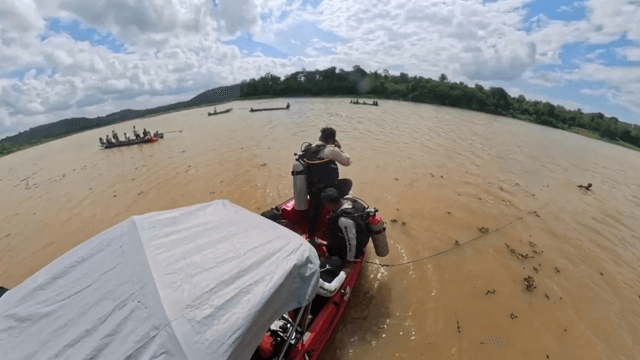
Aweera Pakkamat, director of the Environmental and Pollution Control Office (EPCO) Region 1, said arsenic levels in Kok River samples taken at three locations in Chiang Mai’s Mae Ai district last month far exceeded the safe limit.
“Most worrying was Ban Kaeng Tum subdistrict, where water samples contained 0.026 milligrams per litre – far higher than the safe limit of 0.01mg,” he said.

File photo: Pollution Control Department
Worse still, mercury levels in the same water samples measured 0.076mg per litre, above the 0.05mg safe standard. The source of the poisonous heavy metals is believed to be Chinese-owned gold mines upstream in Myanmar.
Exposure to arsenic, particularly through water and food, can cause cancer, skin lesions and cardiovascular disease. Long-term exposure can also lead to neurological damage and developmental problems in children. Exposure to mercury carries similar dangers.
Calls for solutions
Academics and civil sector representatives in Chiang Mai and Chiang Rai provinces accuse the government of failing to systematically address cross-border pollution from Myanmar’s many open-pit mines.
“Pollution Control Department data shows five Myanmar open-pit mines are located near rivers that flow into Thailand’s North,” they said in a recent petition addressed to Prime Minister Paetongtarn Shinawatra.
The petition called on the premier to urgently tackle contamination of the two rivers, the source of tap water for 1.2 million people in Thailand and livelihoods for thousands of families.
It demanded that Paetongtarn raise these issues with Myanmar’s leadership, pointing out that activities in the neighbouring country are damaging lives in Thailand.
The petitioners called for the creation of a working panel made up of representatives from the government, public and academic sectors to tackle the cross-border pollution. They also urged the creation of a water-quality monitoring centre for Chiang Rai.
Finally, they called on the Thai government to coordinate with Myanmar’s military regime, ethnic forces controlling border zones where the mines are based, and China, to monitor river water quality and find solutions that prevent contamination.
“We also expect the government to keep the public informed and updated,” the petition said.
Myanmar junta chief Min Aung Hlaing made two visits to Thailand in April. On April 3-4 he attended the 6th BIMSTEC (Bay of Bengal Initiative for Multi-Sectoral Technical and Economic Cooperation) Summit, before returning on April 17 for talks with Paetongtarn and Malaysian PM and ASEAN chair Anwar Ibrahim.
The talks focused on ceasefires and humanitarian aid in the aftermath of the devastating March 28 earthquake.
The academic Chainarong said tackling the river contamination would be difficult, but the Thai government must make efforts to halt the flow of poisonous heavy metals from mines and force the polluters – no matter where they are based – to pay damages.
Asst Prof Satian Chunta, who lectures on natural resources and environmental management at Chiang Rai Rajabhat University, said the only effective way to tackle the problem was at its source – in Myanmar, a failed state whose junta has lost control of vast swathes of the country, including zones where the mines are operating.
“Hence, the only way to handle these problems is through political means,” he said.
Government response
The Office of the National Water Resources (ONWR) says it has contacted the authorities in Myanmar as well as the Mekong Committee Secretariat to seek support for launching a joint mechanism to monitor water in the Kok River.
“The worsening quality of water in the Kok River now threatens to harm both the environment and people’s health,” the ONWR said.
Cross-border smog is also on the government’s agenda, having been a concern on the ASEAN radar since the 1990s. Yet, despite the introduction of the Regional Haze Action Plan in 1995 and the ASEAN Agreement on Transboundary Haze Pollution (AATHP) in 2002, smog has continued to plague the region, including Thailand.
In 2017, the Thai government unveiled an action plan with Vietnam, Laos, Myanmar and Cambodia for a haze-free region by 2020. The plan failed.
Last year, the 2nd ASEAN Haze-Free Roadmap was rolled out with great fanfare. However, the number of hotspots – mainly burning of farmland – that produce the smog remained stubbornly high.
Paetongtarn pledged to combat the smog crisis when she took over as PM in August 2024. Her government even coordinated with Laos and Myanmar as part of the Clear Sky Strategy to eradicate hotspots.
However, Chainarong dismissed the many rounds of negotiations as ineffective. “Progress in negotiations has not translated into results,” he said.
He claimed that large Thai conglomerates are implicated in farmland burning in Myanmar. “These investors buy corn from local farmers, who clear their field stubble with fire,” he said.
He pointed out that Thai investors are also behind the Xayaburi hydroelectric dam in Laos, which is blamed for widescale ecological destruction in the downstream Mekong basin.
Glimmer of hope
Amid the complex problem of cross-border pollution, some hope has emerged in Thailand’s deep South, where smog has reduced thanks to decisive action by Indonesia and Singapore.
A decade ago, thick haze from agricultural fires in Indonesia would blanket the provinces of Narathiwat, Yala, Pattani – even spreading north to Songkhla, Satun, Trang and Krabi. The haze crisis regularly forced flight cancellations.
However, southern skies began to clear after Indonesia introduced new curbs on factory and vehicle emissions and Singapore tightened investment laws.