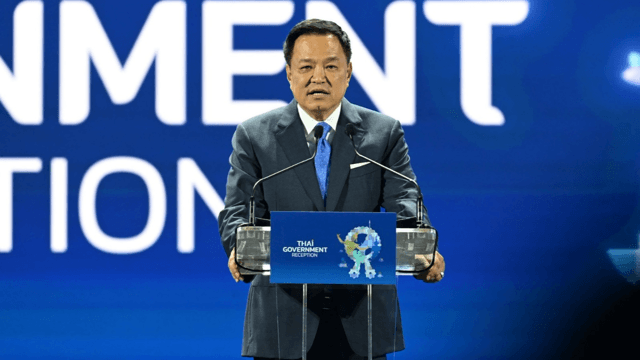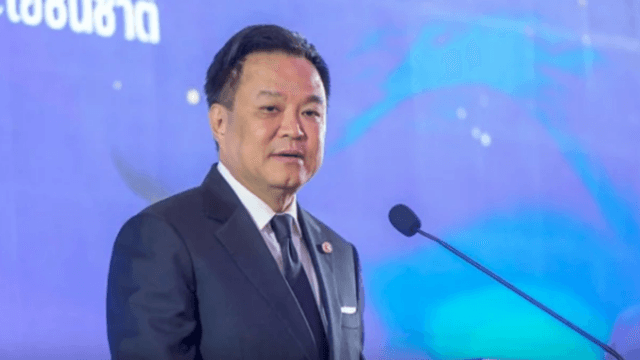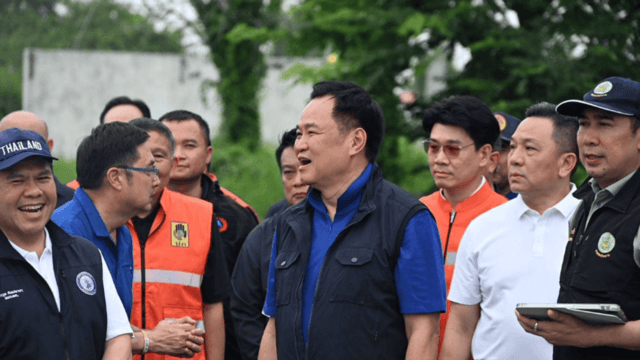



Thailand and Cambodia badly need peace and restoration of bilateral relations in their mutual interest, but domestic pressure has forced the Thai government under Prime Minister Anutin Charnvirakul to maintain certain nationalist narratives that could impede an end to the conflict.
Anutin and his Cambodian counterpart, Hun Manet, signed on October 26 the Joint Declaration on the outcome of their meeting in Kuala Lumpur, with US President Donald Trump and Malaysian Prime Minister Anwar Ibrahim acting as witnesses.
Shortly before the signing, Anutin addressed the Thai people via Facebook live, assuring them that none of the elements in the declaration would put Thailand at any disadvantage.
The Thai prime minister reiterated that the declaration consisted of four main points that the Cambodian government must implement: the withdrawal of heavy weapons from the border areas, clear all remnants of explosives, cooperate in combating crimes such as online scams or cybercrimes, and explore joint management measures in the overlapping areas to prevent future problems.
Cambodia to act first
“All four actions must be initiated by Cambodia. Once Cambodia begins implementation, Thailand will then assess and proceed accordingly in order to promote peace and strengthen bilateral relations between the two countries,” Anutin said.
Pushed by Trump and facilitated by ASEAN Chair Malaysia, Thailand and Cambodia reached a ceasefire agreement on July 28 after a border flare up that killed a number of civilians and soldiers as well as displaced more than 300,000 people on both sides.
Rounds of negotiations via bilateral mechanisms including the General Border Committee, Regional Border Committee and Joint Boundary Commission failed to ease tensions between the two countries as a hawkish Thai military and right-wing nationalists obstructed the peace effort.
The Thai authorities have maintained border closure since late July and issued an ultimatum to Cambodia to remove over a hundred Cambodian households in the disputed areas adjacent to Ban Nong Chan and Nong Ya Kaeo in Thailand’s Sa Kaeo province.
Thailand has detained 18 Cambodian soldiers since July 29 and rejected Phnom Penh’s demand to release them on humanitarian grounds. The Thai military also accused Cambodia of laying anti-personnel landmines in the disputed border areas and demanded that they take responsibility and cooperate to help clear them.
Pressure from nationalists
Thai right-wing nationalist Panthep Phuaphongphan raised grave concerns over the ASEAN-facilitated peace deal, accusing the joint declaration of failing to force Cambodia to take responsibility for Thai civilian and soldier casualties.
Panthep and his group have demanded and pressured the government to scrap two memorandums of understanding — one signed in 2000 for survey and demarcation of the land boundary and another in 2001 to settle maritime disputes in the overlapping claims continental shelf in the Gulf of Thailand.
They have expressed concern that negotiations with Cambodia within the framework of the MOUs could lead to the loss of territory for Thailand. Notably the 2000 MOU, which recognized the 1:200,000 scale French map, could repeat the national humiliation of losing territory as in 1962 when the International Court of Justice ruled in favor of Cambodia in the Preah Vihear case.
“The signed declaration lacks an essential objective — to hold Cambodia accountable for its serious violations of the 2000 MOU,” he said at a press briefing. “These include the use of war weapons in civilian areas, resulting in the deaths, disabilities and injuries to many Thai citizens — a grave breach under Article 8 of the MOU.”
The laying of new landmines that caused the deaths of many Thai soldiers, left some of them maimed or injured constitutes another serious violation, this time under Article 3 of the MOU, he added.
Anutin’s government proposed its policy in Parliament recently to hold a national referendum, placing the onus on eligible voters to decide the fate of the two MOUs.
The Thai government and its representatives in all meetings have failed to reserve the right to terminate the 2000 MOU, despite Cambodia’s serious violations under Articles 8 and 3 of the MOU, according to Panthep.
“Thailand has not exercised its right to terminate the agreement under Article 60 of the 1969 Vienna Convention on the Law of Treaties,” he said.
No loss of territory
Prime Minister Anutin rejected all allegations made by the nationalists, saying there was no plan whatsoever to open border checkpoints or take any action that could suggest Thailand was surrendering its territory.
“Claims that we will lose land, build fences or use the 1:200,000 map are completely unfounded. Thailand is not bound by any such conditions,” he assured.
This declaration serves as a framework for both countries to take practical steps toward achieving peace and stability along the border and strengthening bilateral relations, he said.
“We do not wish to be an enemy to anyone — not a single person. As our national anthem says, ‘Thais love peace, but are not afraid to fight’. This principle has guided us consistently since tensions first arose with Cambodia,” Anutin said.
Symbolic removal of weapons
While Thailand has been stuck in its perception trap of lost territory, Cambodia showed its readiness to enforce the ceasefire agreement shortly after the signing ceremony.
On October 27 the Cambodian Senate, currently chaired by former prime minister Hun Sen, endorsed the comprehensive and practical framework laid out in the joint declaration.
The Cambodian Defense Ministry has begun implementing the first phase of heavy weapon withdrawals from the Cambodia–Thailand border, in line with the peace agreement signed in Kuala Lumpur, according to Khmer Times.
The action was an initial step and served as a symbolic demonstration of the commitment to implementing the joint declaration.
Thai Defense Minister Nattaphon Nakphanit told reporters the Thai military in the area of the 2nd Army Region had also undertaken a similar symbolic action on the night of October 26 to show their commitment to the ceasefire agreement and the joint declaration. Thai media, however, reported the action on the Thai side on October 28.
The two feuding countries would fully implement military de-escalation under the observation and verification of the ASEAN Observer Team (AOT), to ensure the full and effective implementation of the ceasefire, according to the Joint Declaration.
The AOT has been assigned to verify the removal of heavy and destructive weapons and equipment from the border and return them to their respective normal military installations.
Forming the ASEAN team
Thai Defense Minister Nattaphon and his Cambodian counterpart Tea Seiha have signed the terms of reference (TOR) for the establishment of the AOT and would begin the process of setting it up as soon as possible.
The AOT, with a mandate for three months, will be established separately in Cambodia and Thailand and operate within the border areas of the two countries, without crossing the border, as per the TOR, a copy seen by Thai PBS World reveals.
While they would be neutral and impartial in ensuring compliance with the ceasefire agreement, the AOT would enter and conduct field observation in border areas only after receiving permission from the host country, the TOR says.
The AOT may be invited to conduct field observation, attend briefings and participate in activities deemed appropriate by the host country, it adds.
They would not be able to express themselves freely in public. Any press release or information about activities conducted by each AOT must follow close consultation with the respective host country and the ASEAN Chair before publication, according to the TOR.
Nattaphon said commanders on both sides have worked on the details of heavy weapons withdrawal and expected to remove all equipment from the disputed border areas in six weeks.
The de-escalation and implementation of the ceasefire agreement were expected to be fully achieved within the AOT’s three-month mandate, he said.