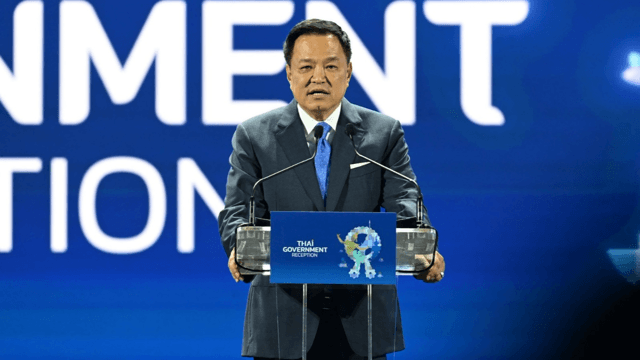
The new Thai government under Prime Minister Paetongtarn Shinawatra has vowed to resume negotiations to settle maritime disputes with Cambodia and pave the way for tapping the abundant hydrocarbon resources in the Gulf of Thailand.
Declaring her government’s policies to Parliament on September 12, Paetongtarn said that the negotiations on the overlapping claims areas (OCA) with neighboring Cambodia were aimed at achieving energy security and reducing costs.
Differing continental shelf claims since the 1970s have created an overlapping area of 26,000 square kilometers in the gulf, which potentially contains up to 11 trillion cubic feet of natural gas and 500 million barrels of condensate and oil.
Thailand and Cambodia signed a memorandum of understanding (MOU) regarding the areas of their overlapping maritime claims to the continental shelf in June 2001 to settle the dispute and jointly develop and share the benefits of petroleum production.
Both sides have, however, failed to achieve any progress over the past 23 years due to technical issues, political difficulties, and internal and international conflicts.
The Pheu Thai Party-led government under billionaire Srettha Thavisin had espoused the same policy, but failed to make much headway over the past year to jump-start talks with Cambodia due to resistance from a conservative faction in his government.
In June, Palang Pracharath Party deputy leader Paiboon Nititawan petitioned the Constitutional Court for a judgment on the constitutionality of the MOU.
Article 178 of the 2017 Constitution requires a treaty signed with a foreign country or international organization that makes changes to territory and impacts economic and social security to get approval from Parliament.
Paiboon said the 2001 MOU had never been approved by Parliament before the signing, and hence it was legally void from the beginning.
He asked the court to nullify the MOU and told the Foreign Ministry to take responsibility for violating the constitution.
Court rejects petition
Soon after Pheu Thai dumped a Palang Pracharath faction led by General Prawit Wongsuwan and Paiboon from the coalition, the Constitutional Court on September 4 ruled 6:3 to dismiss Paiboon’s petition. The court said he did not have the constitutional authority to approach the court.
While the court did not rule on the key issue of contention whether such a document needed to be approved by Parliament before negotiations, the decision has allowed Paetongtarn’s government to pursue a deal with Cambodia.
In the next step, the government needs to set up a Joint Technical Committee, made up of representatives of all relevant agencies and experts on legal, sea boundary, and energy to resume talks with Cambodia, according to an official at the Foreign Ministry.
However, there will be hurdles ahead as ultra-nationalist groups have not given up their hopes of derailing the negotiations on the OCA.
They argue that they fear loss of territory and suspect conflict of interest.

Graphic by Thai Foreign Ministry
In a Facebook post, former senator Somchai Swangkarn accused the Paetongtarn government of dealing with Cambodia to extract petroleum resources in the area for the benefit of her family and its cronies in exchange for sea territory.
In 1972, Cambodia unilaterally claimed a continental shelf in the Gulf of Thailand without legal legitimacy, therefore there was no overlapping area to negotiate, he said.
“We must insist on our territorial integrity over the area, notably Koh Kut, that is the only truth,” Somchai said.
He was among the nationalists who had raised territorial disputes with Cambodia when Phnom Penh proposed the Hindu temple of Preah Vihear be listed as a UNESCO World Heritage Site in 2008.
This ignited a series of border clashes between the two countries and severely hurt bilateral ties.
Senator Chib Jitniyom argued during a Parliament session on September 12 that such bruised nationalism could jeopardise negotiations to settle the maritime dispute as well as the good relations between the countries.
“I believe these things need to be handled cautiously, as they are precarious matters that could affect international relations.”
“Therefore, speaking carelessly just for amusement could create difficulties in negotiations,” he warned.
Chib urged Paetongtarn’s government to be ready for compromise and seek realistic ways to engage with Cambodia for the sake of mutual interest and economic development.
"The best approach for our discussions is to seek compromise and negotiations, as the relationship between Thailand and Cambodia has significantly improved at the moment,” he said.
Energy beyond boundary
The 2001 MOU determined that the two countries would accelerate negotiations for a joint development regime in the areas below latitude 11 degrees North and delimitation of the territorial sea in the area above the latitude 11 degrees North.
They will also establish a Joint Technical Committee to facilitate the two objectives.
The stumbling block is a stipulation in the MOU that the negotiations for joint development areas and delimitation of the territorial sea must be conducted simultaneously as an indivisible package.
Many senior officials in government believe that addressing the demarcation of the sea boundary and establishing the joint development scheme at the same time would be an uphill task
Finance Minister Pichai Chunhavajira told Parliament on September 12 that he preferred to focus only on the joint development of hydrocarbon resources. “It might take us at least 50 years to settle the territorial disputes, but we don’t have such a long time as fossil fuel could be obsolete within perhaps 30 years,” he said.
Pichai, who is also deputy PM, echoed the thoughts of former PM Thaksin Shinawatra who suggested in August to drop the boundary issue in the negotiations with Cambodia and focus only on the joint development scheme, as Thailand had done with Malaysia in the 1970s-1980s.
Pichai said that Thailand badly needed this source of energy to reduce its dependency on natural gas imports, which accounted for more than 60 per cent of the total gas supply.
Gas is the main fuel for electricity generation in the country.
As of July, Thailand imported liquid natural gas at 443 baht per million BTU, while the price of natural gas from the Gulf of Thailand was 201 baht per million BTU, according to the Energy Ministry.
If Thailand could extract petroleum resources from the OCA, it would reduce electricity price to below 3.50 from the current 4.18 baht per unit, Pichai guaranteed.