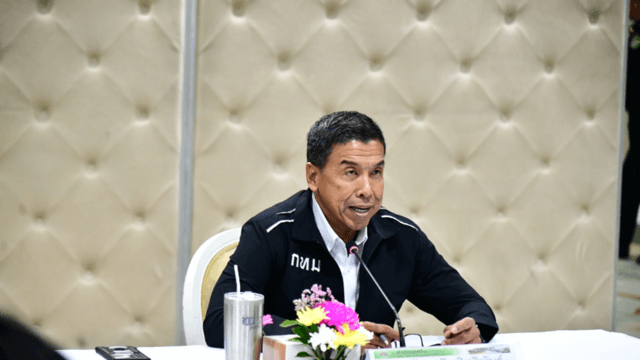



Amid the many natural disasters that have struck Thailand over recent decades, one community stands out for robustly defending its inhabitants against floods, fires and landslides: Koh Khan in Nakhon Si Thammarat’s Cha-uat district.
“We have drawn up response plans and rehearsed them, so we know exactly what to do when disaster actually strikes,” said Komest Thongbunchu, chair of the Nakhon Si Thammarat Disaster Management Network.
Model disaster management
Komest said the most important lesson from disaster situations is that the affected people must take responsibility for getting out of difficult circumstances.
“That’s the first step. As soon as they are aware of this fact, authorities and agencies can step in to educate them about skills and knowledge [needed to handle disasters],” he said.

Komest’s network holds disaster-response training for communities and encourages them to form networks to reduce disaster risks and boost responses.
“We teach them how to identify at-risk locations, as well as muster points and potential evacuation centres,” he said.
His network has over 20 years’ experience, not just in its home province but also in other parts of Thailand. In 2006, his team helped out at Uttaradit’s Laplae after 87 residents there died in flash floods and landslides.
In 2021, it reached out to victims of Nakhon Ratchasima’s huge floods, while last year, it conducted rescue and relief operations when heavy rain submerged communities in the South.
More recently, on September 9 Komest’s team travelled to Chiang Rai’s Mae Sai district to help rescue locals stranded by a deluge after Storm Yagi.
“We were given the job of helping people in the Maikhon community, where ferocious water currents made access by boat impossible,” he said.
Instead, his team devised an ingenious solution to rescue the 32 stranded residents – using a kilometres-long rope to guide them to safety through the torrential flood.
Born of the tsunami
Komest said his network formed in the wake of the 2004 tsunami, which decimated coastal areas of many southern provinces, including Nakhon Si Thammarat.
“Volunteers initially acted on their own, without any guidance or knowledge of disaster management,” he said.
Fortunately, the Thai Health Promotion Foundation (ThaiHealth) came forward and offered to back disaster-training sessions.
These spawned the formation of several disaster-management networks across Thailand.
ThaiHealth now supports the Nakhon Si Thammarat Disaster Management Network (NDMN)’s ongoing efforts to establish disaster management training centres across the country.

And Koh Khan has been chosen to pilot this initiative, said ThaiHealth’s Nisa Rattanadilok Na Phuket.
NDMN has 78 volunteer trainers, along with more than 500 volunteers and over 30 networks for disaster management and response across the province.
Their operations have also expanded as more people and communities join the network. In the South alone, more than 379 volunteers have joined their cause, along with another 262 in other parts of the country.
Preparing communities
Komest said that once people and communities are well informed, they can take effective steps when facing an impending natural disaster.
For example, they can stock up on necessities like food and find a safe place to evacuate to.
“Apart from teaching people to take care of themselves, we also encourage communities to take care of their neighbours and surroundings,” he said, pointing out that communities are closely-knit units.
Komest explained that it was not difficult to talk people or entire communities into taking care of themselves and making necessary preparations.
“But relevant authorities must also help by getting them started and providing support where needed,” he said.
Whenever a disaster looms, every subdistrict in his network is allocated 200,000 baht for basic supplies, food, water and petrol. Team members then check all maps, review relevant information and ensure they are ready to help.
“Our team members are trained to read telemeters [used to measure distances] and check reliable websites for useful information,” Komest said.
He added that his network also sets up command hubs to direct operations via subdistrict-level disaster management centres.
In Cha-uat district, muster points and main evacuation centres have been identified and publicised, so people know where to go in times of disaster. “We have also set up a system to share warnings in case the mobile phone signal goes down,” he said.
Grassroots warning system
After years of suffering from floods, locals in Songkhla’s Hat Yai district took matters into their own hands and set up the Southern Cities Climate Change Resilience Network (SCCCRN).
Low-lying areas of Hat Yai are regularly submerged, with floodwaters rising to critical levels in 1988, 2000 and 2010.
In 2011, to protect themselves against disaster, a group of locals installed 11 CCTV cameras over key canals, including Utapao.
They can now monitor footage from the cameras via www.hatyaicityclimate.org to get an early warning of potential flooding.
“The private sector and civilians are the key forces behind SCCCRN,” said Chakrit Phocharueng, a member of the network.
Hat Yai residents used to drive to the canal to check the water level with their own eyes, or check if the Hat Yai Municipality was flying red warning flags.

“But why go out in the middle of the night just to do that? With key data provided on the website, people can prepare in advance, without waiting for an official warning.” “People can check the data and judge for themselves,” Chakrit said.
Govt’s role
Seree Supraatid, a climate expert and chief of Magnolia Quality Development Corporation’s FutureTales LAB, urged the government to empower communities to cope with disasters by equipping them with information, support and funding.
Chainarong Setthachua, a lecturer at Maha Sarakham University, pointed out that the 20th anniversary of the devastating 2004 tsunami should serve as a powerful reminder to the government of its minimal progress in disaster management.
“Many disaster response plans have been drawn up, but they are often impractical.”
“We sometimes see warning towers erected in irrelevant areas or at temples, but they do little to inform locals of impending disaster,” he said.
Komest, meanwhile, said the best policy was for the government to empower communities to help themselves.
“When disaster strikes, nobody can reach the locals faster than fellow locals,” he said.