


This week’s election results in the United States do primarily three things: They uplift the Democrats, unnerve the Republicans, and overshadow a highly-significant opinion poll conducted just days earlier.
It is the opinion survey, carried out by the Washington Post, ABC News and Ipsos Poll that should serve as a reminder to all Thais what a bad political divide can lead to.
The opinion poll, of course, suggests Donald Trump’s rating continues to sink. But more important than that, it shows that nobody is benefiting from it, because Americans left and right have stopped trusting their government(s) due to years of cutthroat and divisive politics.
Political parties will take turn winning and losing, but the permanent loser is what is the most important element of every democracy.
Public trust in the people they choose to represent them, that is.
The opinion poll says two-thirds of the American public say the country has been on the wrong track. Respondents see the president and the two political parties as "out of touch" with their lives.
A major surprise is that America’s Democrats, despite being the opposition, get the brunt of it, with the majority of those surveyed identifying them as most out of touch. (Incredibly, sixty-eight percent agreed with the criticism, compared to 61% and 63% saying the same of the GOP and the president, respectively.
It has to be stressed that this is never a pro-Republican poll, because many findings are absolutely anti-Trump.)
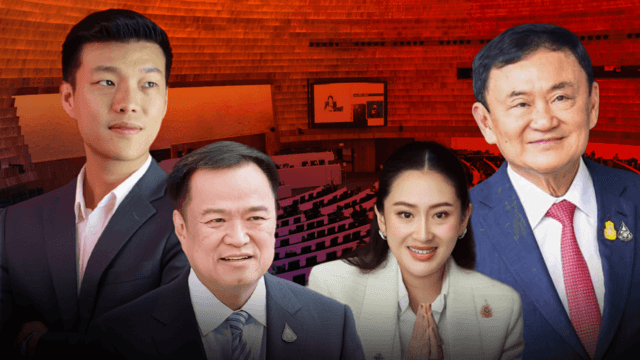
This sounds very familiar. A NIDA poll weeks ago has found that more than 27% of Thais it surveyed were undecided, the biggest portion that topped even the People’s Party’s Nutthaphong Ruengpanyawut (22.8%) and Prime Minister Anutin Charnvirakul (20.44%) of the Bhumjaithai Party.
How come the oppositions in both countries do not benefit from not being the incumbents? They should have, if the public trust that the system will give them a better future.
The answer is that in countries where “left” and “right” are badly and irreconcilably divided, people are locked inside their own echo chambers. The social media have made it a lot easier for everyone to see, read or hear only what he or she likes.
When you love one person, you see past every bad thing he or she does. When you hate one person, every good or noble thing will be downplayed or go unnoticed. As a result, a divided society does not recognize many good deeds, which are important for noble and long-lasting progress.
Not only love blinds you. Politics does it, too.
What’s worse is that politicians understand this electoral psychology so well. In order to win, they never stop promoting themselves and keep demonising their opponents. They can’t praise their rivals and vice versa.
What we get is a vicious circle that is getting more vicious each passing days. Americans are hating everything the rival camp does, some of which may be good, actually. When is the last time, for example, CNN praised Donald Trump? Have you ever heard Fox News compliment the Democrats?
In Thailand, many Orange and Red supporters are saying that they will take all the profits of the co-payment scheme but they will never vote for the Blue. The same has been happening to the “Gold Card” public health programme initiated by a Red government. A lot of people benefiting from “Gold Card” will never vote Red.
This is not healthy or productive politics good for national progress. Yet it’s happening in a “model” democracy and in a fledgling democracy alike. And bad news is that the worst is yet to come for both.
Is America rolling toward another Civil War? That used to be a cynical and not-too-serious question, and many said it was more worrisome in Thailand.
Now, the question causes a real alarm and Thailand can consider itself lucky because divisive politics never forces its government to shut down leaving a countless number of people without salaries and struggling for food aid simply because rival politicians cannot agree among themselves.
Who should learn from whom, then? At the height of the Yellow-Red showdown, America should look at what happened in Thailand. Today, it has to be the other way around.
The first thing to ponder is the winner-take-all concept America has been trying to sell to the rest of the world.
Is Trump a bad president in a good system? Or is it vice versa? This week’s election results in the United States indicates that the voting public might be believing that the former is the case.
Or the voters just don’t have a choice.
Thailand’s constitutional amendments have taken place throughout modern history and they have gone back and forth in favoring one side or the other in the long-standing political divide. But the changes have revolved around the concept of winner takes all without fail.
Maturity and patience are needed, according to western preachers. Truth is that the higher the stakes, the lower the maturity. To add to that, divisive and cutthroat politics never allows patience.
So, what system best suits Thailand, which is considering changing its highest law yet again? America’s? Even Trump and Kamala Harris would say don’t try.
The European ones? The likes of France and United Kingdom are changing governments for fun and that is a main reason why their economies are not ones to envy.
A logical thing for Thais to do is simple. It’s like getting dressed. Copy others at your own peril because their “fabulous” clothes may look very disastrous on you.