


We all forget things from time to time, like blanking on someone’s name, searching for our glasses while they are perched on our head or misplacing our phone. This normal forgetfulness can happen to all of us once in a while and is usually not a serious memory problem. But when it happens too often and begins to affect daily life, such as getting lost in a place we know well or repeatedly forgetting that we have just eaten, that forgetfulness could be a sign of memory loss.
To celebrate World Alzheimer’s Month, a global awareness campaign held every September, Thai PBS World is covering issues related to dementia and Alzheimer’s disease, the most common form of dementia, which affect memory and thinking and the ability to perform daily activities. The aim is to promote better understanding and raise awareness about these conditions as Thailand is officially in an aged society.
“People are living longer than ever before. Women tend to live longer than men. And dementia is more common as people grow old,” Dr. Thanin Wechanpinan, deputy director-general of the Department of Medical Services (DMS), told participants at a seminar on the theme ‘Long Life, Bring Mind’ organised by the Neurological Institute of Thailand (NIT) in Bangkok early in September.

According to the doctor, an estimated 680,000 people in Thailand are living with dementia. Of these, Alzheimer’s disease may contribute to over 500,000. The number of people living with dementia is expected to grow to 1.17 million within the next few years and to 2.4 million in 2050.
A survey revealed that a large number of older adults have not gone through cognitive screening to look for early signs of Alzheimer’s disease or other types of dementia. Access to suitable healthcare services and treatment for individuals with dementia remains restricted.
“Memory problems in older adults are often overlooked. That’s a barrier to receiving proper treatment,” he said.
Dementia and Alzheimer’s affect not only the individuals diagnosed but also the entire family. On top of that, caring for someone living with these conditions can be costly.
A study by Siriraj Hospital’s Faculty of Medicine found Alzheimer’s disease and related dementia care costs range from 388,246 to 1,039,634 baht per person per year. More than 90% of people living with Alzheimer’s and related dementia are cared for at home by family caregivers who spend, on average, 207 hours per person per month.
Around 4-8% of caregivers said they decided to leave their jobs to fully care for someone with Alzheimer’s or another form of dementia. About 59% of them report suffering from very high levels of stress, and more than 30% are found to be at risk of developing depression and anxiety.

Screening and early detection for dementia: Why they matter
Dr. Thanin noted that cognitive screening and early detection for dementia and Alzheimer’s are vital for timely intervention, which will have an impact on the quality of life of the patients themselves and family caregivers over the long term.
“When older adults ask the same questions over and over again, or they often forget that they have eaten meals due to short-term memory loss, these are signs that it’s time for them to talk to a doctor,” he said.
The doctor urges family caregivers to observe the elderly carefully and watch for changes in their memory to ascertain whether their forgetfulness is related to age or more serious memory loss. He is also calling on the public to arm themselves with health literacy skills so as to be able to support older adults living with dementia and Alzheimer’s disease in the community.
In addition to loss of cognitive function, individuals with dementia may have problems with language skills and a loss of behavioural abilities.
Dr. Thanin noted that the DMS supports using blood tests as a tool to help diagnose Alzheimer’s disease, saying the procedure can be cost-effective and is less invasive than cerebrospinal fluid (CSF) biomarker testing that has been used to investigate Alzheimer’s disease in the early and dementia stages of the disorder for many years.
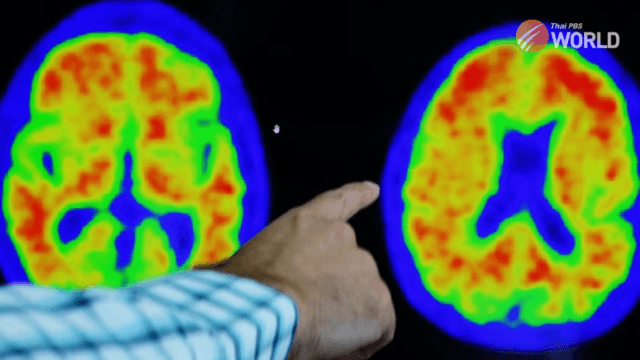
However, while CSF is included in the guidelines for diagnosis of dementia, it’s not widely accessible for most patients as the service remains limited to leading hospitals. PET scans, meanwhile, can be more expensive.
The doctor urges individuals aged over 55 to undergo a psychological test, which is used as a screening tool to assess cognitive function. The testing service is offered at general hospitals and covered by Universal Health Coverage Scheme or the so-called a 30-baht gold card scheme, social security benefits and the civil servant medical benefit scheme.
He said individuals with low scores on the cognitive test may be referred to a leading hospital for further evaluation, explaining that doctors use several diagnostic tools together with medical history and other information, cognitive and functional assessments, CSF, PET scans, or blood tests to make an accurate diagnosis.
“Take the test when you qualify to do so. Don’t wait for symptoms to appear,” Dr. Thanin said.
He also recommended some techniques that may help people stay healthy and deal better with changes in memory and mental skills.
“Eat well, exercise, and learn a new skill which can boost memory and cognitive function,” he said
Dr. Thanin stresses that early detection and timely treatment can affect both individuals with dementia and the family, saying it can enhance the patient’s quality of life and allow them to lead a meaningful life, while maintaining dignity and independence.

Committed to improving care services
The NIT’s director Dr. Anek Kanoksilp noted that the CSF biomarker testing and PET scans can be complicated and expensive. In addition, the services tend only to be offered at leading hospitals.
These barriers can keep people from receiving diagnosis and care, he said.
The institute has implemented blood-based biomarker tests for p-Tau217 / p-Tau181 as part of its diagnostic tools for dementia. This procedure can be less costly and is quicker and provides more accessible diagnoses for individuals and families affected by Alzheimer’s.
Dementia and Alzheimer’s: what’s the difference?
Dr. Tasanee Tantirittisak at the NIT said that the two terms have different meanings, explaining that dementia is an umbrella term that describes a wide range of symptoms characterised by a decline in memory, changes in thinking skills, poor reasoning skills and changes in behaviour. Alzheimer’s, meanwhile, is a disease in the brain.
“Let’s imagine dementia as the mango. So, Alzheimer’s disease could be a khiew savoey, a type of mango. Put simply, Alzheimer’s is the most common disease that causes dementia,” she said.
That said, dementia is a collection of symptoms that can be caused by many different diseases, not just Alzheimer’s. However, Alzheimer’s is the most common type of dementia, accounting for 70-80% of dementia cases.
She explained that amyloid plaques form in the brains of individuals who have Alzheimer’s and this can lead to problems with brain function. Excessive buildup of amyloid is closely linked to Alzheimer’s disease and other forms of cognitive decline.
It’s still unclear what actually causes Alzheimer’s. It may have something to do with the amyloid protein deposit in the brain. Individuals with Alzheimer’s have deposits of these proteins.
Dr. Tasanee said studies indicate that sleep disturbances can lead to increased levels of beta-amyloid in the brain. Stress may be a factor in its development and depression is also linked to Alzheimer’s.
According to the doctor, there is no cure for Alzheimer’s. However, medications may improve symptoms and slow decline in thinking. In the early stage of Alzheimer’s, individuals may have memory and thinking problems or mild cognitive impairment (MCI).
Individuals with MCI are still able to take care of themselves and go about their normal daily activities. They are also at a greater risk of developing Alzheimer’s disease or related dementia.
Improving the quality of life of people with memory problems
With Thailand now a full-blown aged society, dementia should be high on the national agenda, Dr. Tassanee said, urging state agencies to put their heads together to create a safe environment for individuals with dementia, Alzheimer’s and MCI.
The Ministry of Interior, for example, should work to create a safe community. The Ministry of Social Development and Human Security, meanwhile, should provide support for caregiving and consider caregiving welfare. The Ministry of Natural Resources and Environment may need to work harder to ensure cleaner air by tackling air pollution, including the dangerous fine dust known as PM 2.5. Long-term exposure to PM 2.5 has been found to be associated with higher rates of dementia.
In addition, blood-based biomarker tests may need to be included on the list of dementia screening tools covered by basic healthcare benefits for cost-effectiveness. Individuals with mild to moderate dementia should be registered as disabled, giving them the right to receive assistance from the government to enhance the quality of their lives. Development of a support system for daycare centres for dementia and providing support to dementia associations are also of paramount importance.
To help protect the brain, the doctor advises eating balanced meals and staying physically active as well as challenging the brain by learning new skills. Sleeping well is also vital, the doctor noted, saying it’s a major driver of waste clearance from the brain, which could help ward off dementia.
She also urges practising letting go, which can bring happiness and peace and managing stress effectively, noting that cumulative stress can lead to a significant impact on your emotional and physical health and affects the brain.
“Cultivate these habits. It could help to protect your brain from dementia and Alzheimer’s,” Dr. Tassanee said.