


As heavy monsoon rains hit Thailand, a humble district in Ayutthaya is once again sacrificing itself to save Bangkok from devastating floods.
Low-lying Bang Ban has served as a flood-retention zone since 2017, protecting downriver cities like Bangkok from being submerged during the six-month rainy season.
However, locals say the floods are worsening year after year, leaving them struggling to survive as their communities disappear beneath water for months on end.
“People say we should get used to floods because we live in a water-retention zone. But how can we when the floodwaters keep rising and the floods last longer?” asked Sawas Sanyawiri, a village head in Bang Ban.
In the past, floodwaters in the district rose no higher than two metres and usually lasted only a couple of months, he said.

File photo: Sena district, Ayutthaya
“Now, floods are several metres high, sometimes submerging the second floor of our homes. This nightmare lasts at least three months every year,” said Sawas, questioning authorities’ water-management strategy.
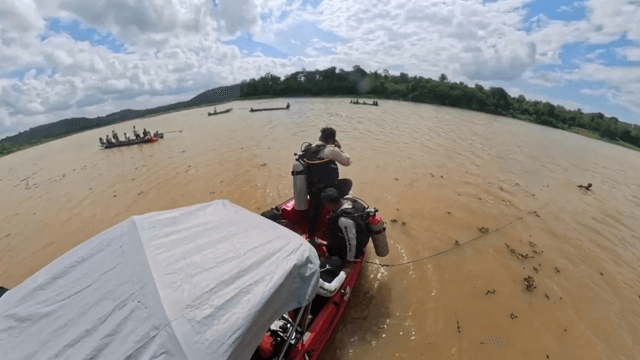
The Chao Phraya and Noi rivers have been overflowing in Ayutthaya since August, with massive volumes of runoff diverted into Bang Ban and neighbouring areas.
While some residents have evacuated to higher ground, others have chosen to remain in their half-submerged homes, sleeping on raised platforms.
Sawas is among those who stayed. He sleeps on a platform that nearly touches the ceiling and rows himself out of a window whenever he needs to leave the house.
Compensation falls short
The government has offered compensation of 9,000 baht per flood-affected household in Bang Ban. Farmers whose land is submerged can claim 1,000 baht per rai, up to a maximum of 10,000 baht.
“These remedies are far from adequate. We cannot support ourselves while cut off by floods, and when the waters recede, we have to spend time and money repairing our homes,” Sawas said.
He also questioned why some sections of the district remain dry while others are sacrificed to the floods.
Sawaeng Janpitak, a 77-year-old Bang Ban resident, said she had got used to the flooding over the years but was now weary of the annual deluge.
“This problem hits us every year. Why don’t the authorities fix it?” she asked, adding that the floods had plunged her family into a life of misery.
In neighbouring Sena district, a 74-year-old woman said her home had been underwater for over two months, and she has now developed a fungal infection on her feet.
“I am upset because I have received hardly any help,” she said, complaining that relief packages are not distributed fairly, with some households getting more than others.
One-fourth of Ayutthaya’s total area, including Bang Ban and Sena, serve as water-retention areas under Thailand’s flood-management strategy.
With Ayutthaya about an hour north of Bangkok, their strategic function is to store surplus water temporarily to protect economic hubs downstream, especially Bangkok, from being inundated.
“Water-retention zones are necessary to protect the capital from floods,” said Supachai Mapol, director of the Royal Irrigation Department (RID)’s Phak Hai Operation and Maintenance Project.
Farmers living in the retention zones are advised to harvest their crops by September 15 every year.
However, some respite may be in sight: Supachai said the flooding should ease once the drainage canal being built between Bang Ban and Bang Sai is completed.
“This RID project is nearly 95% complete and should speed up the drainage of water through Ayutthaya,” he said.
The government has fast-tracked the Bang Ban-Bang Sai canal’s construction amid the worsening flood problem.
However, locals like Sawas doubt the project will end Ayutthaya’s annual flooding. He said the Royal Irrigation Department has yet to offer a clear explanation of how it will divert the large volumes of water from Bang Sai.
“If downriver areas don’t expand their capacity, the extra water will still hit a bottleneck. Digging a new canal won’t help much if those areas can’t absorb more flow,” he said.
Management gaps, uneven inundation
Asst Prof Dr Arthit Thongin, a civic rights expert who lectures at Sukhothai Thammathirat Open University, said that runoff is not being managed or channelled evenly across the retention areas. Roads sometimes act as floodwalls, meaning some communities are protected while others flood, he added.
“That’s why some parts are completely submerged, while others stay dry.”
He added that while locals understand they live in low-lying, flood-prone areas, they expect better water management and drainage so they don’t have to suffer flooding for months on end.
“People also want the authorities to provide fair compensation. Currently, the Finance Ministry only covers damage to homes, while ignoring lost income and disruption to education.”
Arthit added that, despite knowing Ayutthaya’s water-retention areas flood annually, the government does not set up shelters for vulnerable residents in advance.
He also noted that while several flood-prevention projects are planned for the lower Chao Phraya Basin, only one – the drainage canal – has made headway so far.
What more can be done
Assoc Prof Seree Supratid, director of the Centre for Climate Change and Disasters at Rangsit University, warned that Ayutthaya’s yearly flood crisis will continue unless Thailand’s flood-management strategy is overhauled.
“The government should have a clear, efficient plan to handle large runoff volumes from upstream sources,” the climate expert urged.
He also called on the government to urgently create permanent water-retention areas further North before runoff reaches Nakhon Sawan, where the Chao Phraya River begins.
“The government should expropriate land and relocate residents to create new water-retention zones.”
He added that AI and predictive modelling could be employed to improve water management.
Nine major water-management projects have been planned to tackle the chronic flooding problem in the lower Chao Phraya Basin, which encompasses Greater Bangkok.
These include the Bang Ban-Bang Sai drainage canal, expansion of the Tha Chin River’s capacity, and a 95-billion-baht project to upgrade irrigation system in the eastern part of the basin.