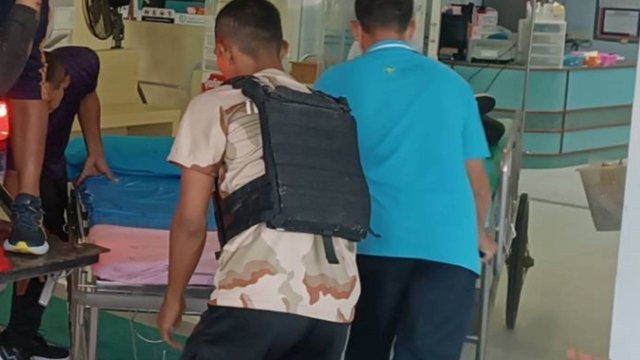



Despite their role of treating patients, medics are often subject to violent attacks by the very people they are trying to help. The latest victim of this disturbing trend was a nurse at Rayong Hospital.
Security camera footage shows a man walking into the restricted area behind the nurses’ counter and slapping a female nurse at the intensive care unit where his mother-in-law was being treated for a severe case of influenza.
The incident occurred on February 16 after the nurse had warned the man that children were not allowed in the ICU zone. Her attacker and his wife had brought along three young kids to visit their elderly family member. The 26-year-old nurse wants the man prosecuted for the attack.
“I will bring him to justice,” she vowed.
The hospital, Public Health Ministry, and several medical associations have spoken out to condemn violence against medical staff while supporting the nurse’s decision to take legal action against her attacker.
Police have charged the 46-year-old attacker on two counts, including assaulting an official on duty. If convicted, he faces up to three years in jail and/or a fine of up to 60,000 baht.
Many assaults unreported
A 2023 survey published by the Journal of Thailand Nursing and Midwifery Council found that 51.4% of healthcare workers in emergency and ICU departments have experienced violence from patients or their families.
The most common form was verbal abuse (46.0%), followed by physical violence (30.6%), and psychological violence, such as unauthorised recording of images, audio, or video (29.7%).
Registered nurses experienced a higher prevalence of violence (53.2%) compared to other healthcare workers (46.9%). Emergency unit workers reported higher rates of violence (74.2%) than those in ICU (42.5%).
The underlying causes of violence included alcohol or drug intoxication (63.2%), long waiting times for treatment (56.1%), medical conditions (50.9%), and poor communication (40.4%).
However, only 12.3% of victims reported the incidents. Reasons for not reporting included the belief it would make no difference (48.0%) and being too busy with other tasks (40.0%).
Impacts of violence
Most medics said their confidence and job satisfaction dropped after facing violence at work, prompting them to consider quitting or changing workplaces. In most cases, they reported that their performance also declined and their risk of making errors increased. However, 77.2% said they tried to improve their performance in a bid to prevent future problems.
The survey came with recommendations, urging medical administrators to better protect nurses and other health workers against violence by developing preventive policies and implementing specific risk management guidelines.
It emphasised this was particularly important in situations involving clients under the influence of alcohol or drugs, or in crowded settings with a high volume of clients. It said training nurses and other health workers to communicate effectively was also crucial for fostering a safe and supportive work environment.
Meanwhile, the wife of the Rayong Hospital attacker has acknowledged that her husband was wrong to slap the nurse, but said she hoped that medical workers would speak more kindly to patients or their relatives.
“I know nurses work really hard. But please think of patients’ relatives too. We are in a difficult situation,” she told media. “I don’t know whether my mother will make it.”
Her comment attracted a wave of support from social media users, some of whom complained of harsh treatment by medics at some state hospitals.
‘No excuse for violence’
The Thailand Nursing and Midwifery Council said no matter what issue, all parties should abide by the rules and never resort to violence. It pointed out that if the patient’s relatives were upset by the nurse’s words, they should have raised the issue with her supervisor to resolve the conflict.
The young nurse says she is now suffering from stress as a result of the attack.
Meanwhile, her case has underscored the need for employers to do more to ensure the safety of medical workers, with data showing that violence at medical facilities is on the rise.