


The Provincial Waterworks Authority (PWA) has moved to reassure the public that tap water across five key service areas in Chiang Rai contains arsenic at levels well below international safety thresholds, even as local farmers continue to battle the sweeping fear among the public that contamination of crops is real, which is, in turn, hurting the province's agricultural produce market.
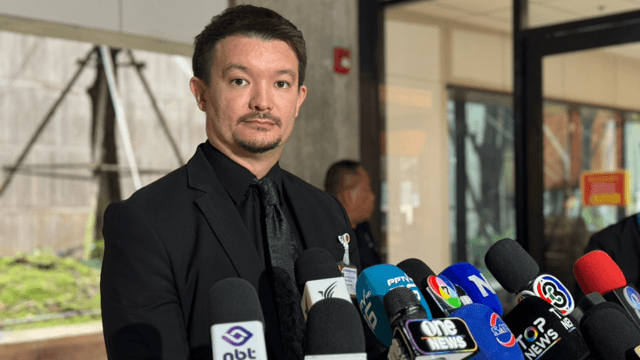
At a public demonstration, held at the Chiang Rai PWA water production station on Wednesday, officials tested tap water samples using field kits to demonstrate the water’s safety to residents.
Nimit Pinthanee, manager of the PWA’s Chiang Rai branch, said that the authority operates six branches covering 10 districts across the northern province and strictly adheres to World Health Organization (WHO) drinking water guidelines.
According to Nimit, water quality was tested 48 times last year and is currently monitored four times a month, twice at central laboratories and twice at local PWA facilities, with no readings exceeding safety limits.
Recent average arsenic levels recorded across five locations were all well under the maximum allowable limit of 0.01mg/L, registering at 0.0031 mg/L at the Chiang Rai branch, 0.0049 mg/L at the Mae Sai branch, 0.0026 mg/L at the Koh Chang station, 0.0027mg/L at the Chiang Saen station and 0.0039mg/L at the Wiang Chiang Khong branch.
The PWA also offered technical advice on water testing and production systems to community-run waterworks in surrounding districts.
Despite assurances over tap water, agricultural leaders say public anxiety is damaging the reputation of Chiang Rai’s farm sector.
Thanaratkorn Suwannaprakarn, chairman of the Mae Sai District Farmers Council, said widespread generalisations have led consumers to assume that all crops from Chiang Rai, particularly rice, are contaminated, even though most farmland does not draw water directly from affected waterways.
He urged state agencies to demarcate clearly high-risk and safe agricultural zones to restore buyer confidence.
Over the longer term, he called for alternative water sources and urgent talks with neighbouring countries and mining investors to prevent toxic sediment from accumulating and threatening farmers' livelihoods.
Concerns have also rippled beyond the province, with shoppers at Municipal Market 1 in Phitsanuloke’s Muang district admitting risk of water being contamination has left them unsure about the safety of fresh vegetables sold in markets and served at local restaurants.
Meanwhile, Industry Minister Varawut Silpa-archa announced stricter regulatory measures to prevent foreign mining operators in Myanmar from using Thailand as a transit corridor for minerals.
In a post on his official Facebook page, Varawut said he has instructed his ministry to draft a new ministerial announcement governing the import, transit and export of regulated minerals.
Under the first measure, the ministry plans to add antimony, lead, copper, gold and rare earth elements to the controlled import list, following a sharp rise in import volumes over the past two to three years.
The second measure requires import applicants to submit documentation specifying exact mine coordinates, so authorities can use geospatial technology to inspect sites and assess environmental impacts.
The third measure focuses on monitoring chemicals used in smelting and regulating the export of ore-dressing agents from Thailand, such as cyanide.
The draft regulation is currently the subject of public hearings via the government's central legal portal, before being submitted to Cabinet for approval, with enforcement expected by late January next year.