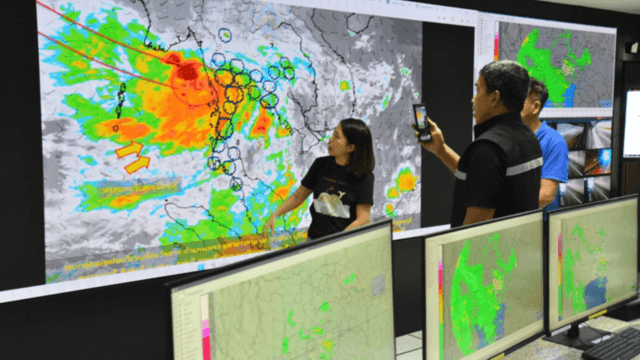



The flood situation in Bangkok appears to be stabilising and is unlikely to worsen, according to a water resources expert at Kasetsart University’s Faculty of Engineering.
Asst Prof Sitang Pilailar, a lecturer in the Department of Water Resources Engineering, said heavy rain is expected to shift towards western and lower northern parts of the country.
She wrote on her Facebook page yesterday that Bangkok is likely to remain relatively stable, with no further significant deterioration expected.
Heavy rain is forecast in the west, particularly Kanchanaburi, as well as Suphan Buri and parts of the lower North, including Tak, Nakhon Sawan and Uthai Thani.
Rain is also expected to continue in the eastern region, with Sa Kaeo and Prachin Buri requiring particular attention, she said.
For Rangsit, water levels are expected to fall as water drainage into the area has been reduced, giving authorities more time to pump the water out and allow the area to dry, Sitang said.
She said the Chao Phraya Dam is likely to increase its discharge rate from the current 1,950m³/s to about 2,300m³/s, with a possible peak of 2,500m³/s, depending on rainfall in the coming days.
The expert said rainfall over the past 24 hours had been particularly heavy in Bangkok, with several areas recording more than 100mm.
These included Bang Na, Bang Kapi, Bang Bua, Bang Khen, Chatuchak, Lat Phrao and Don Mueang.
The widespread and heavy rainfall has filled canals across Bangkok, with the Saen Saep Canal among those experiencing overflowing water.
High tides exacerbated the situation, causing water levels to continue rising as rain persisted, she said.
Bangkok, the Central Plains and nearby provinces, including Phetchabun and Prachuap Khiri Khan, were expected to see more rain on Saturday. Rainfall should decrease today, with the overall situation gradually returning to normal after the weekend, she said.
Sitang also cited results from the Royal Irrigation Department's modelling, based on rainfall forecasts from the Meteorological Department, which indicate that the discharge rate from the Chao Phraya Dam may need to be increased.
She said the rate is likely to be increased gradually from 1,950 to 2,300m³/s, rather than by several hundred cubic metres per second all at once.
In Nakhon Sawan, upstream of the Chao Phraya Dam, water levels caused by backflow are expected to be similar to those recorded last year, she said.
Main photo: Vibhavadi Rangsit Road, September 26.