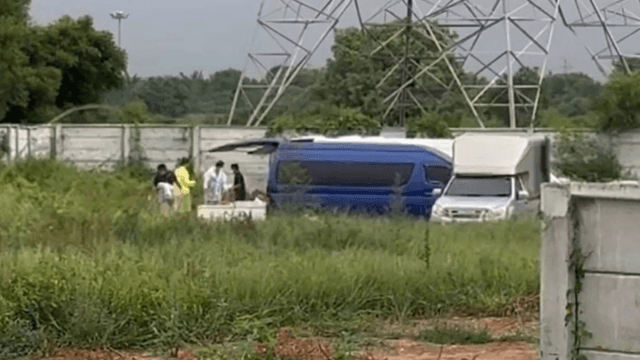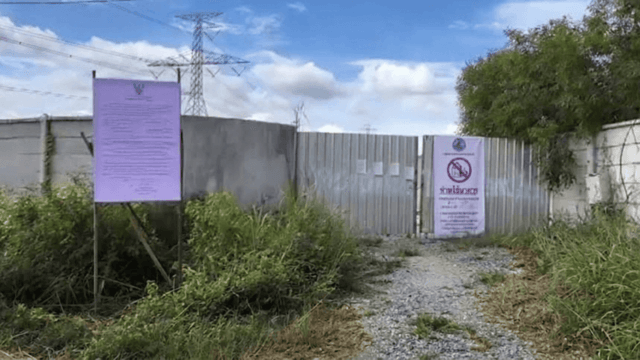



Authorities have uncovered four graves during an inspection visit yesterday to a 0.96 hectare plot in Bang Khla district of Chachoengsao province, following complaints that a private operator was operating an unauthorised Jewish cemetery near a school and community water sources.
The inspection in Moo 2, Samet Tai sub-district, was carried out by administrative officers, sub-district headmen and village chiefs. Access to the private property was restricted exclusively to official personnel, while local residents and media representatives were barred from entering the site.
Authorities spent approximately 20 minutes inside the premises and subsequently confirmed the presence of four graves. One was near the rear perimeter fence, marked with a headstone, while the other three covered by a large tent.
Namphueng Khamsa-ard, the sub-district headman of Samet Tai, stated that she believes three of the bodies were buried recently without proper authorisation.
She noted that, unlike established graves framed in concrete and lined with stones, these three graves featured temporary handwritten name markers and were shielded under a tent to conceal them from public view.
Kittipong See-Leung, mayor of the Samet Tai Sub-district Administrative Organisation, stated that preliminary findings suggest one body may have been buried before the graveyard and crematorium operating permit expired and which has not been renewed.
Authorities are now working to ascertaining whether bodies have been disposed of there since the permit expired and are preparing to file appropriate charges.
According to Kittipong, a private company initially sought permission to establish a foreign-run cemetery on the site in 2021.
Although the local administration did not grant permission at the time, due to an upcoming administrative transition, the company later obtained provincial-level documentation and erected a perimeter wall between 2022 and 2023.
Subsequent transfers of human remains to the location triggered widespread protest from residents in 2023 and 2024, who voiced deep concerns over the site’s proximity to homes, a school, a child development centre and local natural water resources.