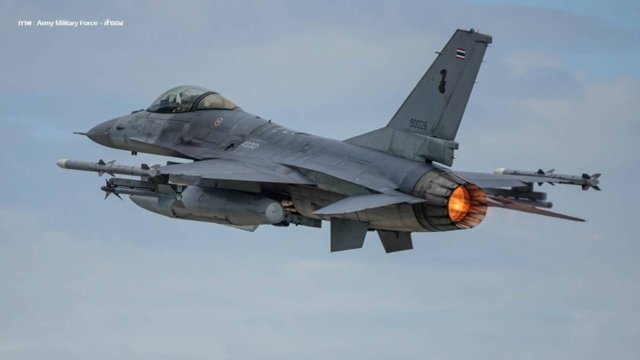



The heated exchange of rhetoric between Senator Angkhana Neelapaijit and self-made crusader Kannawat Pongpaibulwech, better known as ‘Kan Chompalang’, over his blasting the sounds of ghosts howling and fighter aircraft engines at Cambodian civilians, has provoked widespread reaction on social media, and a debate about whether such an action constitutes psychological torture.
Angkhana, in her Facebook post of October 12, referred to a letter to the UN High Commissioner of Human Rights from Keo Remy, head of the Cambodian Human Rights Commission, complaining about the loud noises being directed at Cambodians living near the Thai border in Ban Nong Chan and Ban Nong Ya Kaew, saying that they disturb the Cambodian people and that such action constitutes a violation of the UN Charter.
She said that the act may also amount to psychological torture and questioned how the Thai government could explain this at the international level.
Kan hit back, saying that Angkhana is only good at talking, while doing nothing, as Thai troops have sustained injuries from landmines and Thai territory has been encroached upon by illegal Cambodian settlers.
He accused her of being more sympathetic to Cambodians than to her compatriots, while defending his action as being non-violent and proportionately appropriate.
Today, a human rights advocacy group issued a statement, praising Angkhana for her honesty and for upholding of the principles of human rights, adding that she has chosen to speak up, with full awareness that what she said flies in the face of current sentiment in Thailand, because she believes in the truth and intends to protect the rights of all people.
The group also called on the Thai government, the army and the National Human Rights Commission to comply with international human rights laws, to stop the use of nationalist rhetoric to foment hatred and to protect the dignity of all civilians, regardless of on which side they are.
Assistant Professor Dr. Wanwichit Boonprong, a lecturer at the Faculty of Political Science of Rangsit University, said in his Facebook post that the South Korean government used such tactics, by aiming loudspeakers across the DMZ towards North Korea in 1963, 2015 and 2024, in retaliation for North Korea’s aggressive actions, such as landmine laying in the DMZ and the dumping of garbage into South Korean territory using balloons.
He noted that no countries blamed South Korea for aiming loudspeakers at North Korea.
A former Supreme Court judge and former human rights commissioner, Was Tingsamit, said he does not think that the use of disturbing sounds, like ghosts howling, constitutes a form of psychological torture under Thai or international law.
He said that the sound only causes a temporary disturbance, but did not cause pain or suffering, which could constitute a form of psychological torture.
The former judge also questioned Angkhana without mentioning her name whether the person who referred to a false accusation made by a Cambodian official to the UNHCR over the disturbing sound at the border villages should be subjected to suspicion that she is a Thai national, but her heart is for Cambodia.