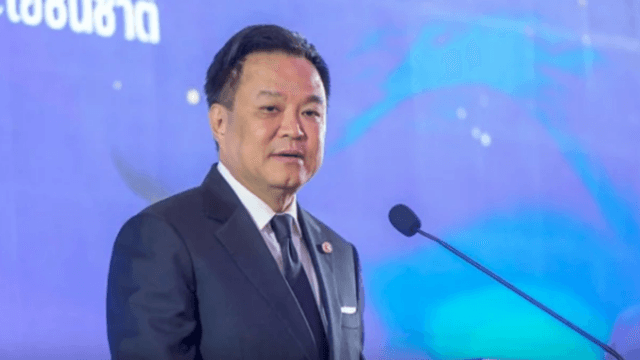
Auttapol Rerkpiboon, who is expected to take over the Energy Ministry in the new government, brings decades of expertise, having previously served as president and chief executive officer at PTT Public Co Ltd, the country’s largest energy player—a hybrid entity owned by the government but operating as a public company.
Auttapol, 60, will be the third former top executive from PTT to become energy minister, transitioning from corporate to national governance.
He spent over 30 years at PTT, including his tenure as CEO from 2020 to 2024. Auttapol’s term as CEO was marked by serious challenges caused by the COVID-19 outbreak and a general global decline in the fossil fuel business.
Auttapol currently serves on the board of directors of Kasikornbank PCL and CP Axtra PCL.
He holds a bachelor’s degree in civil engineering from Chulalongkorn University, a Master of Economics degree from the National Institute of Development Administration, and a diploma in petroleum management from the College of Petroleum Studies at Oxford University, United Kingdom.
Challenging job at the Energy Ministry
His new role helming the Energy Ministry is expected to be even more challenging than his tenure at PTT, given the broader range of national issues and the expected short tenure of the current government. Incumbent Energy Minister Pirapan Salirathavibhaga and his predecessors have been criticized for focusing only on short-term fixes such as price subsidies, neglecting deeper structural problems, which have allowed serious issues to persist.
Businesses and households have long complained about high electricity costs, with many experts blaming government policies that favor large power plants at the expense of other businesses and consumers.
There have also been allegations of collusion and corruption among regulators, politicians and private electricity providers.
The public has high expectations from Auttapol even though his tenure is expected to be only four months before the anticipated dissolution of Parliament by the minority government.
The opposition People’s Party has repeatedly raised the issue of high electricity costs in Parliament, arguing it is unfair to consumers while private electricity providers reap large profits.
Recently Gulf Energy Development PCL, one of Thailand’s largest energy firms, filed a defamation case against the People’s Party leader and prominent lawmakers, including its party-list MP Woraphop Viriyaroj, seeking a combined 300 million baht in compensation.
The company claims that criticisms of the lack of transparency and bidding processes in the Thai government's energy procurement had damaged its reputation.
Three urgent issues
Woraphop said the new energy minister and minority government must urgently prioritize three issues:
First, the government should delay the purchase of two new lots of renewable electricity—5,200 megawatts and 3,600 megawatts—from private plants. This is due to concerns about oversupply and unnecessary costs for taxpayers, with large energy firms benefiting disproportionately.
Second, the new minister should extend the solar roof electricity production program for households, allowing them to sell excess capacity back to the Electricity Generating Authority of Thailand (EGAT).
The scheme has been closed since mid-last year when the 90-megawatt household quota was achieved. “It would be unreasonable for the new government to purchase renewable electricity from private firms but not from households,” says Woraphop.
Third, the government should accelerate the implementation of the Direct Power Purchase Agreement (Direct PPA) model, which enables businesses to buy renewable electricity directly from producers, bypassing the state-run utility as the sole intermediary.
Woraphop noted that the Direct PPA was initiated as a pilot last year. The National Energy Policy Council launched the pilot in 2024, capping initial capacity at 2,000 megawatts, but so far it has not taken off.
If implemented, this would represent a significant shift from the traditional “enhanced single buyer” model, which required all power be purchased through EGAT.
Miscalculated growth and over-investment
Critics and economists have called out the current and previous governments for committing to long-term electricity purchases from private producers, despite real demand being much lower.
The government is then forced to pay an “availability payment” to power plants even when they do not operate, in exchange for power security.
Miscalculations in the growth of the economy and the demand for electricity have led to over-investment, with allegations that politicians have made overly favorable deals with private firms.
Repeated calls have been made for the current energy minister and his predecessors to review concessions to private power firms, but with little success so far.
“The new minister may need to renegotiate with power firms, but it will not be easy,” says Prof. Praipol Koomsup, an independent economist closely following the energy sector.
By Thai PBS World’s Business Desk