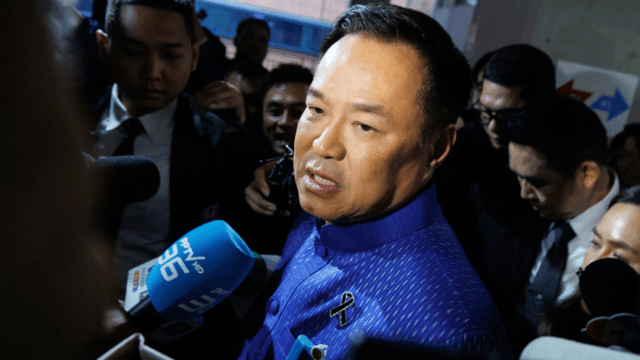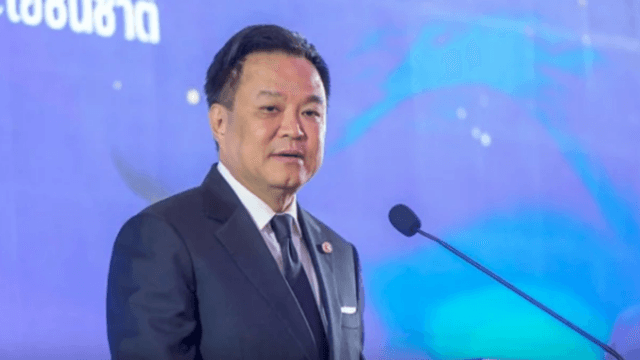



Election fever has seized Thailand’s political parties after Prime Minister Anutin Charnvirakul vowed to dissolve Parliament in four months.
Anutin made the promise to the core opposition People’s Party in exchange for its support in forming a new government, after the Pheu Thai-led coalition fell following the Constitutional Court’s removal of Paetongtarn Shinawatra as premier.
Experts predict an election victory for the opposition leader, successor to Move Forward, but say Pheu Thai will struggle to win more than 100 MP seats.
The reformist People’s Party of Natthaphong Ruengpanyawut appears to have retained strong public support despite deciding to back Anutin and his conservative Bhumjaithai Party.
Bhumjaithai, meanwhile, faces the challenge of luring conservative voters away from the Democrats, who are eager to reclaim their status as the party of the elite.
Pheu Thai’s decline
Stithorn Thananithichot, a political science lecturer at Chulalongkorn University, notes that Pheu Thai’s downfall began in June when a leaked conversation between then-PM Paetongtarn and Cambodian strongman Hun Sen went viral.
Paetongtarn was accused of flattering “Uncle” Hun Sen while disparaging her own military commander, prompting Anutin’s party to quit the coalition as fighting raged on the Thailand-Cambodia border.
The Constitutional Court suspended Paetongtarn on July 1, before removing her and nullifying her Cabinet the following month. Parliament convened to choose a new prime minister, with Anutin emerging as the winner.
Stithorn said Pheu Thai had blundered in its response to the crisis.
“If Paetongtarn had chosen to resign over the leaked clip, Pheu Thai Party would be in a better position now,” he argued. Instead, she tried to deflect mounting criticism by insisting her tone with Hun Sen was a negotiating tactic while denying she had harmed the nation’s interests. Her defence failed to impress the court.
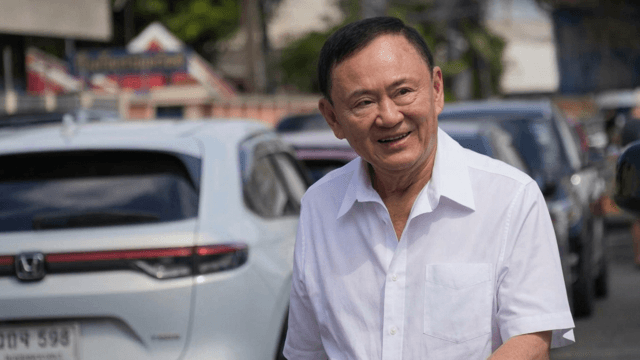
Paetongtarn’s removal left Pheu Thai in such a weak position that its de facto leader, her father and former PM Thaksin Shinawatra, had to return from a trip abroad and accept a jail term, Stithorn said.
Phumtham Wechayachai, Pheu Thai’s acting prime minister until Anutin was chosen, admitted his party would need to work hard to restore its former glory. He said Pheu Thai had suffered a series of setbacks since coming to power.
“Despite successfully forming the government, we faced numerous obstacles in pushing policies, most of which were created by our coalition partners,” he said.
Stithorn cited Pheu Thai’s poor performance in government as another reason for its declining popularity, a point Phumtham also acknowledged.
“We are re-evaluating ourselves and will do better, because we cherish the public’s trust and support,” he said.
The party is already seeking candidates for the upcoming election, according to Pheu Thai’s Somkid Chueakong. He said the plan is to field familiar faces in roughly half of the constituencies, with fresh candidates in the rest.
Asked about Thaksin’s eventual imprisonment, Somkid predicted a double-edged impact: it had shaken public confidence in the party, but also stirred sympathy among voters.
Thaksin was initially detained upon his return to Thailand in August 2023 over power-abuse convictions stemming from his 2001-2006 tenure.
However, he was moved to a Police Hospital suite for alleged health problems and then released on parole after six months following a royal pardon, meaning he avoided jail time.
The Supreme Court ruled earlier this month that his hospital stay did not count towards his sentence, ordering him to serve the remainder at Bangkok’s Klong Prem Prison.
Somkid meanwhile shrugged off concerns over Pheu Thai’s declining popularity, insisting the party has weathered ups and downs over the years and remains resilient.
Stithorn went as far to say that Thaksin’s imprisonment would work in Pheu Thai’s favour, pointing to the party’s recent win in a Chiang Mai by-election.
He also claimed that Pheu Thai would have won far fewer seats if Thaksin had fled instead of choosing to face the music. “But now that he has returned and gone to jail, Pheu Thai could win anything between 50 and 100 MP seats,” he said.
Prospects for People’s Party
Almost one in three (23.94%) Thai voters pledged support for the People’s Party in a recent national survey, with Bhumjaithai second on 14.2%, followed by Pheu Thai (11.61%) and Palang Pracharath (10.39%).
Stithorn said support for the People’s Party remained strong despite its backing for Anutin, because progressive voters had no other choice.
“There’s no alternative for People’s Party supporters, who won’t suddenly be swayed by [the conservative] Pheu Thai or Bhumjaithai,” he said.
Also, if Anutin honours his pledge to dissolve the House in four months, the People’s Party could gain extra credit and more easily promote charter amendments in its election campaign.
People’s Party MPs and members have been tasked with holding small public forums to explain their stance and policies, according to party member Wiroj Lakkhanaadisorn.
Bhumjaithai’s chance
Regarding Bhumjaithai, Stithorn said the party was not traditional enough to win the mass conservative support needed for an election victory.
“However, if Anutin’s current Cabinet contains respectable members who are not politicians, then conservative voters may be impressed,” he predicted.
In the 2023 election, former coup leader General Prayut Chan-o-cha led the ultraconservative United Thai Nation Party to win an impressive 4.6 million party-list votes.
Where are the Democrats?
Once Thailand’s main conservative party, the Democrats have lost their shine in recent years but are striving to regain their voter base.
“Recent polls show up to 21.35% of voters are undecided,” noted former Democrat MP Thepthai Senapong. “I think this group is mainly made up of conservatives who are still looking for a suitable party. As such, the Democrats could rebrand to align with conservatives again.”
What voters say
Pheu Thai appears to have undercut its status as the champion of the poor against the elitist establishment after forming a coalition government with its former political rivals in 2023.
Wimon, a 56-year-old voter, said he had switched from Pheu Thai to the People’s Party because he preferred its policies, adding he would remain loyal despite its support for Anutin.
“I will vote for it again,” he affirmed.
A deputy village chief in Khon Kaen, once a Pheu Thai stronghold, said locals were more concerned about bread-and-butter issues and would back whichever party best addressed their daily needs.
“We have voted for Pheu Thai for a long time because of its association with Thaksin Shinawatra, who is still remembered for his 30-baht universal healthcare scheme and his war against drugs,” she said, citing the introduction of universal healthcare under Thaksin’s Thai Rak Thai government.