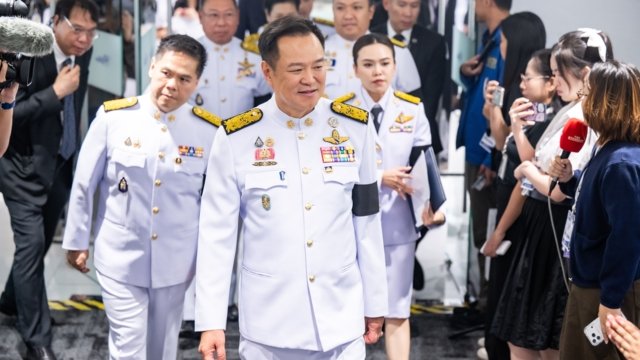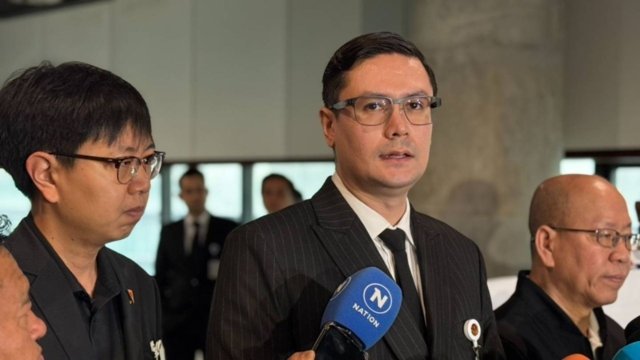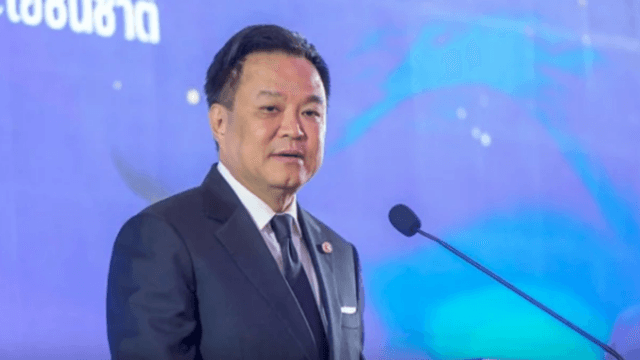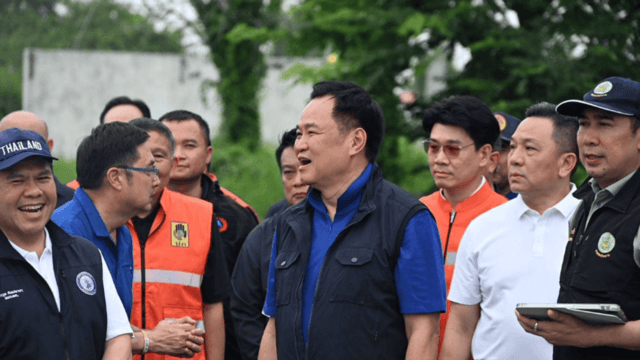



Prime Minister Anutin Charnvirakul on Wednesday left open the option of dissolving the House to pre-empt the opposition from lodging a no-confidence motion against his government.
“I play it by ear,” Anutin replied in English when pressed by reporters.
Anutin, however, reaffirmed his pledge to dissolve the House by the end of January next year – a pledge he made in a political pact with the People’s Party in exchange for its support for him to become prime minister.
There has been speculation that the opposition might seek a no-confidence debate against Anutin’s minority government for what it sees as its failure to deal with the cross-border scams and other issues.
Asked whether he might choose to dissolve the House to avoid a censure debate, the prime minister said he would have to consider the motive behind such move.
If it is not intended to scrutinize the government’s performance, Anutin said he may dissolve the House before the four-month deadline, because he does not want to see his ministers or himself being reprimanded in Parliament, adding that there is not much difference between dissolution in four months or three months.
The prime minister said he is confident that his government will do its best, within the limited period of four months, to restore public confidence and hope. Citing the country’s economic problems, he said he has adopted a “quick big win” approach to address the security issue with Cambodia and to compensate affected Thai citizens.
Regarding the second phase of the co-payment scheme, he assured that it will be launched at the end of December. The first phase was launched on October 29.
For holders of state welfare cards, who were excluded from the co-payment scheme, he said the government has given them 1,700 baht each as a one-time payment, on top of the monthly 300-baht allowance, to ensure that no one is left behind.
Anutin also said that the Finance Ministry has been working hard to resolve the household debt problem by refinancing low-income borrowers whose accumulated debt does not exceed 100,000 baht.
On the problem of transnational online scam networks, the prime minister explained that Thailand is not the centre of the illegal activities but is surrounded by scam operations in neighbouring countries.
He stressed the need for harsher laws and stricter enforcement to deal more effectively with these offenders.