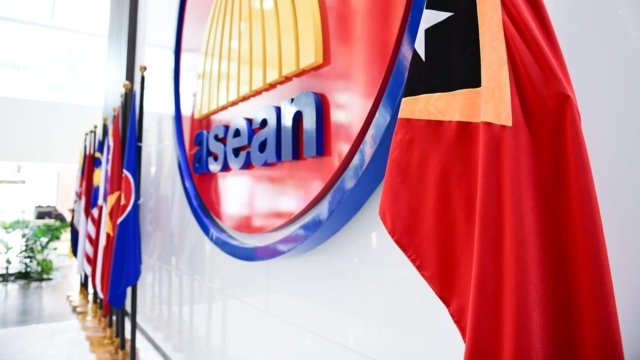


When ASEAN faces serious external threats, its members form a pangolin-like shield.
This time, ASEAN leaders did just that. They also demonstrated unity and flexibility in responding to unexpected challenges like never before.
The biggest outcome of the 46th ASEAN-related summit was the decision to admit Timor-Leste as the 11th ASEAN member.
Less than 18 hours before the summit on May 26, during a preparatory meeting, some ASEAN foreign ministers were still ambivalent about fully supporting the world’s youngest democracy.
Dili is not yet ready to join ASEAN this year.
However, once the leaders met the following morning, they quickly reached a consensus to welcome Timor-Leste as the 11th member in October, during the 47th ASEAN summit.
The reason was simple: when push comes to shove, ASEAN leaders make decisions.
Of course, Timor-Leste still faces a long to-do list under the roadmap before it can fully integrate with ASEAN after admission.
The main sticking point between Timor-Leste and some ASEAN members had been the pace of implementing the roadmap prepared by the ASEAN Secretariat.
These criteria had long been a barrier to admission. A surprise voice of support at the last minute allowed Dili in.
Myanmar’s representative, Permanent Secretary for Foreign Affairs Aung Kyaw Moe, remained silent.
With the new member, ASEAN moves on to the next chapter for the second half of this century.
Another surprise development was the discussion on Myanmar.
For the first time, ASEAN leaders discussed the idea of a permanent special envoy for Myanmar under the ASEAN chair.
This idea, originally proposed by Thailand after the 2021 coup, had previously failed to reach consensus.
Now, they have agreed on the modality. The next step is to develop the terms of reference for the selection process.
Leaders also tasked the chair and Thailand with continuing their follow-up on the previous visit to Naypyidaw.
They plan to return soon. The bloc wants to reassure Myanmar of its commitment to the five-point peace process.
Peace and stability remain pivotal.
The junta’s planned election in the last two weeks of December must be inclusive and acceptable to the international community.
ASEAN has made it clear: the ceasefire must continue and expand to cover more areas.
Humanitarian efforts and foreign aid must reach all affected zones.
Another key outcome was the ASEAN Community Vision 2045, completed nearly a year ahead of schedule—demonstrating the chair’s forward-looking leadership.
The 22 drafters held 22 meetings over 58 days to finalize the 1,860-word vision. It draws on the aspirations of the previous vision to ensure continuity and relevance.
The new vision focuses on how the bloc can survive in a world full of unpredictable geopolitical shifts.
“Future-ready ASEAN” has become a slogan calling for inclusivity, greater strategic autonomy, and resilience, along with faster and better decision-making—Timor-Leste’s admission being a recent example.
Initially, drafters feared the 20-year vision might quickly become outdated due to growing rivalries—U.S.-China, U.S.-Europe, and U.S.-Global South.
They suggested the vision be reviewed periodically to stay relevant, even though ASEAN leaders had already agreed to a mid-term review in 2035.
On the U.S. unilateral tariff hike, ASEAN leaders were firm: negotiate, not retaliate.
While individual members will work out their own deals with the U.S., they will also maintain a collective voice.
ASEAN leaders pledged that no member will undermine regional interests or allow Washington to divide the bloc.
Malaysian Prime Minister Anwar has proposed a special ASEAN-U.S. summit with Trump later this year.
During Trump’s first term, a planned summit in Las Vegas in March 2020 was postponed due to COVID-19.
If he wishes, Trump can easily renew his invitation.
In the coming months, ASEAN will announce the completion of the ASEAN-China Free Trade Agreement 3.0 upgrade and substantive progress on the Digital Economy Framework Agreement.
Additionally, RCEP membership may be expanded to include Hong Kong, Sri Lanka, Bangladesh, and Chile.
ASEAN will also sign the upgraded Agreement on Investment in Goods and Services in October.
The new scope of ATIGA will include supply chain connectivity, the circular economy, and trade facilitation during humanitarian crises.
To cope with rising protectionist measures, ASEAN must increase intra-regional trade, diversify its markets, and update free trade agreements with dialogue partners.
The ASEAN-Gulf Cooperation Council (GCC) and ASEAN-GCC-China meetings reaffirmed ASEAN’s central role in global trade and future economic frameworks.
The three regions pledged support for transparent, rules-based international trade under the World Trade Organization.
For ASEAN, the GCC offers new opportunities—particularly in energy, food security, and labor mobility.
These were the key outcomes of the 46th ASEAN summit—real-time responses to a fast-changing world shaped by the Trump administration’s sudden shifts in diplomacy and economic policy.
In less than two months since President Trump declared “Liberation Day” and announced global tariff hikes, trading partners—both large and small—have scrambled to negotiate with Washington to avoid fallout.
Their responses reflect varying degrees of confidence and resolve. But for ASEAN, restraint, negotiation, and timing remain the core strategy.