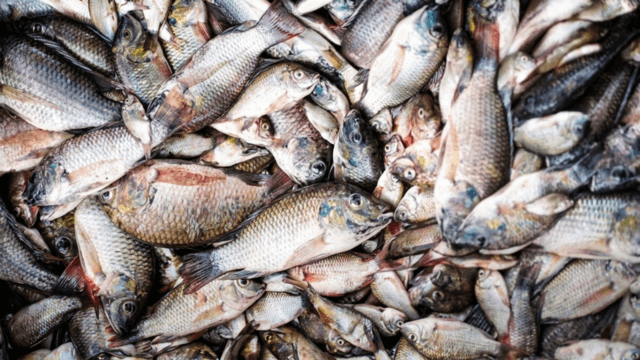



The Fisheries Department has announced that deformed fish caught in rivers flowing through the northern province of Chiang Rai are infected with a Digenea parasite and that their deformities were not caused by heavy metals.
The department said that samples of the deformed Bagarius sp fish, caught in the Mekong River in Ban Som Kha of Chaing Saen district in Chiang Rai, were tested in the department’s labs and the findings show that the deformities, found on several parts of the fish, were caused by a Digenea parasite which caused the inflammation of the tissue.
The department said, however, that Digenea parasites are not an infectious disease, but consumers are advised not to eat the deformed fish.
Meanwhile, the Pollution Control Department has released results of its third test on sediment taken from the Kok River, its tributaries and the Mekong River.
The findings show a heavy concentration of arsenic, above the standard level, in sediment samples taken from 13 locations along the Kok River. The department warned that eating too much fish caught in the river may endanger health.
The amount of lead found in the sediments is also above the standard level, but is not yet a threat to health.
The amounts of other heavy metals, such as chromium and nickel, found in sediment collected from the Kok’s tributaries, were higher standard level, but still do not pose a health threat.
Regarding the Mekong River, the amounts of arsenic and other heavy metals found in the sediment are also above standard levels, but do not yet pose a threat to health, according to the Pollution Control Department.