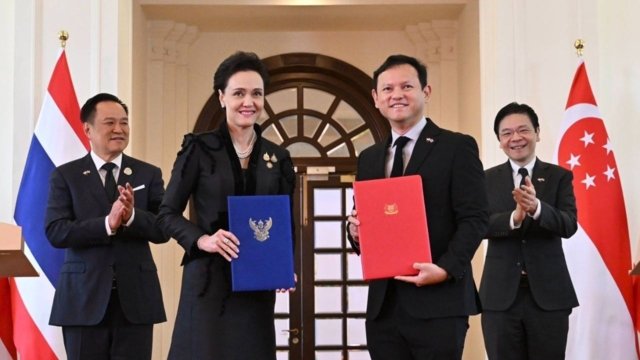



Thailand and the United States issued a joint statement today on a framework for an agreement on reciprocal trade on the sidelines of the ASEAN Summit in Kuala Lumpur, Malaysia.
Thailand’s commerce minister, Suphajee Suthumpun, said that the statement represents the joint spirit of Thailand and the US to work out an agreement on reciprocal trade, which is based on mutual benefit and stable and sustainable economic relations, with the expectation that the trade talks can be concluded by the end of this year.
She said that the framework for talks covers multiple aspects, ranging from tariffs, non-tariff issues and services to investment, the digital economy, rules on the origin of products, measures to prevent tax evasion and mutual economic stability.
The minister also said the Thai government attaches great importance to trade talks with the US, because the US is a major export market for Thai products and the second largest trade partner after China.
Thai exports to the US last year were valued at US$54.9 billion, compared to US$74.4 billion with China. The main products exported from Thailand to the US are computers and computer accessories, phones and accessories.
The key items in framework for reciprocal trade talks between Thailand the US include:
· Thailand eliminating tariff barriers on about 99% of US goods, covering a full range of US industrial, food and agricultural products.
· The US maintaining 19% reciprocal tariffs, as set forth in Executive Order 14257 of April 2 on goods originating in Thailand and will identify products from the list set out in Annex III to Executive Order 14346 of September 5.
· Thailand addressing and preventing barriers to US food and agricultural products entering the Thai market, including expediting access for US Food Safety and Inspection Service certified meat and poultry products.
· US and Thailand finalising commitments to protecting internationally recognised labour rights.
· Thailand committing to adopt and maintain high levels of environmental protection and effectively enforcing its environmental laws.
· Thailand committing to refraining from imposing digital service taxes or measures that discriminate against US digital services or digital products, to ensure free transfer of data across borders.