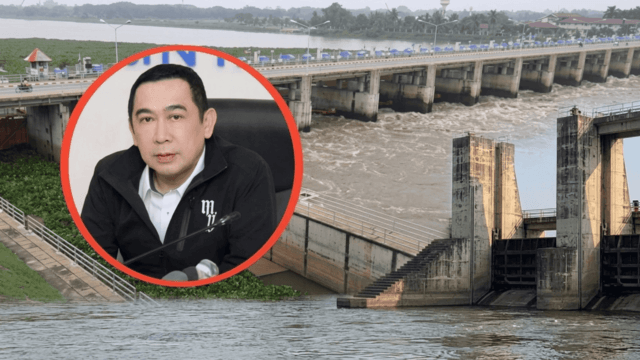



The damage caused to the country's economy by the current flooding across the country is estimated at 12.283 billion baht, with Bangkok taking the highest toll of about 7.014 billion baht, followed by the eastern region at 2.976 billion baht, according to the University of the Thai Chamber of Commerce (UTCC)'s Centre for Economic and Business Forecasting.
Dr. Thanavath Phonvichai, the UTCC president and advisory chairman of the university's Centre for Economic and Business Forecasting, said that the estimate is based on five days of flooding, from Sept 25-29, in Bangkok and 26 other provinces in the central, eastern, northern and northeastern regions.

He said the 12.283 billion baht in damage is equivalent to 0.066% of this year's GDP projection.
The estimate ranges between 5.896 and 20.635 billion baht, or 0.03-0.11% of the GDP, based on the actual flooded areas and the ability to offset the economic activities halted by the floods.
The figures do not, however, include damage to property,such as houses, vehicles, goods in stock and agricultural products, which will be clearly assessable within one week of the end of the flooding, Dr. Thanavath said.
If the flooding persists, however, the estimate of the damage to the economy would have to be reviewed, he added.
According to the estimate, Bangkok would take the heaviest toll of about 7.014 billion baht or 57% of the total damage, since it is the country's largest economic centre.
It is also the centre of activities of the commercial and service sectors, which rely on travel by consumers and employees.
Although the flooded areas are mostly in the eastern part of Bangkok, the financial sector and most of the offices can still operate online from home, thus partly reducing the effects on the economic sector.
The total damage in the four provinces surrounding Bangkok, namely Samut Prakan, Pathum Thani, Nonthaburi and Nakhon Pathom, is estimated at 1.839 billion baht, with Samut Prakan taking the biggest hit.
The flood damage in the eastern region is estimated at 2.976 billion baht, with Chon Buri hit the hardest, with about 2.101 billion baht, since it is where the flooding started and the floodwater in Pattaya at one point was nearly 1 metre deep.
Chon Buri's economy relies heavily on tourism, retail tradeand port logistics, which are sensitive to travel disruptions.
The Eastern Economic Corridor (EEC) is, however, less affected, because it is flooded only in certain limited areas. There have been no reports of any industrial estates having halted their operations.
The flood damage to the economy in the central, north and northeastern regions is still limited.
Consumption, tourism and service sectors have been heavily hit.

The UTCC's Centre for Economic and Business Forecasting points out that the flooding has, in general, affected people's spending for consumption, tourism and services in urban areas. People spend less at department stores, retail shops, restaurants and petrol stations. Travel by employees has been disrupted.
The special holidays declared by the government on Sept 28 and 29 in Bangkok, Nonthaburi, Pathum Thani and Samut Prakan have curtailed workdays in economic areas.
Pattaya and other tourist spots in Chon Buri have been hit by cancellations or postponements of tourists' travel, affecting the revenues of hotels, restaurants and related businesses.
Some main roads have been flooded, making it more difficult to transport goods to retailers in some areas such as Bang Kapi, Min Buri and Rangsit.
The production sector has been indirectly hit by the limitations on workers’ ability to travel and the transport of raw materials, but factories are not directly affected. The situation is very different from the major floods of 2011.
Limited impact on inflation
Concerning consumer goods, prices of vegetables have risen. The trend will be monitored until the Vegetarian Festival, which runs from October 10 to 18.
The effect of the flooding on inflation is expected to be limited and temporary.

In the agricultural sector, the main risks are now in provinces in the Chao Phraya river basin, particularly Chai Nat, Sing Buri, Suphan Buri and Ayutthaya, where the water level is still rising while the yearly crops are near to harvest.
The damage in this sector will be apparent after the floodwater has receded and the flooded areas have been examined.
The UTCC's Centre for Economic and Business Forecasting says the damage is about 0.26% of GDP in the third quarter of 2026, following the decline in growth from 2.8% in the first quarter to 1.9% in the second quarter.
The centre says the initial estimate of flood damage is not serious enough to change the course of the Thai economy this year, but will increase pressure on growth in the second half of the year, particularly if the flooding in the Chao Phraya river basin drags into the fourth quarter.
Three measures proposed

The centre suggests that the government rolls out three measures to cushion the damage.
The first measure is to distribute remedies to groups affected by flooding quickly by focussing on workers outside the labour system and small entrepreneurs in Bangkok and surrounding provinces. The remedies include debt moratoria and loans for the recovery of affected businesses.
The second is to improve the management of the Chao Phraya river basin, to reduce damage to agricultural areas and industrial estates in the southern Central region.
Assessment of damage should be conducted quickly to speed up compensation payments for damage in the agricultural sector.
Third, the quantities and prices of essential goods should be closely and continuously monitored until the Vegetarian Festival. Investments should be made to improve the Bangkok Metropolitan Administration (BMA)’s water drainage capacities, to reduce risks of damage to the economy by future flooding.