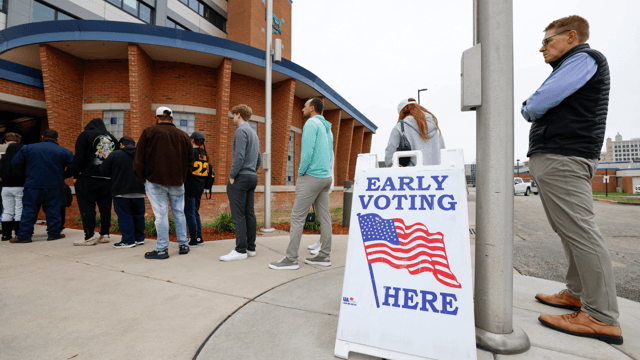



American voters have spoken, and they shouted out in blue.
Democrats took both the House and the Senate in the midterm elections.
It was a major blow to a president who said these midterms were about him and his policies.
President Donald Trump told voters to vote as if he were on the ballot. Bingo. Voters took him at his word and slapped him right in the face.
However, Southeast Asia should be careful not to read too much into the results.
After all, Americans voted against Trump. They did not vote against the US that produced him and his cronies.
Whoever occupies the White House after 2028, this America is here to stay.
Truth be told, the livelihoods of Americans will remain the weathervane.
Remember, during the Biden administration, many of Trump's policies remained unchanged.
Today, the US is more inward-looking. It worries about grocery prices, rent, healthcare and jobs.
In addition, voters are angry about corruption, immigration and wars of choice.
As such, the new Democrat-controlled Congress will check the president's power in Washington.
It will hold hearings, block budgets and slow down Trump's knee-jerk reactions and policies.
One thing is clear: the old America that supported free trade, defended democracy abroad and paid the bills for the global order will not return.
Over the past decade, Democrats have learned their lessons. Their constituencies also want America to come first, but they do not say it out loud.
They want allies to share America's pain, not its gains.
What does this consequential outcome mean for Southeast Asia? First, tariffs will not disappear.
Trump's protectionist policies will remain in place, as he will continue to weaponise trade whenever he can.
It is interesting to note that protectionism has now become a bipartisan position.
Thailand, Vietnam, Malaysia and Indonesia, which have enjoyed trade surpluses with the US, must realise that the good old days are gone for good.
Second, Washington's attention will turn even further inward.
A blue-led Congress means two years of political battles in Washington, investigations and possible impeachment talk ahead of the 2028 presidential race.
Trump is under siege, and his unpredictability is likely to increase.
At the moment, his planned attendance at the ASEAN-related summits on November 16-18 and the APEC summits could be jeopardised.
The hosts must be prepared for these eventualities.
Finally, democracy in the region has lost some of its appeal.
Countries that offer stability coupled with tighter controls are receiving praise and attracting foreign investment.
At the same time, Washington is quiet on issues related to rights and values, as it has its own political system to repair.
Despite its shortcomings, the US remains a land of opportunity that attracts migrants from all over the world.
There is no reason to underestimate a country that still possesses the world's most powerful military.
Moreover, many of the world's leading tech giants come from Silicon Valley.
American universities continue to attract the best minds. The present American syndrome is a lack of political will.
Under these circumstances, the region should not wait for Washington to return.
With or without Trump, Southeast Asia must strengthen its own hand through deeper integration and broader regional cooperation.
That is the way forward for its long-term resilience.
The most important message of the midterms is simple: America can still correct itself at the ballot box.
But there is one caveat: the US in the coming decades will be more self-centred, more cautious and more focused on its own problems.
Well, the world has changed because the US has changed. Asia must change, too.
Written by Kavi Chongkittavorn