


As Thailand counts down to Loy Krathong, Lamphun province in Thailand’s north is getting off to an early start. Contemporary light installations and thousands of traditional lanterns illuminate this ancient city, turning its temples, streets and historic landmarks into one big after-dark experience.
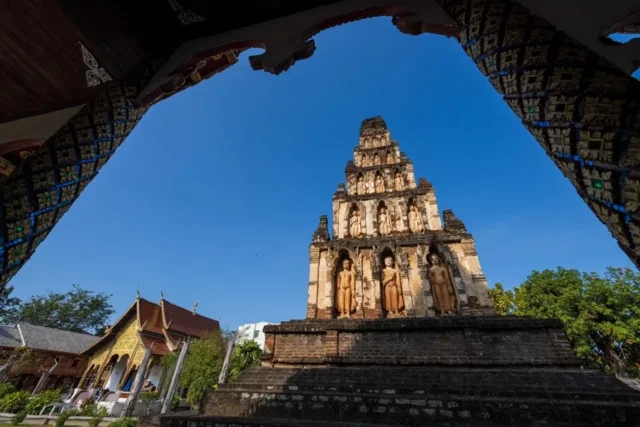
Lamphun is usually at its best when you slow down. The compact old town, just south of Chiang Mai, is a place of temple courtyards, quiet streets and traces of Hariphunchai, the ancient kingdom whose legacy still runs through the city.
But come evening over the next couple of months, slowing down might be difficult. There’s simply too much to look at.

From late September into November, two festivals are lighting up Lamphun in very different ways. VIJIT Thailand @ LAMPHUN uses projection, light, sound and multimedia to bring the city’s history to life, while the Hundred Thousand Lantern Festival fills temples and streets with colourful lanterns carrying prayers, wishes and centuries of Lanna belief.
One is contemporary and high-tech. The other is rooted in faith and tradition. Together, they make this one of the most atmospheric times of the year to explore Lamphun after dark.
Walk through Hariphunchai after dark
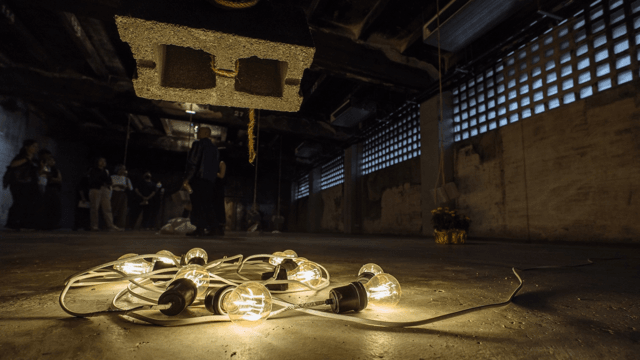
Running from September 25 to October 4, VIJIT Thailand @ LAMPHUN turns the old town into a giant outdoor gallery, with 12 installations spread across nine locations.
This isn’t a festival where you stand in one place and wait for the show to begin. The fun is in walking between the installations, watching familiar landmarks change character as darkness falls.

Start at Tha Sing Bridge, opposite Wat Phra That Hariphunchai, where “Hariphunchai – The River of Light” sets the scene. From here, the route leads through historic gates, along the old city moat and past temples, monuments and former royal buildings.
At Tha Nang Gate near Wat Chang Rong, “Wall of Memories” turns the historic entrance into a gateway through time, combining light, colour and multimedia. Five-minute light-and-sound shows run four times each night, with fireworks joining the performance on selected evenings.
Continue towards the old city moat for “The Eternal Stream of Time”, then look out for the woven-bamboo installation inspired by Phra Rod, the revered Buddha image closely associated with Lamphun. Its theme, appropriately enough, is “Timeless Light of Dharma”.
It’s history, but without the glass cases. Instead, you encounter it while walking through the city at night.
Meet Lamphun’s legendary queen
One figure keeps appearing in Lamphun’s story: Queen Chamadevi.
Her monument is one of the main stops on the VIJIT route, transformed after dark for “The Eternal Queen of Hariphunchai”. Light-and-sound presentations tell her story, while cultural performances take place each evening.

Nearby, installations illuminate Khum Chao Chakkham Khachonsak, the former Lamphun royal residence, and Wat San Pa Yang, where light is used to evoke Buddhist art and spirituality.
It’s a good reminder that Lamphun is much more than a quieter alternative to Chiang Mai. Its identity stretches back to Hariphunchai, and temples, monuments and sacred sites still anchor everyday life in the old city.
VIJIT simply gives you another way of seeing them.
And just as its projections begin to fade, thousands of smaller lights start taking over.
From pixels to lanterns
The Hundred Thousand Lantern Festival begins on September 30 and continues through November 28. That creates a particularly good window between September 30 and October 4, when both festivals are running at the same time.
This is when Lamphun should look spectacular.
But the lanterns are about more than creating a good photograph.
The festival forms part of Yi Peng, the northern Thai or Lanna celebration associated with the Loy Krathong season. In Lamphun, lanterns are offered in devotion to Phra That Hariphunchai and in honour of Queen Chamadevi.
Traditionally, making and hanging a lantern is an act of Buddhist worship. Light represents prosperity, peace and the hope of finding a better path through life.
Visitors can become part of the tradition too. Many write their names and wishes on lanterns before hanging them around temples and public spaces.
One lantern is pretty. Thousands of them are something else entirely.
As more appear, temple courtyards fill with colour and streets turn into glowing tunnels. Walk beneath them after dark and the effect is both festive and surprisingly intimate: among all those lights are thousands of individual hopes and wishes.
Where VIJIT uses light to tell Lamphun’s history, the lantern festival uses it to express the city’s faith.
Follow the lanterns – and your appetite
Don’t rush between the main sights. Some of the best festival experiences happen in between.
Communities take part in lantern processions through the city, eventually making their way towards Wat Phra That Hariphunchai, where the lanterns are presented as Buddhist offerings.
Street markets bring another dimension to the evening. Browse stalls selling local textiles, jewellery, woodcrafts and food, or stop for coffee before continuing your walk. Lanna music, arts, performances and creative workshops add a more contemporary edge to the traditional celebrations.

This is where Lamphun’s small size becomes an advantage. You can explore much of the historic centre on foot, following whichever illuminated lane, temple entrance or food stall catches your attention.
There’s no real need to stick rigidly to a route.
An early taste of Thailand’s season of light
By November, much of Thailand will be looking towards Loy Krathong, when candlelit krathong are floated on waterways across the country. In the North, Yi Peng adds its distinctive Lanna traditions to the celebrations.
Lamphun starts building towards that moment weeks earlier.
First come the projections and light installations. Then the lanterns begin multiplying across the city. Temples glow, streets change colour and the old capital of Hariphunchai gradually settles into its own season of light.
The two festivals may look very different, but they share something fundamental. Both use light to connect the present with what came before – whether through ancient history, Buddhist belief or traditions handed down through generations.
And perhaps that’s the best reason to come.
Visit Lamphun during the day and you’ll find one of northern Thailand’s oldest cities. Stay after sunset, follow the lights and you may find yourself seeing it very differently.