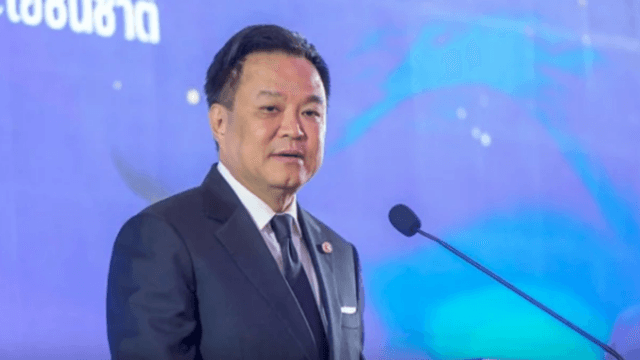



Foreign Minister Sihasak Phuangketkeow said Thailand hopes to see a decrease in violence, a release of more political prisoners and opening up for humanitarian assistance in Myanmar following the recent visit by Myanmar President Min Aung Hlaing.
He said they would constitute what he described as “measurable progress” to justify ASEAN’s “calibrated re-engagement” with Myanmar.
They were among topics that were raised with the Myanmar leader who made his first visit to Thailand last week after being appointed president in April this year, he said.
However, Sihasak admitted there was no commitment from the Myanmar president on whether or when the appeals would be complied with.
“We expressed our concerns. But in diplomacy, sometimes we don’t really need commitment on the spot. Give them time to think about it, to appreciate the sincerity of our efforts, and hopefully, there will be continued progress,” he said.
Min Aung Hlaing’s visit drew heavy domestic and regional criticism for conferring diplomatic legitimacy on a leader seen as dictator responsible for continuing gross human rights violations.
“It’s not about legitimacy. It’s about trying to bring peace back, trying to promote a peace process, trying to encourage by way of engagement, for the government of Myanmar to continue with dialogue, to do more in term of reconciliation,” Sihasak told Thai PBS World in a recent interview.
He said Thailand has to live with “reality” in Myanmar whose internal strife has seriously affected it as its immediate neighbour. Continued fighting between Myanmar government forces and ethnic armed groups has frequently spilled over into Thailand, which is also grappling with cross-border pollution and scam operations originating in Myanmar.
He said there are also concerns among ASEAN countries that an isolated Myanmar risks becoming an arena for major power rivalry.
Sihasak pointed out what he believes to be some of the positive changes in Myanmar since the recent general elections which, however, were largely seen by the international community as a sham.
He said many political prisoners have been released while Myanmar’s democracy icon Aung San Suu Kyi was moved from prison to house arrest and later allowed to receive a representative of the International Committee of the Red Cross (ICRC).
However, Sihasak said ASEAN expects to see more positive political developments in Myanmar within the framework of the “Five-Point Consensus” adopted by ASEAN in 2021 following the military coup but was recently rejected by Naypyidaw.
“They may say that they don’t accept the Five-Point Consensus, that’s fine. But please, what’s in the Five-Point Consensus are legitimate concerns that they do have to address,” he said.
Sihasak said ASEAN expects to see more areas in Myanmar open to humanitarian assistance and a reduction of violence, especially against civilians, and a credible process of dialogue with all stakeholders.
“And we hope to see more positive political developments, release of more political prisoners,” he said and expressed hope that the ASEAN special envoy will be permitted to visit Aung San Suu Kyi.
Sihasak said Thailand has also been in contact with the various ethnic groups and anti-Naypyidaw forces and is prepared to help facilitate peace dialogue between them and the Myanmar government.
“We are ready to facilitate and provide them with a safe zone for a dialogue,” he said.
As part of the calibrated re-engagement with Myanmar, Sihasak said that during their summit in the Philippines later this year ASEAN leaders may need to review its stand of not inviting high-ranking Myanmar officials to attend the group’s high-level meetings.
However, he dismissed the possibility of Min Aung Hlaing being invited to this year’s ASEAN summit.
By Thepchai Yong