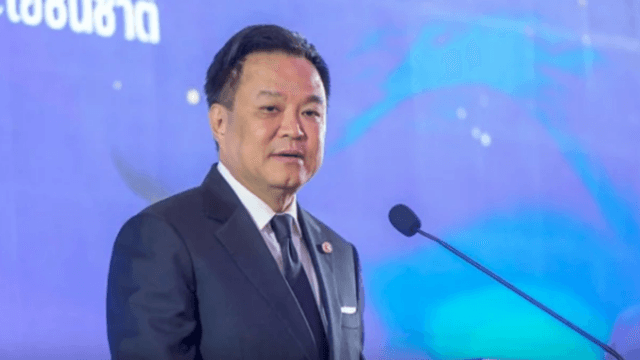
Chaiwut Thanakhamanusorn, who as digital economy and society minister under General Prayut Chan-o-cha threatened to impose Chinese-style controls on the internet, has formed a new political party he says aims to empower the younger generation.
Chaiwut chose Constitution Day to launch the Rak Chart Party (Patriotic Party), unveiling the reformist slogan: “No corruption, no greyness, no backscratching”.
He explained that the slogan targets what he called the three most entrenched problems in Thai politics.
Rak Chart, featuring a logo of two hands forming a heart, was rebranded from the People Harmony Party, which had lapsed into inactivity after its formation in 2010.
Chaiwut was named as leader of the new party on November 1 alongside a new executive board of 22 other members.
The party is expected to contest the upcoming election, due early next year.
‘Power of the youth’
“We have not lost hope, because we believe in the power of patriotic young people who want to enter politics to change the country. We want to see our country prosper,” Chaiwut said at the party’s launch on December 10.
He also insisted his fledgling party has no financial backing from so-called “grey businesses” and no ties to powerful political dynasties with questionable backgrounds.
“In this way, we can fully serve the people without being beholden to any group or individual,” he said.
Chaiwut, 54, contends that Thai politics has long been dominated by a handful of political families, which he blames for the country’s sluggish progress over recent decades.
“In my 24 years in politics, I have witnessed these families take turns running the country through parties they control, leaving no room for newcomers to bring change,” he said. “In the end, the country comes to a standstill and the economy slumps.”
Chaiwut quit as deputy leader of the Palang Pracharath Party in late September, having served as a close aide of its leader, General Prawit Wongsuwan, a long-time powerbroker and ally of 2014 coup-maker Prayut.
Banned from politics
Born on November 2, 1971, in Sing Buri province, about 150 kilometres north of Bangkok, Chaiwut graduated with a bachelor’s degree in industrial engineering from Chulalongkorn University and a master’s in the same field from the University of Southern California.
He later completed a master’s degree in economics at Chulalongkorn University.
He first entered Parliament in 2001 aged 30 as a Democrat MP for Sing Buri, having been mentored by veteran politician Arthit Ourairat. However, he left the Democrats three years later to join the Chart Thai Party and was re-elected in the 2007 general election.
A year later, Chart Thai was dissolved by the court for electoral fraud, and Chaiwut, as a party executive, was banned from politics for five years.
During this hiatus, he entered the private sector, working as director of community relations at Gulf Energy Development Plc. He also lectured at Rangsit University, an institution co-founded by his former mentor, Arthit.
Making a comeback
In 2014, soon after his ban expired, Chaiwut was elected as senator for his home province. His tenure was cut short when the military staged a coup in May and ousted Parliament.
In 2018, he joined the military-backed Palang Pracharath Party, became a member of its executive board, and was elected as a list MP in the March 2019 general election.
Palang Pracharath went on to form a coalition government that returned General Prayut to power.
In Parliament, Chaiwut was among the outspoken coalition MPs who frequently took the floor to defend government leaders and the monarchy.
In March 2021, he was appointed as digital economy and society (DES) minister, replacing fellow Palang Pracharath member Buddhipongse Punnakanta, who was disqualified when he was convicted of insurrection for his role in anti-government protests in 2013-2014.
Chaiwut remained in the post until the Prayut government’s tenure ended in September 2023.
During his time as DES minister, Chaiwut took aim at internet scams and what he claimed was a torrent of fake news concerning the government’s efforts to tackle the Covid-19.
At one point, he threatened Facebook with legal action, complaining it was failing to tackle scammers using the platform to lure victims.
More controversially, he pushed to resurrect the post-coup regime’s idea for a single internet gateway to monitor and control online information.
The push triggered a public backlash driven by fears the move would impose heavy internet censorship and be a drag on business.