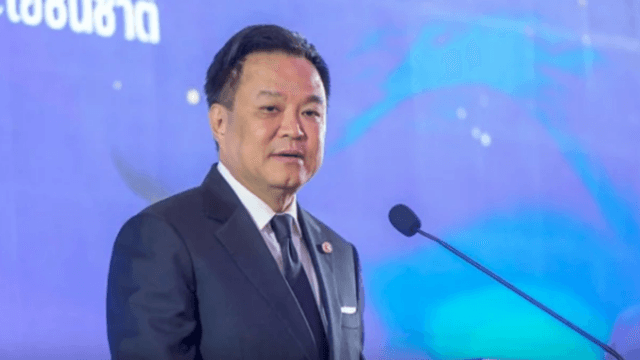
Democrat Party leader Abhisit Vejjajiva has ruled out any possibility of cooperating with the Kla Tham Party led by Thammanat Prompao after the upcoming general election.
Abhisit was among party leaders and their prime ministerial candidates contesting the election who were invited to a debate organised by Thai Rath TV yesterday.
During the debate, the moderator asked all guests to reveal their parties’ conditions for cooperating or not cooperating with other parties after the general election.
Abhisit said the upcoming election must mark a turning point for political integrity.
“The goal of this election is to restore honesty in the country,” he said. “For the Democrat Party, the positive condition for joining a government is that we must be confident we can push forward our policies.
“The negative condition is that we will reject any party whose policies contradict our principles or create division. We cannot join a government with the Kla Tham Party — absolutely not.”
He did not give a clear reason for his refusal to join hands with Thammanat’s party.
In November, Abhisit submitted documents to the Anti-Money Laundering Office (AMLO), urging the agency to investigate financial transactions linked to transnational scam networks, which he said may be connected to two unidentified former ministers.
Yesterday’s debate featured eight prime ministerial candidates from political parties, including Natthaphong Ruengpanyawut of the People’s Party, Yodchanan Wongsawat of Pheu Thai, Thirachai Phuvanatnaranubala of Palang Pracharath, Pirapan Salirathavibhaga of the United Thai Nation Party, Suchatvee Suwansawat of Thai Kao Mai, Khunying Sudarat Keyuraphan of Thai Sang Thai, and Gen Rangsi Kitiyansap of the Setthakit Party.
The Kla Tham Party and the Bhumjaithai Party of Prime Minister Anutin Charnvirakul did not field prime ministerial candidates for the debate.
Natthaphong said his party would not accept any politicians or ministerial nominees linked to “grey businesses”.
“The most dangerous problem facing Thailand in the next election is grey money dominating the political system,” he said. “With no Senate votes next time, the people’s voices will matter most. We must prevent corruption and grey influence in politics.” He declined to name specific parties, citing election law restrictions.
Thirachai echoed concerns over “grey” issues, saying any party with such problems would face public scrutiny if included in a coalition, though he also refrained from naming names.
Pheu Thai’s Yodchanan said his party would not accept corrupt individuals and stressed that coalition partners must allow Pheu Thai to implement its policies for the public.
Pirapan said coalition partners must accept his party’s core policies, adding that Thailand urgently needed a decisive solution to the Thailand–Cambodia issue, strong anti-corruption measures, and no policies that undermine the country’s key institutions.
Gen Rangsi said his party would not work with any party linked to grey businesses, adding that “everyone knows which parties they are, but we cannot say it openly”.
Suchatvee said Thailand was facing a severe crisis and that his party wanted to work only with parties that genuinely served the public interest and operated on professional and academic principles. He warned that his party would immediately withdraw from any coalition if evidence emerged linking partners to scam networks.
Khunying Sudarat said the country remained trapped by corruption and insincere politicians who repeatedly deceived voters. She said her party would refuse to work with parties that broke election promises or relied on populist handouts, insisting that structural reform was needed to fix the economy.