


At a time when Thailand is being weighed down by heavy headlines, the opening of Dib Bangkok offers a rare breath of cultural optimism.
Opening to the public on December 21, the international contemporary art museum emerges not merely as a new exhibition space, but as a long-term institutional commitment to Thailand’s creative future.

Main entrance area of Dib Bangkok.//Photo courtesy of Dib Bangkok
Conceived by the late artist, collector, and cultural patron Petch Osathanugrah, Dib Bangkok represents the culmination of a decades-long vision.
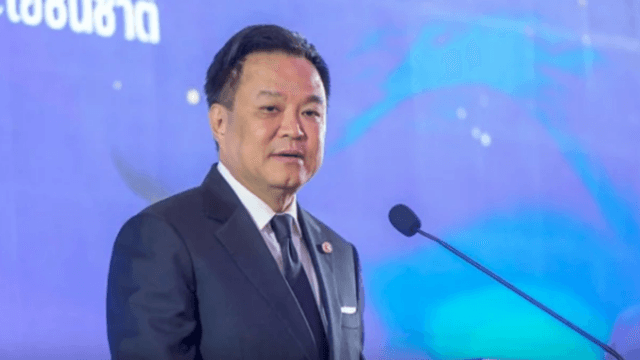
Today, that vision is carried forward by his son, Purat “Chang” Osathanugrah, President and Founder of the museum, who sees Dib Bangkok as a vital bridge between Thai creativity and the global art world.
“In Thailand, we have no shortage of creative talent,” Chang says, “tut we lack the institutional stability to push Thai artists onto the global stage. Dib Bangkok aims to be that bridge.”
More than a gallery, Dib Bangkok positions itself as a public cultural anchor — a museum intended not for a select few, but for the city itself. “I want people to feel like, ‘Dib Bangkok is my museum,’” Chang adds.
From warehouse to cultural beacon
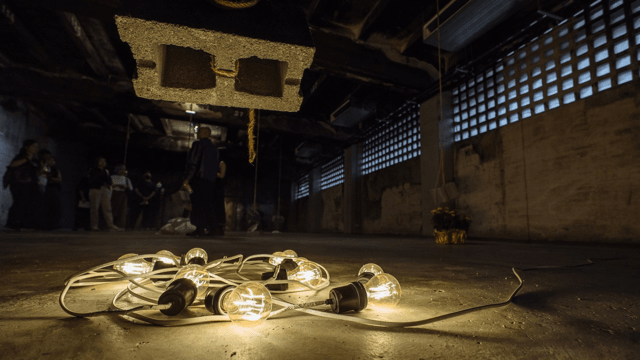
Located on Sukhumvit Soi 40, Dib Bangkok occupies a former 1980s warehouse that has been radically reimagined by architect Kulapat Yantrasast of WHY Architecture.
Rather than masking the building’s past, Yantrasast stripped it back to its industrial core — an architectural gesture that aligns with the museum’s name. Dib, meaning “raw,” speaks to both material honesty and creative authenticity.
The transformation has resulted in 7,000 square metres of light-filled galleries across three levels. As visitors ascend through the building, the spatial experience unfolds as a metaphorical journey — culminating beneath a dramatic sawtooth roof that floods the top floor with natural light, suggesting openness, reflection, and illumination.
Art that begins before you enter
The museum experience begins outdoors. In the courtyard, Alicja Kwade’s Pars pro Toto (2020) anchors the landscape with 11 monumental stone globes, ranging from 70 to 250 centimeters in diameter.

Alicja Kwade’s “Pars pro Toto”//Photo courtesy of Dib Bangkok
A permanent addition to Dib Bangkok, the installation offers a poetic meditation on planetary systems, materiality, and scale.
“Looking at them can make you think about our planetary system,” Chang notes. “You can interact with the works and feel the art.”
Nearby, the architecture itself becomes a canvas. Sho Shibuya’s Memory series, painted on vinyl, wraps the exterior walls like wallpaper — transforming the industrial façade into part of the exhibition and drawing visitors seamlessly into the museum’s artistic universe.

Sho Shibuya’s Memory (2025) //Photo by Veena Thoopkrajae
Inside: (In)visible Presence
Dib Bangkok opens with the exhibition (In)visible Presence, featuring 81 works by 40 artists, spanning generations and geographies.
The exhibition includes seminal Thai artist Montien Boonma alongside internationally acclaimed figures such as Anselm Kiefer, Alicja Kwade, and Pinaree Sanpitak.

Thai master Montine Boonma’s “Lotus Sound”//Photo courtesy of Dib Bangkok
According to Dr. Miwako Tezuka, Director of Dib Bangkok, the exhibition was conceived as both a tribute and a continuation of Petch’s philosophy. “We selected works that ask how we sense and remember what is meaningful yet unseen,” Tezuka explains. “It is also a response to our time — when the world is in image overdrive and in need of stillness and attentiveness.”

From left, Phrat Osathanugrah and Dr. Miwako Tezuka.//Photo courtesy of Dib Bangkok
Many works extend beyond the visual. Sound, scent, touch, and spatial perception play central roles — reinforcing the exhibition’s insistence that contemporary art is something to be experienced with the body as much as the eye.
“We wanted the opening exhibition to unfold through the body. These works challenge our expectations of scale, weight, and everyday materials, revealing affinities with movements such as arte povera, where ordinary materials carry deep human memory," curator Ariana Chaivaranon explains.
On the upper terrace overlooking the courtyard, Pinaree Sanpitak’s Breast Stupa Topiary (2013) — stainless-steel forms shaped like breast-like stupas — invites reflection on femininity, spirituality, and care, offering a quiet counterpoint to the surrounding cityscape.
For several participating artists, including Sho Shibuya, Finnegan Shannon, and Hugh Hayden, (In)visible Presence marks their first presentation in Thailand, expanding a global conversation through shared enquiries into memory, identity, and impermanence.
A Collection built for generations
Beyond its temporary exhibitions, Dib Bangkok’s commitment lies in its permanent collection, which comprises over 1,000 works by more than 200 artists worldwide, dating from the 1960s to the present.

Weisz_Bumpman on a Tree Trunk.//Photo courtesy of Dib Bangkok
The collection spans paintings, sculptures, photography, large-scale installations, and new media. “We collect not only to support artists today,” Chang says.
“If we fast-forward 20 or 40 years, we want to leave something meaningful behind — so future generations can learn from the great artists of the past.”
The museum’s ethos mirrors the belief long held by Petch: that Thai creativity possesses a distinctive rawness and authenticity — qualities that deserve global recognition.

Sudodh Guptua’s “Incubate” //Photo by Veena Thoopkraje

Louise Bourgeois’s Untitle//Photo courtesy of Dib Bangkok
Beyond the galleries
Completing the experience is Watthu-Dib Bistro & Bar, the museum’s all-day dining space offering local and international flavours. Open Thursday–Monday, from 9am to midnight, the restaurant welcomes both ticketed and non-ticketed visitors, reinforcing Dib Bangkok’s role as an accessible cultural gathering place.