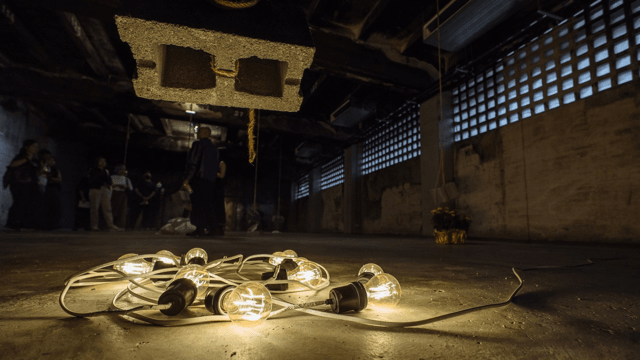



The Bangkok Art and Culture Center (BACC) is currently hosting a historic event: “Catch the Moon | Chatchai Puipia | The Caught Years” (known in Thai as Baan Jub Phra Jan).
This exhibition is a monumental cultural showcase, marking the largest and most comprehensive retrospective of Chatchai Puipia’s work ever held in Thailand.

On view through February 15, the show offers an unprecedented, intimate look into the mind of a revolutionary artist known for his potent social critique and notoriously private practice.
A rare glimpse: Chatchai presses the ‘Only Me’ button

Art enthusiasts and critics have already hailed this exhibition as a must-see cultural event and one of the best exhibitions in Thailand for 2025/2026.
This excitement stems from the exhibition’s sheer scale and the artist’s legendary privacy; Chatchai Puipia has rarely opened his shows, and he once famously entered a long period of working solitude.
In an unprecedented move, the exhibition is akin to Chatchai pressing the metaphorical “only me” button for the public, revealing the journey of his life and career to the outside world.
This monumental show gathers over 140 works, including pieces that, despite his international renown—such as those displayed at the Singapore Art Biennale—have never been seen by Thai audiences.
Curators Kasamaponn Saengsuratham and Wutigorn Kongka designed the exhibition to reflect this intimate disclosure.

As Wutigorn explains, “It is like entering a house and waiting in a room where you can enjoy looking at all the photos and paintings.”
The small room at the entrance functions as a conceptual guest room, displaying Chatchai’s early works, including the first piece that won him a prize as a university student at Silpakorn University, and another that landed him another prize after graduation.
The rare collection of personal artifacts provides a deeper context to his creations, offering intimate documentation from his youth, including memoirs, photos from his art student days, and personal letters.
This collection opens a crucial dialogue between the man, the memory, and his evolving worldview.
The significance of ‘Catch the Moon’

The exhibition’s title, Baan Jub Phra Jan, was inspired by a painting for which the artist attempted to catch the shadow of the moon on water.
The Thai title plays on the word Baa(n), which can also signal Baa (insane, mad), symbolizing the artist's complex relationship with his artworks throughout his life.
Moving beyond the entrance room, audiences proceed to halls featuring his iconic, large-scale paintings and powerful sculptures loaned by major private collectors.
“When you view them piece by piece and move through the exhibition, you can see changes in the artist and his view of the world surrounding him,” Wutigorn notes.
Here, visitors find a conclusion of the artist’s journey and the critical thoughts evolving inside his head.
The art of satire: Unmasking the ‘Siamese Smile’

Chatchai Puipia emerged in the late 1980s as a pivotal figure among the first generation of truly progressive Thai avant-garde practitioners.
His art is a powerful blend of precise observation and deep personal reflection, delivered through a genre often termed Thai Magic Realism.
Chatchai is most celebrated for his incisive social satire. He masterfully uses his own image in his large-scale self-portraits to comment on the psychological and societal landscape of modern Thailand.
His most famous series, the “Siamese Smile,” perfectly embodies this critique.
The paintings depict the artist's face with unsettling, exaggerated grins, which are not joyful but rather sarcastic and discomfiting.
These weird and powerful smiles directly mock the cliché of Thailand as the “Land of Smiles,” using the grotesque expression to expose a deeper, often ignored reality.
The smiles—at once strange and powerful, in the eyes of the viewer, reflect his critique of hypocrisy.
The contorted expression suggests a façade of happiness and politeness that covers underlying frustration, anguish, and despair at the country’s rapid industrialization and moral decay.
The artwork also reflects how Chatchai addresses the conflict between traditional Buddhist values and the pervasive greed and consumerist mindset that dominate modern society.
From ‘Meaningless’ art to enlightenment

Photo by Warunee Maneekum
The exhibition implies three major phases of the artist's life, starting from his student days when he felt his work was “meaningless” and submitted it merely “to my teacher.”
The turning point came when he heard about the plight of Thai conservationist Seub Nakhasathien.
This incident prompted a profound realization: art should create more value, reflect society, and communicate to the public.
From that pivotal point, the public can see a distinct change in his work.
Chatchai eventually entered an enlightenment phase where he settled into a long-term relationship with his art, one that has less to do with outside factors and more with personal conviction.
“Catch the Moon” affirms Chatchai Puipia’s enduring position as a contemporary artist whose work challenges the viewer to look beyond the surface.
The exhibition provides a comprehensive key to unlock the legacy of an artist who continues to compel and influence art across Asia and beyond.
Photo courtesy of BACC