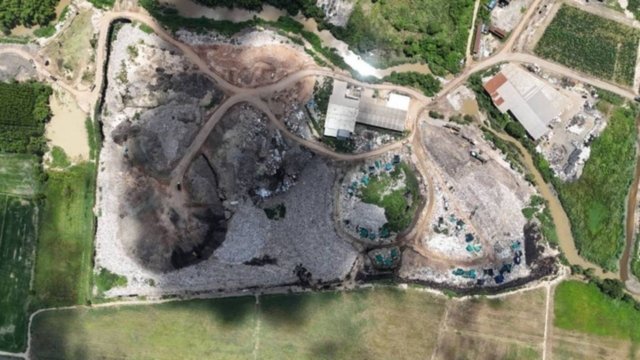



The volume of Thailand’s waste continues to grow. According to the Pollution Control Department’s 2024 report, Thais generated 27.20 million tons of waste in 2024, compared to 26.95 million tons in 2023, a rise of 0.9 per cent.
Of that waste, about 10.51 million tons were recycled, another 10.42 million tons were managed properly, leaving more than 6 million tons of leftover waste.
With smart strategies, technology and groundbreaking ideas, forward-thinking startups have come up with innovative solutions that help combat waste and improve waste management in a creative way.
Some use a recycling app to help people dispose of recyclable waste responsibly and the waste they donate can yield some golden benefits.
Many adopt a circular economy approach that eliminates waste and keeps resources in use, which contributes to sustainable development. They also use fin-tech to raise funds, allowing investors to become involved in environmental advocacy.
From trash to gold
Based in Bangkok, Trash Lucky is a startup which developed a recycling app to help people sort waste properly. It was founded in 2019 by Nattapak Atichartakarn and Worrawit Wonglek with the goal of keeping plastic out of the ocean.
During his water sports activities, long-time surfer and scuba diver Nattapak said he witnesses how bad the pollution in the ocean is, and he’s determined to do something about it. He worked with Worrawit to help create a sustainable solution to this problem.
“It pains me to having to pick up plastic every time I surf. This notion of sorting plastic pollution in the ocean keeps coming back to me,” he said.
Thailand ranks among the top 10 global contributors to marine plastic pollution. The country produces around two million tons of plastic waste and debris annually.
The startup sows the seeds of “From Trash to Gold” by encouraging people to sort their recyclable waste by types – plastic, glass, paper and metal - and donate their recyclables to it.
It then sells the waste to manufacturers who use recycled materials in their products.
The enterprise incentivizes participants’ efforts in recycling by turning it into points which can be exchanged for lucky draw electronic lottery tickets to win prizes including gold, smartphones and shopping vouchers.
“The lottery is a culture in Thailand. Twenty million Thais spend US$8.3 billion a year buying lottery tickets. So, we leveraged this and created the recycling incentive scheme to motivate people to do good. We know they love this kind of game. We want to make recycling fun for them,” he said, adding that the points participants earn are based on the amount of waste they recycle.
“The more you recycle, the better your chances, Nattapak said.
The recyclables can be sent to the enterprise via mail. They can also be placed at drop-off points at public and private community bins. Pick-up services are provided in Bangkok.
Since 2021, the enterprise has worked with the most popular cola soft drink brand to roll out a plastic bottle recycling campaign, which aims to make recycling a habit and help the planet.
So far, the campaign has collected more than 2 million PET bottles that have been recycled, helping reduce the volume of waste in landfills and mitigate environmental hazards.
“The campaign was a success. More than half of participants return to join the project,” he said, adding that repeated participation is a primary driver of recycling behavior.
Inspiring people to go green
In addition to the recycling incentive scheme, the enterprise works to educate people on waste segregation, the 3Rs of waste management and the harm of plastics to the environment through workshops.
It also empowers the local community, schools, residents and offices in waste management by designing a recycling program for them, which can help them become eco-friendlier and more self-sufficient in fighting pollution.
After working with different groups of people, Nattapak admits that it’s not easy to instill waste recycling habits, saying the effectiveness of the recycling initiative is greatly influenced by how accurately people dispose of the waste.
He noted that education and awareness are instrumental in promoting recycling as they help people understand the importance of recycling, how to do it correctly and its environmental benefits. The convenience of recycling services is another important factor.
“Drop-off points should be easy to reach,” Nattapak said, adding that the enterprise has worked with its partners to provide recycling drop-off points in visible and convenient locations to encourage better recycling habits.
Today, there are more than 80 locations for recycling drop-off points at leading shopping malls, groceries and petrol stations across Bangkok, Phuket, Hat Yai and Surat Thani.
Nattapak noted that behavior is key to positive environmental change, urging people to take individual action for waste segregation and recycling.
“You don’t need to sort your waste into 10 different types. Just start to do it with most of your common types of waste. That’s a small action, but the impact is massive,” he said.
Sleep can be green
Sleep is bliss but it’s not always environmentally friendly.
Old abandoned mattresses occupy large landfill space and take years to fully decompose. Many of them are incinerated openly, which pollutes the environment.
In Thailand, where the hospitality industry is strong, it’s estimated that over 5 million mattresses are thrown away every year.
But, norn norn, a Bangkok-based sustainable mattress brand, believes that sleep can be green. It’s aligned with the circular economy which focuses on the efficient use and reuse of materials to help minimize waste and pollution.
The brand also integrates the United Nation’s Sustainable Development Goals 8-13 into its business strategies that cover decent work and economic growth; industry, innovation and infrastructure; reduced inequalities; sustainable cities and communities; responsible consumption and production; and climate action into its business strategies.
The startup was founded in 2018 with the aim of providing affordable access to brand-new superb-quality mattresses to hospitality businesses and consumers through monthly subscription services, while tackling the old mattress problem by recycling and upcycling them in an environmentally friendly way.
Unlike other brands, it provides removal and recycling services of an old mattress at the end of life of each subscription responsibly, free of charge.
“We believe that business can be a force for good,” said the brand’s CEO Nophol Techaphangam, who was born into a family-owned business that has been providing premium-quality mattresses and bedding for over 95 years.
Mattress recycling gives a new lease of life to used materials, which can help minimize the amount of virgin materials extracted from nature.
He noted, however, that the process can be uneconomical because of the low economic value of materials that can be recovered from used mattresses. The logistic costs for used mattress collection are also high.
“With our recycling service, we envision that we could help save millions of mattresses from going to landfills over the next decades, which will help reduce pollution,” he said.
The mattress recycling process, he explained, begins with deconstructing them, then sorting the components into different material types. Fabrics and fibres are used in industrial oil filters and other textiles applications.
Steel springs are recycled as metal scraps, while polyurethane foam padding is broken down into polyol monomers, the building blocks of polyurethane foams and a wide range of other products.
With green commitment and sustainable business practices, Nophol said the brand takes great pride in its operations that can help reduce global warming, air pollution and human non-carcinogenic toxicity impacts resulting from the production, use and disposal of mattresses by at least 31%, 28% and 24% respectively.
He cited a Life Cycle Assessment of Circular Economy-Based Product-As-A-Service Business Models: Mattresses for Hotel Businesses Study, which aims to determine the potential reductions in greenhouse gas emissions, pollution and waste resulting from the production, use and disposal of mattresses.
The study was carried out by the Technology and Informatics Institute for Sustainability (TIIS), National Science and Technology Development Agency (NSTDA) and supported by a grant from Thailand’s Office of National Higher Education Science Research and Innovation Policy Council.
Green financing
To capitalize on fin-tech, the impact startup managed to raise funds through the issuance of green bonds in Thailand in December 2021 under the Private Placement-10 scheme and in accordance with the International Capital Market Association, Green Bond Principles to support the expansion of its business.
It also mobilizes funding through digital investment tokens under the Digital Asset Act, supported by the Securities and Exchange Commission (SEC).
“The green bond allows us to commit to our circular economy product subscription service. Investors who buy our bond can contribute to environmental sustainability. They can also earn a return on their investment,” Nophol said.
The funds raised are spent on purchasing mattresses for the brand’s products for subscription services, while money generated from monthly subscriptions is paid to token holders as a return on investment and funds recycling technology-related research and development, he added.
“When buying a green bond issued by a sustainable company, you can be part of the movement towards a greener and more sustainable future,” Nophol said.