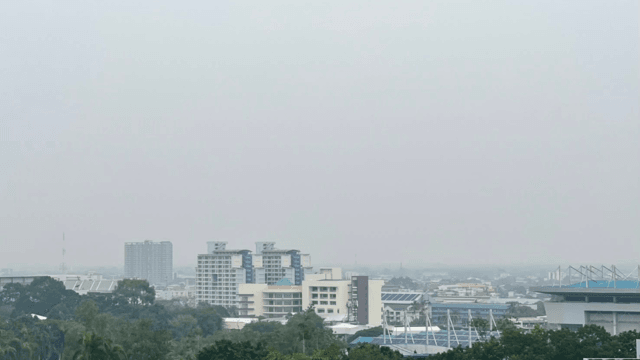
About 144,000 people have suffered from asthma attacks, skin diseases, eye infections and chronic obstructive pulmonary disease during the first three weeks of January, when the level of PM2.5 dust in the atmosphere exceeded the safe level, according to the Ministry of Public Health.
Meanwhile, the Department of Pollution Control reports that PM2.5 pollution reached the Orange (unhealthy for sensitive groups) level in 45 provinces today, while Red (unhealthy) level air pollution was reported in Bangkok, Rayong, Ayutthaya, Phetchaburi, Saraburi, Sukhothai, Pathum Thani, Lop Buri, Samut Sakhon, Prachin Buri, Samut Prakan, Nonthaburi, Ratchaburi, Sing Buri and Samut Songkhram.
Excessive PM2.5 dust was also reported in several north-eastern and eastern provinces today.
Dr. Varoth Chotpitayasunondh, spokesman for the Public Health Ministry, said today that the committee tasked with controlling diseases with environmental and occupational causes has set guidelines for how and when provincial governors should declare pollution-related disease control zones.
When the level of PM2.5 dust has exceeded 75µg/m³ (microns) within a 24-hour period, the governor, with approval from the Pollution Control Department, is empowered to declare a specific area as an airborne pollution-related disease control zone and to role out appropriate measures, without affecting local business and the revenues of the employees, he said, adding that these guidelines will be submitted to the cabinet for approval.
Meanwhile, the Education Ministry has called off a parade planned at the Suphachalasai National Stadium this Sunday, set to mark the 103rd anniversary of the Thai girl scouts, for the protection of the participants amidst worsening air pollution in Bangkok. About 5,000 girl scouts and teachers were expected to participate.
Similar events can be held in other provinces where there is no threat from air pollution.