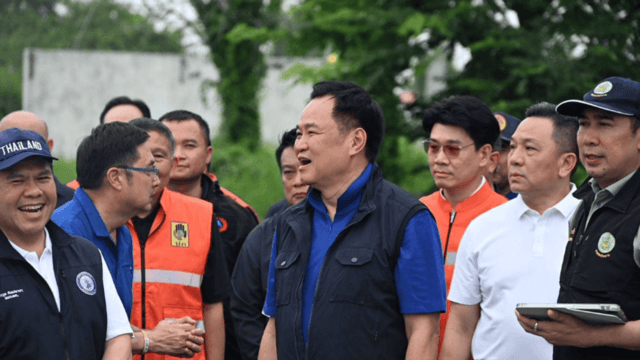



A Thai international trade expert believes that Thailand and Myanmar’s prospects for boosting bilateral trade to US$12 billion, from 7.4 billion, are reasonable, following the encounter between Myanmar’s former junta leader and President Min Aung Hlaing and Thailand’s Prime Minister Anutin Charnvirakul earlier this month.
Some trade constraints still need to be addressed though.
Dr. Aat Pisanwanich commented that Thai investors, businesses and the government should step up and make a move, as Myanmar’s political situation is now undergoing major changes, which he says will be an opportunity for Thailand to resume economic cooperation.
“The two leaders have already met. Now we need to turn that into concrete action and tell Thai businesses that Myanmar still has high potential. We need to establish a presence there early, whether through trade, investment or tourism, and that will ultimately benefit Thailand,” Dr. Aat says.
Both Thailand and Myanmar rely on each other economically.
According to Thailand’s Commerce Ministry, Myanmar ranked as Thailand’s 21st-largest trading partner overall, and eighth-largest among its ASEAN trading partners. Myanmar is also the 3rd-largest border trade partner with Thailand, behind Malaysia and Laos.
Bilateral trade between Thailand and Myanmar was recorded at US$7.3 billion in 2025, while border trade with Myanmar was recorded at US$5.8 billion, a decrease from 7.4% in the year before. Bilateral trade during the first half of 2026 was recorded at US$3.8 billion.
Thailand relies on natural gas and some agricultural products from Myanmar, while Myanmar imports industrial goods, machinery, fertilisers and consumer products from Thailand.
Both Thai and Myanmar leaders promised to push for more trade and investment in various sectors, including energy, agriculture, infrastructure, tourism and future industries, as a restructuring of global supply chains is underway.
Therefore, the international trade expert believes that the encounter is a good sign for Thailand and Myanmar vis-à-vis reviving and expanding their economic relations. The existing constraints, which he thinks must be addressed, are reducing complexities in import licenses and legalising migrant workers from Myanmar. These, he says, remain a major obstacle, making it more difficult and taking longer to increase the value of bilateral trade to US$12 billion as both leaders hoped.
“In Myanmar, if an importer wants to bring goods in from another country, they have to obtain an import licence from the government or relevant authorities, and that’s not an easy process. We may need to discuss how we can simplify the rules and regulations to make the process easier,” he explains.
“Myanmar importers also need to have what is known as ‘export earnings’, which is foreign currency available to pay for goods purchased from Thailand or other countries. Export earnings held by Myanmar importers are mainly in two major currencies, baht and US dollars.”
Min Aung Hlaing himself revealed that the country is working on developing three special economic zones and deep-sea ports, namely Thilawa, Kyauk Phyu and Dawei The latter, which is yet to be completed, has the highest potential.
Dr. Aat assesses that the Dawei seaport project is not only the closest to Thailand, but can also connect with South Asia as it is close to India’s Chennai seaport, bringing more trade opportunities in the region. He believes that the Dawei area doesn’t have to be developed solely as a seaport, it can also be developed into a tourist destination connecting the two countries.
“There’s an opportunity for Thailand to find ways to develop or cooperate with Myanmar on the Dawei seaport, because it’s only about 100 kilometres from Kanchanaburi province. I think this could create opportunities in many areas, for shipping goods to Myanmar, to South Asia or even to Europe,” he says.
Putting internal politics aside, diversifying risk is now important amid ongoing geopolitical tensions. As the international trade expert believes, Myanmar still has high economic potential in today’s global supply chain, as the country neighbours global superpowers such as China and India.
“Myanmar is one of the markets that can help diversify the risks, while also creating new opportunities. Labour costs are lower and the country has abundant resources, with plenty of room for further development. If we can identify what we call the ‘new vision’ and turn it into something concrete, that will benefit both countries,” Dr. Aat concluded.