


As the 61st Venice Biennale opens its doors, a quiet but powerful “hum in a minor key” resonates from the historic chambers of the Palazzo Rocca Contarini Corfù. Here, the Bangkok Art Biennale (BAB) Foundation presents “The Spirits of Maritime Crossing 2026,” a Collateral Event that bridges the deep-water histories of Southeast Asia with the sinking majesty of Venice.
Curated by Prof. Dr. Apinan Poshyananda, the exhibition brings together 20 artists exploring the “precarious ecologies” of our time—where migration, environmental collapse, and spiritual resilience collide.

The Invisible Threads of Trade and Memory
For Thai artist Wasinburee Supanichvoraparch, the journey to Venice is a return to a childhood he once ignored. Growing up in a renowned pottery family in Ratchaburi, Wasinburee recalls being dragged by his father to scavenge for “junk” in the Mae Klong River.
"I found it boring back then," he admits. But a historical discovery changed his perspective. Scholars recently identified a 13th-century jar at San Marco, believed to be the only physical evidence that Marco Polo actually reached China. Thorough research revealed a stunning coincidence: that very jar was produced in the same kiln and departed from the same port as the shards Wasinburee’s father had pulled from the Mae Klong mud decades ago.

“My work is a tribute to the journey,” Wasinburee says. “Not just for those who arrived and became history, like Marco Polo, but for those who set out and vanished. Their spirits created the history we live in today.” His ceramic residues in the Palazzo act as anchors, connecting the trade routes of the past to the cultural flows of the present.
Identity as a Hybrid Spirit
Across the gallery, Myanmar-born artist Soe Yu Nwe uses the tactile language of clay to navigate the complexities of her own heritage. Her family, having escaped civil war to live on the border of Myanmar and China, raised her with animistic beliefs that now manifest in surreal, hybrid sculptures.
“I have three godmothers,” she explains. “A woman, a tree, and a human being.” This fluid view of existence informs her work, where human figures merge with serpents and flora. Her standout piece, a sculpture of a Naga (serpent) bound in chains, is a biting commentary on the oppression in her homeland. By blending the mythical with the political, Soe Yu Nwe gives a voice to the “voiceless” that Prof. Apinan sought to highlight in this edition.

Sinking Cities
While Wasinburee and Soe Yu Nwe look to the past, Singaporean artist Ong Kian Peng uses the cutting-edge tools of Artificial Intelligence to look toward a submerged future.
“Singaporeans often think we are ‘disaster-free’,” Ong notes. “There is a perception gap between the reality of climate change and our personal lives.” Using AI as a creative collaborator, Ong’s film presents the “uncanny” sight of everyday Singaporean spaces—corridors and housing flats—flooded by rising tides. By placing these visuals in Venice, a city famously battling the same rising waters, the resonance is chilling. It moves the conversation from abstract data to a visceral “feeling” of vulnerability.
Ecological Resilience and the Mekong
Environmental fragility is also at the heart of Ruangsak Anuwatwimon’s long-term research. Since 2016, Ruangsak has tracked the alarming changes in the Mekong River, noting how it turned from a natural brown to an unnatural, toxic blue.

His installation, featuring fragile floating soil dioramas, is a result of arduous fieldwork. “The algae people used to eat are now contaminated,” he warns. His work serves as a grim piece of evidence for an international crisis that is often overlooked in the grand halls of European diplomacy.
A New “Cosmovision”
Prof. Dr. Apinan, acting as the bridge between these disparate voices, emphasizes that this exhibition is about visibility. “Artists from Cambodia, Vietnam, Myanmar, and Laos are often overlooked on the international stage,” he says. “This is their opportunity to shine.”
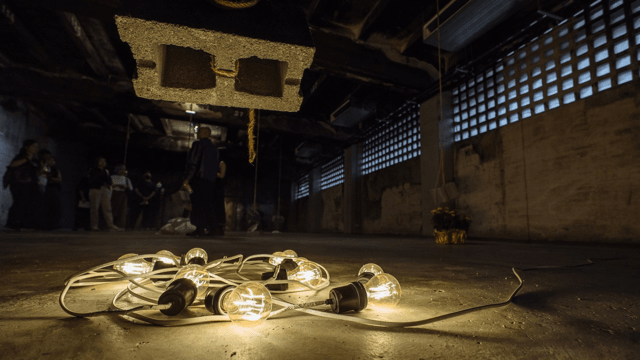
Supported by ThaiBev and One Bangkok, the exhibition isn’t just a display of talent; it is a statement of “poetic resilience.” Whether through Marina Abramović’s haunting film “Sea Punishing” or Amanda Coogan’s silent “Ode to Joy” performed in Thai sign language, the message is clear: the sea may divide us, but the “spirits” of our shared struggles create a path toward a common future.

As the sun sets over the Grand Canal, the works in the Palazzo Rocca Contarini Corfù stand as “spiritual spaceships”—vessels of memory and hope, navigating the precarious waters of the 21st century.
The Spirits of Maritime Crossing 2026 runs at Palazzo Rocca Contarini Corfù, Venice, until 2 August 2026. Free Admission
Photo Credit: Courtesy of BAB foundation