


The climate crisis, once considered a “problem for the future,” is now Thailand’s stark reality. Frequent and intense storms, devastating floods, prolonged heatwaves, and unpredictable droughts have become the new normal, signaling a global shift to an age of uncertainty.

“From Climate Change to Disaster” panel discussion at SX2025.//Photo by Warunee Mane
At the “From Climate Change to Disaster” panel discussion at Sustainability Expo 2025, experts from Thailand’s Department of Climate Change, BiOST, the National Science Museum, and the media warned that Thai society can no longer afford to ignore these signals.
Thailand is one of the world’s most vulnerable nations, ranking ninth on the Global Climate Risk Index by Germanwatch. Its 3,200-kilometer coastline, spanning 23 provinces, leaves the country acutely exposed to tropical storms and rising seas.

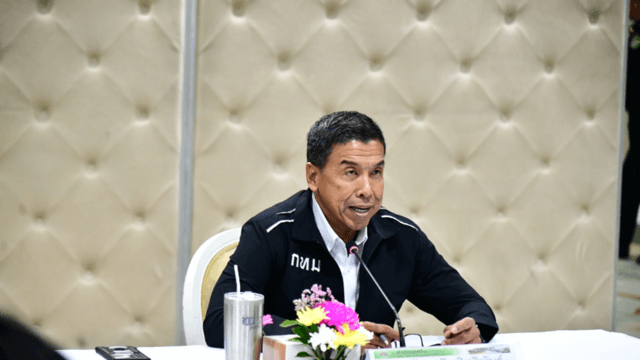
Pavich Kasavawong, Deputy Director-General of the Department of Climate Change and Environment.//Photo by Warunee Maneekum
“Just one disaster can shake the entire economy,” Pavich Kasavawong, Deputy Director-General of the Department of Climate Change and Environment, told participants. He recalled the catastrophic 2011 floods, which cost 1.44 trillion baht in damage (approximately 10% of GDP), shut down thousands of factories, and disrupted global supply chains overnight.
The Threat of Cascading Crises
Global temperatures have already risen by 1.75∘C since the Industrial Revolution and now approach the 2∘C maximum threshold set by the Paris Agreement. Crossing this line could push the planet past a tipping point, leading to irreversible climate change.

Prof. Dr. Pisut Painmanakul of BiOST//Photo by Warunee Maneekum
“Climate change doesn’t cause disasters in isolation,” warned Prof. Dr. Pisut Painmanakul of BRANDi Institution of Systematic Transformation (BiOST). “It triggers a chain of cascading crises.”
He explained that drought-dried forests fuel devastating wildfires, which release massive greenhouse gases, further accelerating warming.
For instance, California wildfires once emitted the carbon equivalent of the combined annual emissions of Thailand and the UK. He also cited the chilling threat of melting permafrost unleashing ancient, unknown pathogens.
Unchecked warming could cause sea levels to rise by one meter by 2050, and potentially up to 2.5 meters in the worst-case scenario.
For areas like Bangkok and Samut Prakan, where land sits just 1.5 meters above sea level, this poses an existential threat. This “drowning city” scenario could displace millions.
The World Bank already names Bangkok among the top 10 megacities most at risk from climate-related flooding.
The Need for Climate Literacy and Investment
Survival requires Thais to improve their “climate literacy,” Prof. Dr. Pisut stated. “It’s not just the job of researchers or the state. Even a street vendor must understand what 1.5∘C versus 2∘C warming means, or risk mistaking it as just bad weather.”

Ganigar Chen, Vice President of the National Science Museum.//Photo by Warunee Maneekum
Ganigar Chen, Vice President of the National Science Museum, connected the crisis directly to food security. Rainfall decline in northern and northeastern Thailand is already reducing crop yields, compounded by the global decline in bees, which pollinate over 70% of food crops.
Thailand spends hundreds of billions of baht annually on disaster compensation, yet preventative investment lags far behind. Experts suggest redirecting these funds towards innovation, climate-sensitive urban planning, and nature-based solutions to both reduce economic loss and build long-term resilience.