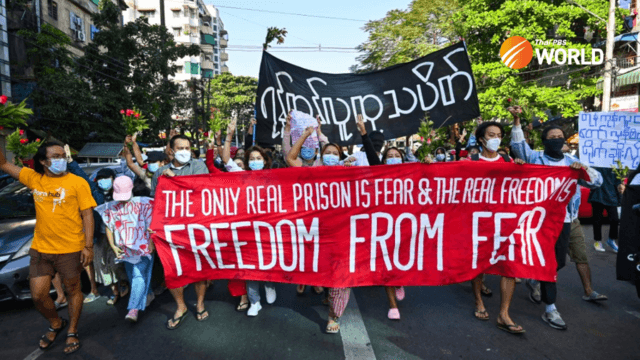
As 2025 draws to a close, Myanmar’s junta government is moving ahead with plans for a general election. Many observers say, though, that this highlights the country’s deep-seated political crisis.
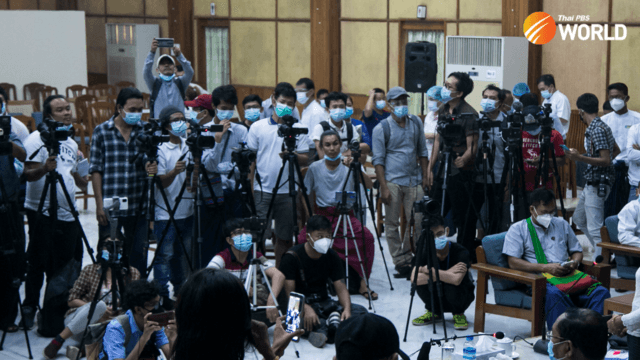
At a recent panel discussion, organised by Thai PBS World, titled ‘Voices from the Frontline: Navigating the Future of Myanmar’, veteran independent journalists characterised the election as lacking both legitimacy and public trust.
Their views mirror those of the United Nations Special Rapporteur on the human rights situation in Myanmar, Tom Andrews, who has described the process as a “sham election.”
Toe Saw Latt, a representative of the Independent Press Council of Myanmar, said the public has little interest in participating. “People don’t want to take part in this election because the outcome is already known. It is the army that is going to win. Why bother going to the polling stations to endorse it?” he said.
He added that many are concerned their names could be recorded and cross-checked against household registrations, heightening fears of potential repercussions, despite the fact that voting is not compulsory.
Signs of low public participation were already evident during advance voting in Bangkok in early December. According to an observer, turnout was low.
“On both days, not even half of the registered voters turned up,” said Onravee Tangmeesang, an independent Thai journalist who monitored the early voting in Bangkok, adding that “this clearly shows the perception of the people towards what we call the ‘sham election’.”
The Myanmar general election is to be conducted in three phases, with the first round scheduled for December 28th, followed by two additional rounds approximately two weeks apart.
What is being presented as a step towards national reconciliation is undermined by the reality on the ground. A 2024 BBC investigation found that the Myanmar military currently controls only about 21% of the country. 42% of the territory is under the control of various resistance groups, while a further 29% remains contested.

According to political scientist, Assoc. Prof. Surachanee Sriyai, a Visiting Fellow with the Media, Technology and Society Programme at ISEAS - Yusof Ishak Institute, the situation highlights the challenge for Thailand to engage with Myanmar constructively.
“The majority of the areas bordering Thailand are now controlled by ethnic armed organisations and their de facto government. So, we need to find a way to work with them for our own national interest”. She also adds that “if we don’t work with them, it might open doors for another great power intervention.”
Similar concerns were expressed by Soe Myint, of the Western-backed media outlet Mizzima News, who described the planned vote as a “China-sponsored election”.
While several Western countries have already denounced the election, Assoc. Prof. Surachanee pointed to, what she described as, a lack of tangible support. “Not much has gone beyond statements or speeches,” she said.
At present, international efforts to address Myanmar’s crisis are largely framed by two initiatives, namely the ASEAN Five-Point Consensus adopted in 2021 and UN Security Council Resolution 2669 passed in 2022, both of which call for an immediate cessation of violence and the release of political prisoners.
So, what is the future likely to hold for Myanmar after this election?
Mon Mon Myat, a senior management consultant for the ‘Democratic Voice of Burma’ expects that it will result in full-blown authoritarianism, under which “democratic norms are dismantled and civil liberties are suppressed to maintain control”.