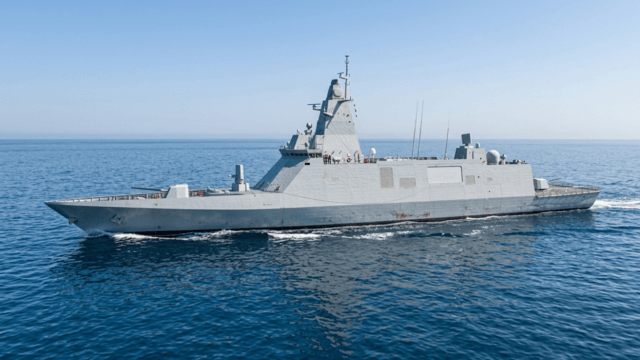
The Thai Navy has been under intense scrutiny over its hardware procurement after deciding to choose the problematic South Korean supplier, Hanwha Ocean, to build a 16.7-billion-baht new frigate, despite the failure of the self-protection system installed on HTMS Bhumibol Adulyadej—one of the frigates it built.
A testimony before the Military Affairs Committee of the House of Representatives on September 10 revealed that the newest Thai frigate has encountered functional problems with the Phalanx Close-In Weapon System (CIWS) since November 2019, less than a year after it joined the fleet.
Military Committee chairman Ekkarach Udomumnuay pinned the responsibility for the weaponry problem on Hanwha Ocean, which took over as the frigate builder years ago and recently won a bid for the construction of another frigate for the Thai Navy.
The Navy filed a claim approximately a month before the warranty of the Phalanx expired after detecting an irregularity in the weaponry system, he said.
Hanwha is therefore responsible for carrying out the repairs. The Navy has maintained contact with the company throughout the process, although it is not the manufacturer of the Phalanx system, he added.
Whose responsibility?
The HTMS Bhumibol Adulyadej was built in South Korea by the company then known as Daewoo Shipbuilding & Marine Engineering (DSME) before joining the Royal Thai Navy fleet in December 2018.
Between 2022 and 2023, five Hanwha Group companies agreed to invest in DSME through the purchase of newly issued shares and later renamed it Hanwha Ocean after the Hanwha Group acquired control.
The CIWS was manufactured by an American defence company—originally General Dynamics and subsequently Raytheon, now RTX—not by DSME.
Who bears the responsibility would depend on the shipbuilding contract, system-supply agreement, warranty provisions and division of responsibility between the prime contractor and the equipment manufacturer.
The Navy has held discussions with both Hanwha and the system’s manufacturer, but a dispute arose over which of the two companies should be held responsible.
Ekkarach argued that the Navy would ordinarily be entitled to pursue its contractual claim against the prime contractor—now operating as Hanwha Ocean—rather than being required to resolve Hanwha’s dispute with the American equipment manufacturer.
Obsolete Phalanx
Navy representatives told the committee during recent testimony that they had asked the manufacturer to inspect the Phalanx and sent components back to the United States for repairs on several occasions since late 2019.
The equipment has been shipped back and forth three times, resulting in a seemingly endless repair process over the past seven years, they said.
The Navy explained that the prolonged repair period was partly caused by the COVID-19 pandemic. However, after the repaired equipment was returned and reinstalled aboard the ship, further damage was discovered.
The Navy had previously written to the Joint United States Military Advisory Group Thailand seeking clarification. It was informed that the Phalanx system procured by the Navy was an older model for which spare parts were no longer available. As a result, the Navy was unable to procure spare parts for its own inventory.
Nearly every country operating the Phalanx system has now modernised or upgraded it. The Navy was therefore advised to upgrade its system to the current model.
Questions for the Navy
“The key question is how the Phalanx system became obsolete over the past seven years. We would like to ask the Navy whether it knew when the shipbuilding contract was signed that it was purchasing an obsolete system. If it did know, why did it not stockpile spare parts?” Ekkarach posed. “If it did not know, did Hanwha inform them about the issue? These are fundamentally questions of management.”
The House’s Military Affairs resolved to request all relevant documents, including the shipbuilding contract and records of discussions between the Navy and Hanwha, as well as those involving the manufacturer of the Phalanx system.
According to Ekkarach, if no clarity is provided within 14 days, the committee will formally request the State Audit Office and the Comptroller General’s Department to investigate the matter.
Another frigate contract for Hanwha?
The Navy announced on September 8 that Hanwha Ocean Co Ltd had won the bid to build another frigate at a total cost of 16.73 billion baht, raising questions on whether the company was sufficiently qualified to undertake construction of the new frigate.
Royal Thai Navy chief Pairote Fuangchan called a press conference on September 18 to defend the decision, saying the Navy had established exceptionally stringent specifications for this procurement, far exceeding ordinary standards.
This was intended to ensure that, regardless of which company won the tender, the vessel would be a high-quality warship with advanced combat capabilities and would provide effective protection for the lives of its personnel, he said.
The Navy chief also stressed that, throughout the selection process, he had instructed the committee and all responsible officials to adhere strictly to five key principles.
The five principles are strict legal and procedural compliance; transparency and accountability under independent observation; fair and equal treatment of all bidders; value for money throughout the vessel’s service life; and maximum benefits for Thailand and the Navy through technology transfer and support for domestic industry.
Call for transparency
Meanwhile, the Industry for National Defence and Security Association (INDSA) submitted a request to the Ombudsman on September 10, asking it to examine transparency in the Navy’s frigate procurement.
While supporting the acquisition of a high-performance frigate, the association questioned whether all bidders and their Thai partners had been treated equally and whether the selection adequately considered lifetime maintenance, upgrades and after-sales support.
It also sought clarification on how the project’s offset value reportedly increased from approximately 2.82 billion to 8 billion baht and whether these benefits were calculated and allocated transparently.
The INDSA argued that the procurement should help develop Thailand’s naval industry through meaningful domestic participation, technology transfer, local production, intellectual-property access and the capacity to maintain and upgrade the vessel throughout the 30-35 years of its service life.
Thai companies participating in the offset programme should be selected based on proven capability rather than personal connections, it said in the letter seen by Thai PBS World.
Thailand’s aging frigates
Frigates are principal naval assets to safeguard Thailand’s maritime interests across an area exceeding 320,000 square kilometres, the Navy’s Deputy Director of Naval Operation, Chumpol Nakbua, said.
Parts of these waters are subject to overlapping claims, while several others are joint-development areas with neighboring countries, where disputes could potentially arise in the future, he said.
The economic value generated from the exploration and utilisation of Thailand’s maritime resources is estimated at approximately 17.9–24 trillion baht annually, he said.
Ideally, the Thai Navy needs at least eight frigates to fulfill its defense mission and protect national security and interests in the Gulf of Thailand and the Andaman Sea, according to Chumpol.
The Thai naval fleet, however, currently has four aging frigates in service to provide security and safety in both seas.
Other than the Bhumibol Adulyadej, which is eight years old, HTMS Naresuan and HTMS Taksin are both 30 years old. The oldest, HTMS Rattanakosin, is scheduled to be decommissioned next year.
By Thai PBS World’s Political Desk