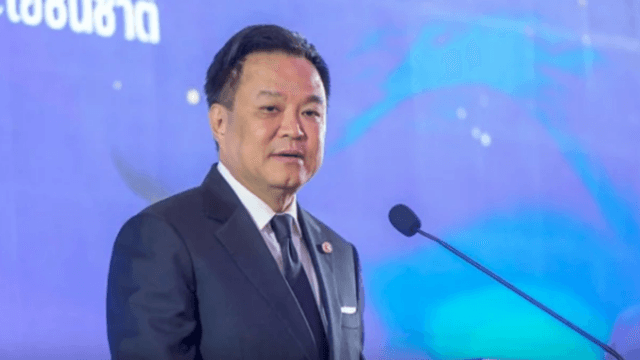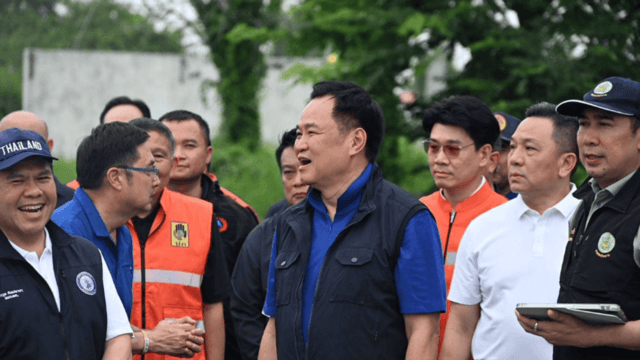



Acting Prime Minister Anutin Charnvirakul, as expected, will be the PM face of the Bhumjaithai Party (BJT) in the general election scheduled for February 8.
The party, however, has added Sihasak Phuangketkeow as its second prime ministerial candidate, citing his capability to “restore Thailand’s honor on the global stage and unify political and security sectors”.
In addition to these leading candidates, Ekniti Nitithanprapa and Suphajee Suthumpun, who are regarded as technocrats, were nominated as prospective deputy prime ministers.
“Promises Plus Action” is the campaign slogan of the Bhumjaithai Party, emphasizing tangible achievements and ongoing results to build public trust.
This slogan builds on their previous slogan “Promises Delivered”, highlighting its focus on not just discussing policies but also taking real action and building on past successes.
Volunteer Military Program
Anutin emphasized national security through a new “Volunteer Military” initiative, replacing the traditional conscription system.
Under this policy, the government will recruit 100,000 volunteer soldiers for four-year terms, each receiving a monthly salary of 12,000 baht. The aim is to build a dedicated, willing force to defend national sovereignty.
Economic relief: Khon La Khrueng Plus
Anutin reaffirmed the party’s signature policy, the “Khon La Khrueng Plus” (co-payment plus). The program, which began on October 29 and ended on December 31, allowed registered individuals to buy goods from local shops at half the price while the government subsidized the other half, through the G-Wallet system.
Anutin promised to address outstanding compensation owed to citizens, stating: “I owe each of you 2,400 baht and I want the chance to settle that debt.”
Foreign affairs and diplomatic strategy
Minister of Foreign Affairs Sihasak, a former permanent secretary at the ministry, pledged to modernize Thailand’s foreign policy, focusing on strategies that are “in step with the world and centred on the people”.
Over the next four years, he aims for Thailand to regain leadership in international affairs, operating with dignity and strategic foresight. Sihasak emphasized the importance of a comprehensive diplomatic approach and long-term strategic planning to navigate global competition and disorder.
Disaster management and digital transformation
Minister of Digital Economy and Society Chaichanok Chidchob, who is the secretary-general of Bhumjaithai, presented the party’s disaster management policy under the slogan “Prepared Before Disaster, Standing with Thailand in Every Situation”.
The policy includes integrating artificial intelligence to enhance forecasting capabilities and improve data accuracy for disaster prediction on both national and international levels. He also proposed cross-agency collaboration for preventive planning and the creation of a nationwide infrastructure to combat droughts and floods.
A key initiative is the “household disaster insurance fund”, providing basic coverage of over 100,000 baht per household per disaster event. Chaichanok vouched for the fund’s feasibility.
He also addressed human-induced disasters, such as online scams, noting the party’s prior success in combating fraud and pledging continued efforts. The “Digital AI Plus” policy aims to digitize all government documents, centralize databases, and connect ministries to boost security and operational efficiency.
Economic Policy: “Economy 10 Plus”
Finance Minister Ekniti had previously described Thailand’s economy as “stuck in a rut” but credited Bhumjaithai’s economic team—led by Anutin—with a turnaround within 73 days. The new “Economy 10 Plus” policy targets comprehensive improvements:
- Small Businesses Plus: Increase income, reduce expenses, build savings, and reduce debt.
- Senior Citizens Plus: Upskill older adults for employment, financial security, and care.
- Community Plus: Encourage production of goods tailored to market needs.
- Equal Education Plus: Free, accessible and flexible learning opportunities.
- Made in Thailand SMEs Plus: Enhance liquidity, lower costs and upgrade Thai SMEs.
- Investment Plus: Raise government investment to 30 per cent of GDP within four years.
- Green Economy Plus: Promote eco-friendly production and add product value.
- AI Plus: Train the workforce in AI skills for higher earnings.
- Trade Plus: Secure global market access via strategic partnerships.
- Thailand Plus: Streamlined government processes for faster approvals.
Trade and SME advancement
Suphajee highlighted the Connecting Global Trade policy, focusing on converting trading partners into allies, integrating Thailand into supply chains, and expanding into high-value services. She also discussed leveraging US tariff increases to find new export opportunities.
A prominent component is the “Wings for SMEs” initiative, which promotes franchises, improves access to funding, and supports products with Geographical Indication certification. Suphajee stressed that GI certification would significantly increase product value and help Thai SMEs grow.
She also outlined plans for the government to foster a “New S-Curve”—developing high-potential industries such as premium tourism, emphasizing visitor safety and encouraging longer, higher-spending stays.
Education and elderly welfare
Minister of Culture Sabeeda Thaised presented the “Equal Education Plus” policy. Key features include:
- Creating a free online learning platform.
- Developing skill enhancement platforms in partnership with educational institutions and the private sector.
- Introducing a credit bank where online coursework earns academic credits leading to formal qualifications.
For senior citizens, the “Senior Plus” policy proposes four measures:
- Double tax deduction for hiring seniors, up to 30,000 baht.
- Tax exemption of up to 50% for seniors earning less than 1.5 million baht per year.
- “One Village, One Volunteer Nurse” program, recruiting 100,000 nurses at 15,000 baht per month for proactive care in every village.
- Nationwide elderly care centers, encouraging private investment on state land for comprehensive long-term care.
Overall, policy platforms appear to address criticism of the government’s poor handling of last year’s severe flood in the southern city of Hat Yai, the military clash with Cambodia, and efforts to win voter support through short-term consumption stimulus.