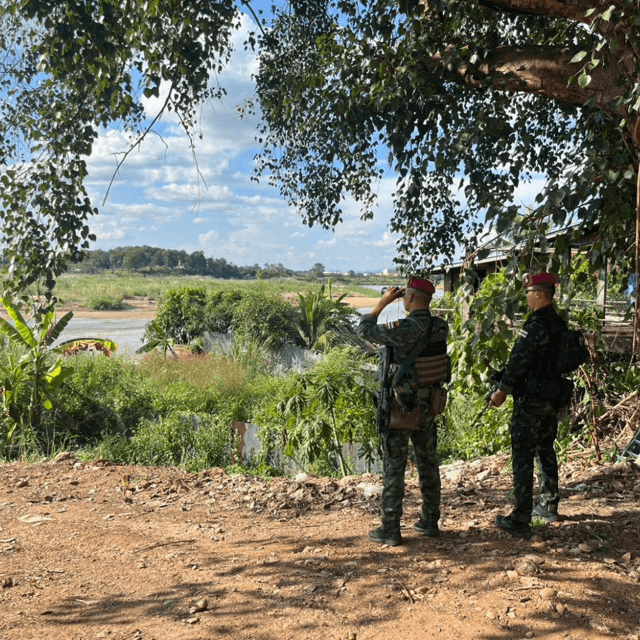



Contamination of the Sai River, which has disrupted tap water production in the Mae Sai district of Chiang Rai province, is being blamed on unregulated mining activities in Myanmar’s Tachileik province, according to well-informed border sources.
Some of the mining is done in the middle of the river and, when the area was hit by heavy rain recently, a huge amount of mud and sediment was washed downstream into Mae Sai district, turning the water in Ban Hua Fai, where it is drawn for tap water production, muddy, said the sources.
The situation has prompted the Provincial Waterworks Authority (PWA) in the district to reduce the production of tap water.
On November 5, the turbidity of the Sai River was measured at 14,000 NTU, compared to 3,000 NTU during a normal rainy season. The PWA’s filtration system can handle a maximum turbidity of 6,000 NTU.
Moreover, the Pollution Control Department has discovered that the level of arsenic in the river has reached 0.25mg/l, which is above the safety standard of 0.01mg/l.
The sources said that Tachileik has become the hub of mining operations for Chinese funded and managed companies. There are 28 such companies, including 12 gold, 5 manganese, six lead and zinc, three tin mines and one antimony mine.