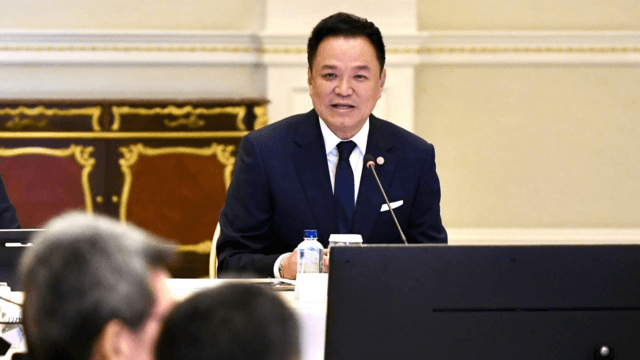



Thailand is raising the stakes over landmines along its disputed border with Cambodia, as the government is preparing to request the first-ever fact-finding mission under the Anti-Personnel Mine Ban Convention (APMBC), Foreign Minister Sihasak Phuangketkeow said.
He said he is scheduled to attend the APMBC meeting in Geneva from December 4 to 6, and that Thailand is taking this step following series of landmine incidents since the border skirmish in late July.
At least seven Thai soldiers have lost their limbs due to landmine explosions that were newly planted by Cambodian troops.
Sihasak told Nikkei Asia that Thailand would take this tough stance with its neighbour even though doing so could further ruffle relations with the US government.
The latest blast, on November 10 at Huai Ta Maria in Kantharalak district of Sisaket province, injured two soldiers, one of them lost his ankle.
This incident prompted Bangkok to bring the issue to the Ottawa Convention’s Implementation Committee in Geneva, Sihasak said.
Thailand is now preparing to invoke Article 8 of the treaty to call for a neutral fact-finding mission to determine whether Cambodia planted new mines.
“It will be a neutral, independent fact-finding mission to establish the facts,” Sihasak said. “If Cambodia refuses to take responsibility, we will bring this to the international community.”
In Geneva, he will deliver a formal statement under the agenda item related to Thailand’s request pursuant to Article 8.
Sihasak will reaffirm Thailand’s commitment to the Ottawa Convention and its reporting obligations.
He will also inform the international community that Cambodia’s laying of new landmines has caused severe harm to Thai soldiers and violates the Ottawa Convention, the UN Charter and international humanitarian law.
The Thai Army has repeatedly said that the evidence is clear that the landmines that exploded in the latest incident were newly planted after July 16.
Thailand also halted the return of 18 Cambodian detainees captured during the July clashes after the landmine incident in early November.
On the same day, Bangkok immediately suspended implementation of the ceasefire agreement signed with Cambodia in Kuala Lumpur on October 26.
In response, Washington suspended tariff negotiations with Thailand.
Sihasak reiterated that Thailand has not abandoned the agreement entirely. “We have suspended implementation,” he said. “The US has said they cannot continue with tariff talks.”
He added that outside pressure will not solve the problem. “This issue must be resolved between Thailand and Cambodia.”
In Phnom Penh, Cambodian Foreign Minister Prak Sokhonn vehemently denied that Cambodian forces have laid any new mines. He said the explosions came from old landmines buried decades ago.
He has accused Thailand of exaggerating the incidents and politicising border tensions. Cambodia insists it remains fully committed to the Ottawa Convention and the ceasefire.
Thailand and Cambodia now present two sharply different narratives.
Thailand says the pattern of explosions, the condition of the devices and the timing all point to newly planted mines. Cambodia insists the border area is full of old mines that shift during seasonal changes.
Thailand says the new mines show Cambodia violated humanitarian norms and international law. Cambodia says Thailand is misrepresenting the situation.
For years, Bangkok tried to resolve border issues quietly through bilateral pressure. But after eight incidents in three months, Thailand says a neutral, independent process is the only way to establish the truth. As such, the invocation of Article 8 marks a major shift.
During his Geneva visit, Sihasak will also hold bilateral meetings with high-level officials and agencies, including the Office of the High Commissioner for Human Rights (OHCHR).
He will provide factual clarification about the border situation and explain Thailand’s efforts to meet its obligations under the Ottawa Convention, human rights conventions and international humanitarian law.
Both countries now face risks. If the fact-finding process finds evidence of new mines laid by Cambodia, Cambodia’s credibility under the Ottawa Convention will suffer.
If the mines turn out to be old, Thailand will face questions about its claims. The meeting in Geneva will test whether the treaty’s mechanisms can resolve a serious dispute between two long-time neighbours.
The truth will likely emerge sooner rather than later. The decision reached in Geneva will shape the future of Thai-Cambodian relations as well as the integrity of the Ottawa Convention itself.