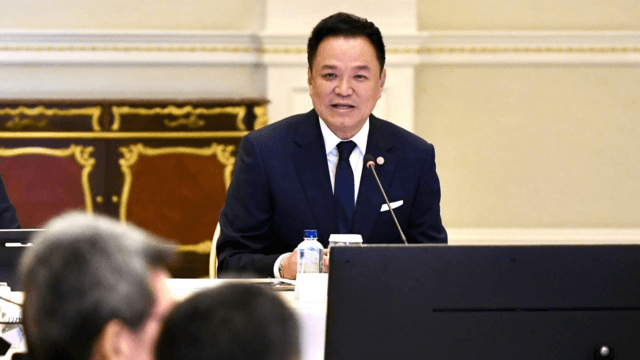
Asst Prof Pimol Srivikorn’s election as president of the National Olympic Committee of Thailand (NOCT) marks a new chapter in Thai sports governance.
However, his rise to power has been anything but smooth, marred by political entanglements and disputes that cast a shadow over his leadership from day one.
Beyond the controversy surrounding his election, Pimol brings a strong background in both sports and administration.
Born on April 14, 1964, he holds a bachelor’s degree in economics from the University of Pennsylvania and a master’s degree in business administration from UCLA.
His contributions to sports, particularly taekwondo, are widely recognised. He has served seven terms as president of the Taekwondo
Association of Thailand and is currently vice president of the World Taekwondo Federation.
Among his most notable achievements is guiding Thai taekwondo athletes to Olympic success, including two gold medals for Panipak Wongpattanakit – an inspiration for future generations.
Election protest and Thaksin factor
Yet, despite his impressive credentials, Pimol’s election as NOCT chief was marred when Suchai Ponchaisakudom, his key rival and president of the Lawn Tennis Association of Thailand, staged a walkout with his supporters before the vote.
Suchai, who had secured the backing of former prime minister Thaksin Shinawatra as his campaign’s honorary advisor, was protesting the selection of certain athlete voters.
Pimol triumphed despite the heavyweight political support for Suchai, signalling a shift in Thai sports governance.
However, controversy erupted immediately when Gen Vitch Devahasadin, a former NOCT Secretary-General and staunch Suchai supporter, declared the election void.
Alleging procedural irregularities, a lack of transparency, and an incomplete quorum, he vowed to bring the matter to the International Olympic Committee (IOC) and the Administrative Court.
Pimol’s ascension also sparked speculation of a growing rift between him and Thaksin.
Although he serves as chair of the Pheu Thai Party’s Sports Advisory Committee and plays a key role in the Muay Thai Soft Power initiative under Prime Minister Paetongtarn Shinawatra, his challenge to Thaksin’s ally in the NOCT election suggests a strategic distancing from one of Thailand’s most powerful figures.
Observers say this move could have lasting implications for both the Thai sporting and political spheres.
Remarkably, Thaksin’s influence – long a dominant factor in Thai politics and sports – failed to sway this election. Pimol’s victory could herald a shift in sports governance, with political connections no longer ensuring success.
Already in the crosshairs
As Pimol takes the reins, his presidency faces an immediate test. Athiprat Kanchanasuwan, former president of the National Shooting Association of Thailand, has filed a formal complaint with the IOC, alleging election irregularities.
The allegations include unequal voting rights among associations, non-transparent appointments, and potential political interference.
If proven, these claims could undermine Pimol’s leadership before he has a chance to implement his vision for Thai sports. The IOC’s response will be pivotal in determining whether his presidency survives the scrutiny.
Despite the election controversy, Suchai publicly congratulated Pimol, urging him to work for the elevation of Thai sports.
He explained his walkout was in protest of voting rights being granted to former Olympic athlete Chanathip Sonkham instead of fellow ex-Olympian Kaew Prongprayoon.
Whether his congratulatory gesture marks a genuine reconciliation or just a temporary truce remains to be seen.
What is clear, however, is that with deep-seated divisions laid bare, Pimol must navigate a web of alliances and opposition within the NOCT to secure his leadership.
First non-military Olympic chief
Pimol is also the first civilian without a military background to lead the NOCT, marking a historic shift in Thai sports administration.
He has already earned international acclaim for his leadership in taekwondo, having helped develop world-class athletes and Olympic medalists.
His biggest challenge now is translating that success into improvements for all sports under the NOCT umbrella.
Bridging divides with rival factions to unify Thailand’s international sporting ambitions will be key to his effectiveness as NOCT president.
The coming months will tell if he emerges as a unifying force or whether the political turmoil surrounding his election sets the tone for his tenure.
With Thai sports entering a new and unpredictable chapter under his leadership, all eyes are on Pimol Srivikorn and how he navigates the turbulence ahead.